
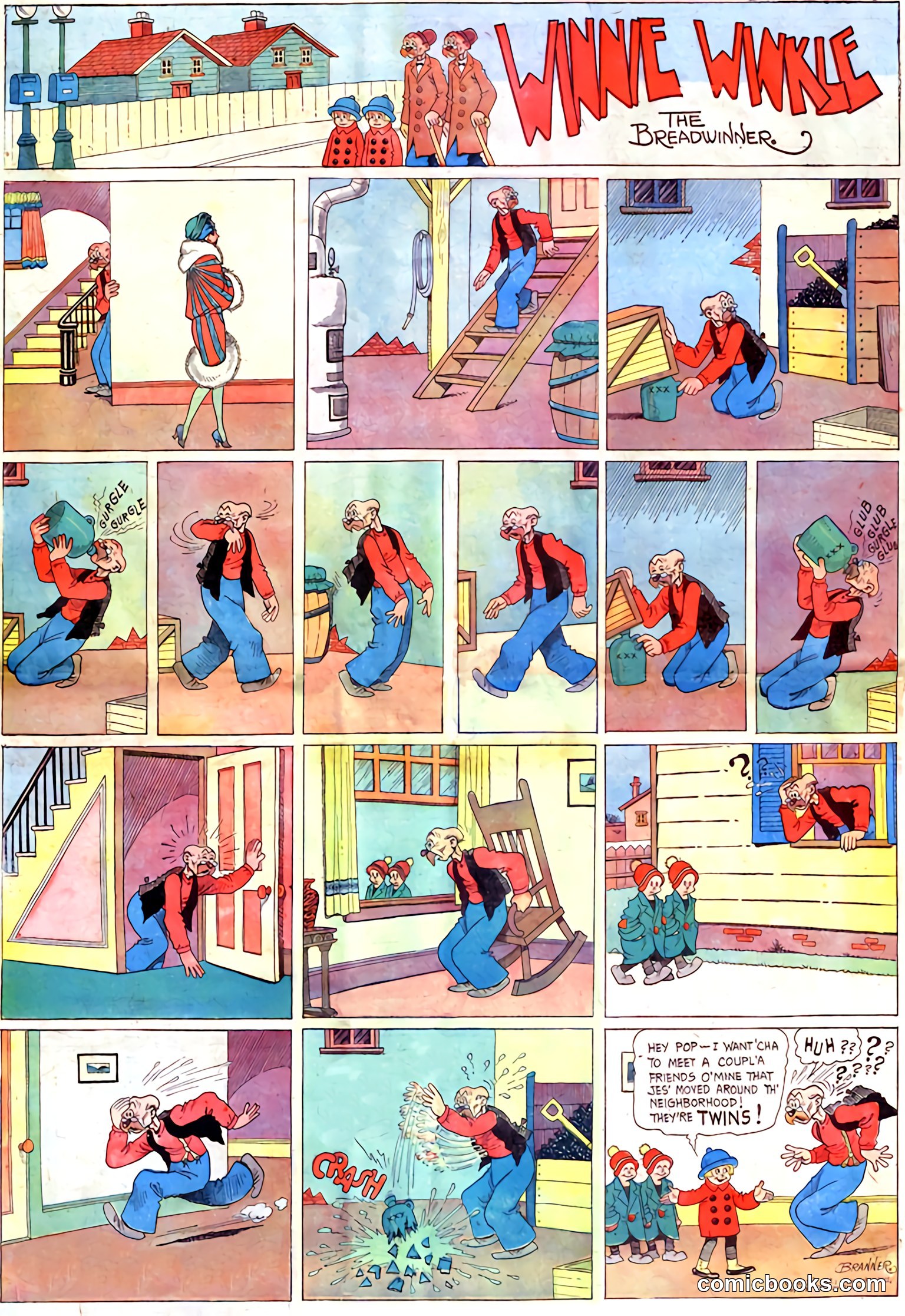
Martin Branner's Winnie Winkle arrived in 1920 as one of the very first strips to build itself around a woman earning her own living, and its full early title, tying Winnie to being "the breadwinner," said it plainly. Winnie went to work to support her family, and readers followed a heroine defined not by a husband or a household but by her job, her independence, and her daily navigation of the working world. That focus made the strip a quiet landmark. In an era when women's roles were shifting fast, Winnie Winkle put those changes on the funny pages, giving mass audiences a sympathetic, ongoing portrait of the modern working woman. The strip proved commercially durable, running for generations and evolving with the times, which only underscored how much appetite there was for stories centered on women's lives and labor. Alongside a handful of contemporaries, it helped establish that the comics medium could speak to and about women as workers and protagonists, not merely as romantic figures. Winnie Winkle stands as an important early marker of the strip's reach into the realities of everyday American life.
About this artifact
- Creator
- Martin Branner
- Date
- 1921
- Rights
- Public domain — free to view, share, and reuse.
- Restoration
- Digitally restored and hosted by ComicBooks.com · high-resolution version available.
Part of our mission to preserve and restore the public-domain heritage of the medium.