
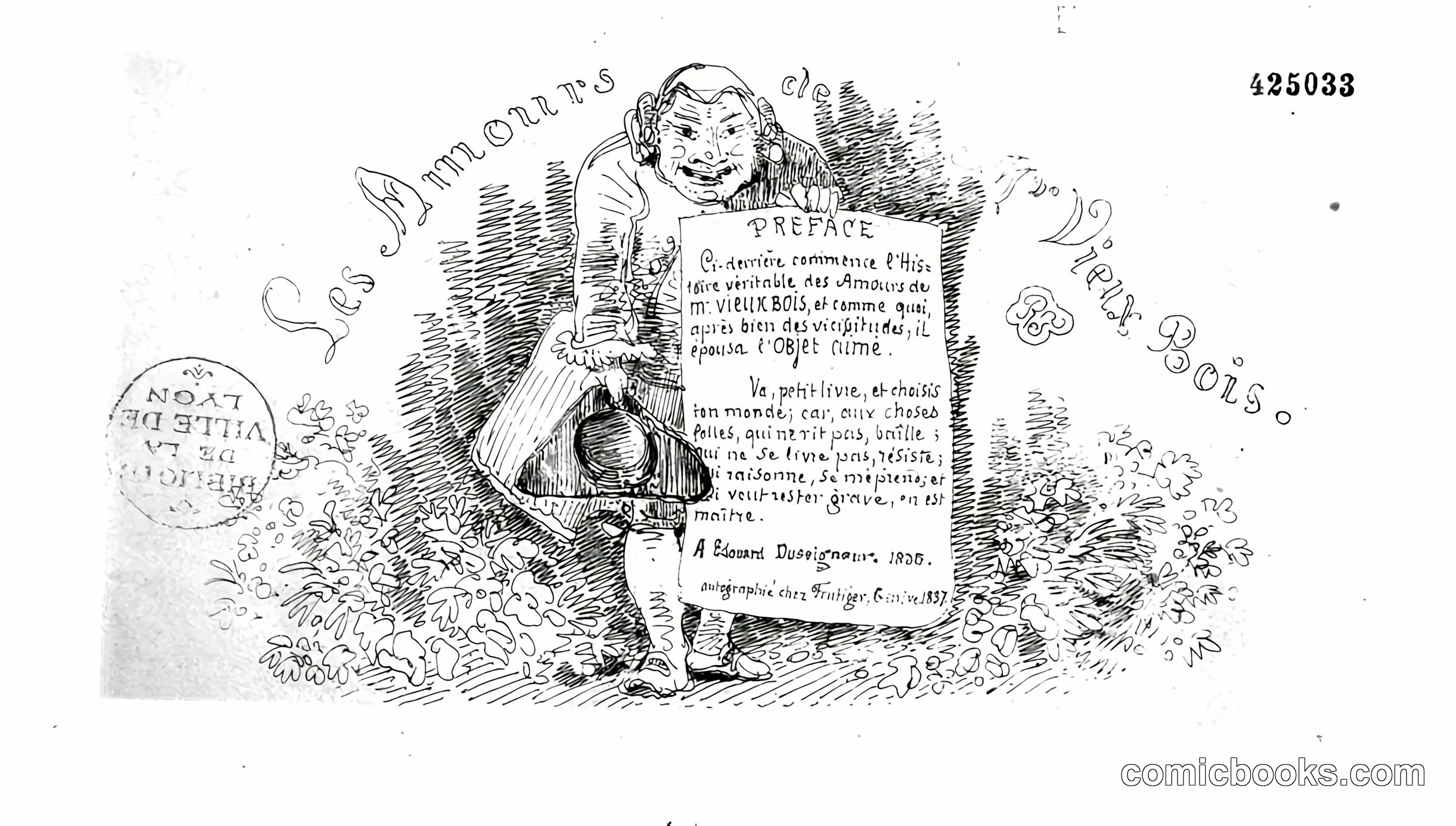
The Swiss teacher and writer Rodolphe Töpffer is the hinge on which this gallery turns. Histoire de M. Vieux Bois — sketched in the 1820s and published in 1837 — sets a running sequence of small hand-drawn images above lines of text, following its lovelorn hero through a cascade of slapstick misadventures. Historians frequently cite it among the first true comic strips: not a set of separate pictures like Hogarth's plates, but a continuous flow of framed drawings and words working as one. Töpffer was also the form's first real theorist. He argued that a story told in "picture-writing" obeyed its own laws, distinct from literature and from fine art, and that the union of image and caption could achieve effects neither managed alone — an idea that anticipates how comics are analyzed today. His work won admiration from no less a figure than Goethe. Pirated editions carried him abroad; an American reprint retitled The Adventures of Obadiah Oldbuck appeared in 1842 and is sometimes called the first comic published in the United States. In Vieux Bois the comic strip is essentially already present, decades before newspapers claimed the form.
About this artifact
- Creator
- Rodolphe Töpffer
- Date
- 1837
- Rights
- Public domain — free to view, share, and reuse.
- Restoration
- Digitally restored and hosted by ComicBooks.com · high-resolution version available.
Part of our mission to preserve and restore the public-domain heritage of the medium.