
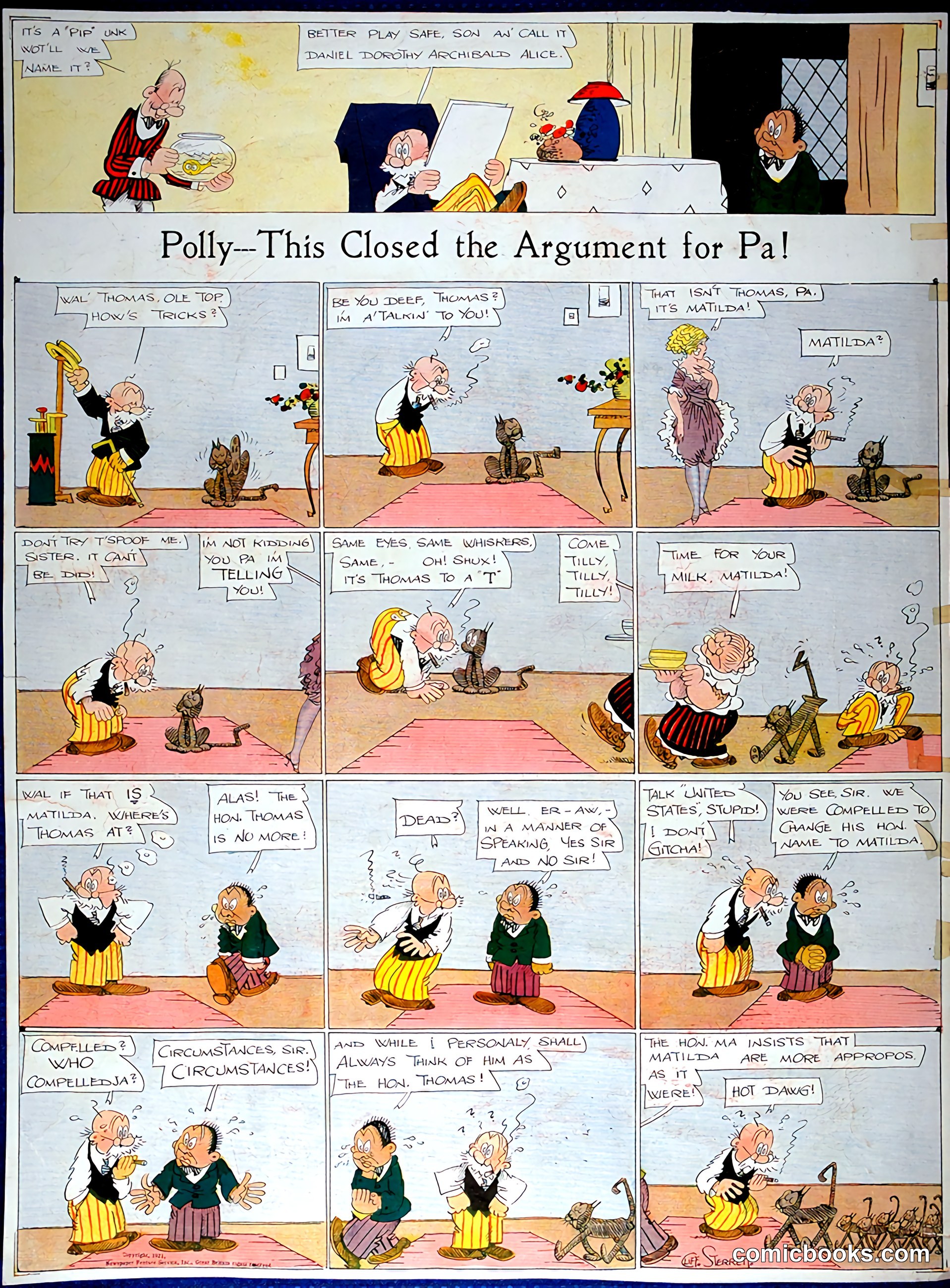
Polly and Her Pals began as a domestic comedy, but its lasting fame rests on something few would expect from a newspaper strip: its astonishing visual design. By the 1920s, Cliff Sterrett was pushing his Sunday pages toward bold, near-abstract compositions — angular shadows, warped perspectives, dreamlike patterning, and daring color that absorbed the Art Deco and Cubist currents electrifying the wider art world. Ordinary scenes of family life became stages for pure formal invention, where a staircase or a moonlit window might dissolve into rhythmic geometry. This matters because it demolishes the idea that early comics were merely crude entertainment for the masses. Sterrett was in genuine dialogue with the avant-garde, translating gallery-wall modernism into the democratic space of the funny pages, where millions saw it whether they knew its pedigree or not. He proved the comic strip could be a site of serious visual experimentation — that a cartoonist working on deadline could also be a designer of real daring. Look past the gentle humor and you find a page composed with the ambition of a painting. In Sterrett's hands the everyday domestic strip became something closer to modern art, smuggled into homes across the country inside the Sunday paper.
About this artifact
- Creator
- Cliff Sterrett
- Date
- 1926
- Rights
- Public domain — free to view, share, and reuse.
- Restoration
- Digitally restored and hosted by ComicBooks.com · high-resolution version available.
Part of our mission to preserve and restore the public-domain heritage of the medium.