
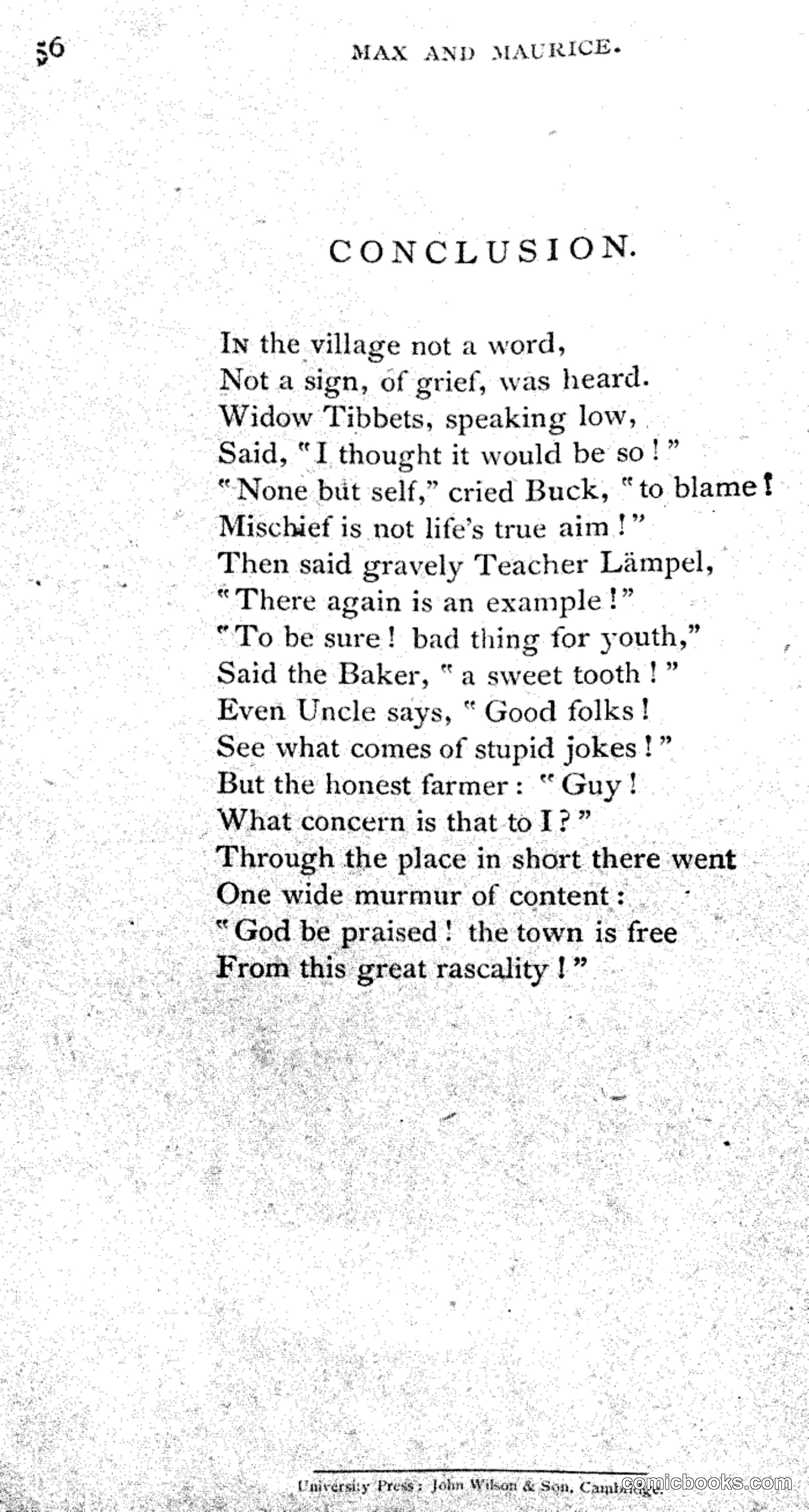
Max und Moritz — Conclusion
Wilhelm Busch · Wilhelm Busch, 1865 (English translation, University Press: John Wilson & Son, Cambridge)
This closing plate contains no pictures at all — only verse — and that absence is itself historically significant. Wilhelm Busch's Max und Moritz (1865) is among the foundational works of sequential picture-storytelling: across its seven 'tricks,' drawn panels carry narrative momentum the way cinema would decades later, with figures caught mid-gesture and cause-and-effect logic moving the eye panel to panel. Here, at the end, Busch lets the illustrated story dissolve into pure text: the village reacts to the boys' fate with collective indifference. The deadpan moral — 'God be praised! the town is free / From this great rascality!' — confirmed Busch's influence on every satirical comic strip that followed, from The Katzenjammer Kids onward.
About this artifact
- Creator
- Wilhelm Busch
- Date
- Wilhelm Busch, 1865 (English translation, University Press: John Wilson & Son, Cambridge)
- Rights
- Public domain — free to view, share, and reuse.
- Restoration
- Digitally restored and hosted by ComicBooks.com.
Part of our mission to preserve and restore the public-domain heritage of the medium.