
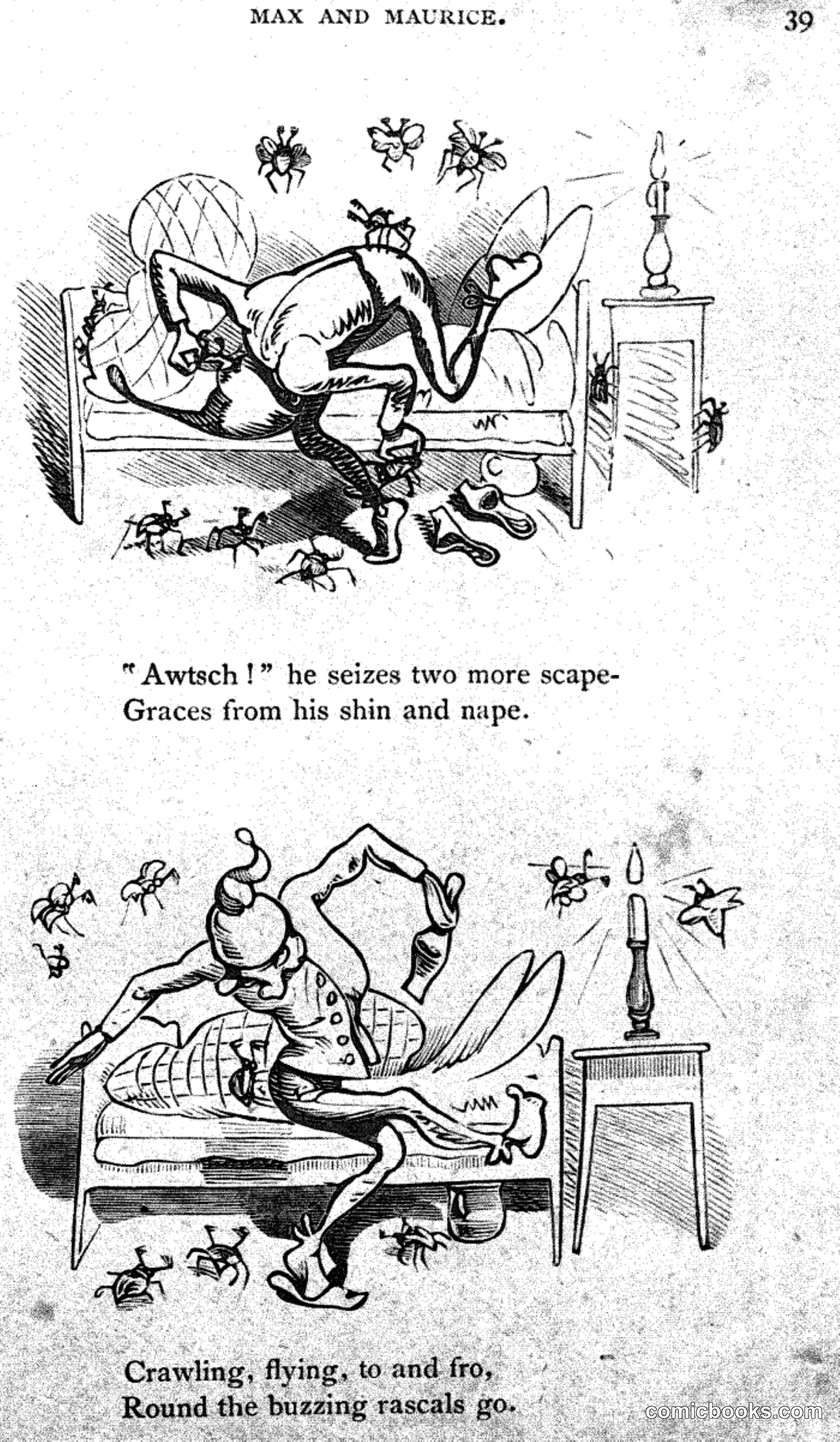
Two stacked vignettes show a nightshirt-clad man writhing on and around his bed, tormented by a swarm of beetles. In the upper panel he tumbles headfirst off the mattress, limbs akimbo, while insects crawl across floor, wall, and bedpost. Below, he sits up clawing at his own back, the candle on its side-table throwing light across the chaos. Busch's line is economical and rubbery—exaggerated anatomy conveys kinetic panic without a single word beyond the rhyming couplets beneath each image. Reading top to bottom, the eye follows one continuous action across time, the sequence doing exactly what a comic page does. Published in Munich in 1865, Max und Moritz gave European picture-storytelling its grammar: fixed characters, causal progression, panel-to-panel continuity—direct ancestors of every newspaper strip that followed.
About this artifact
- Creator
- Wilhelm Busch
- Date
- Wilhelm Busch, 1865
- Rights
- Public domain — free to view, share, and reuse.
- Restoration
- Digitally restored and hosted by ComicBooks.com.
Part of our mission to preserve and restore the public-domain heritage of the medium.