
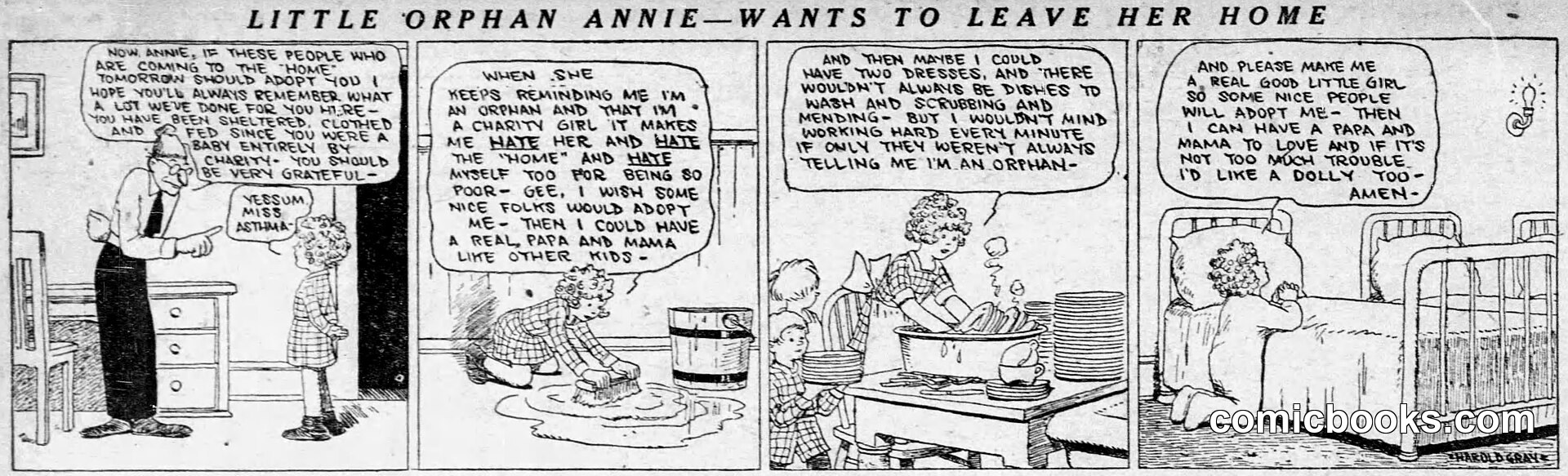
Harold Gray's Little Orphan Annie arrived in the mid-1920s and quickly became one of the most popular — and most distinctive — continuity strips of its era. Its heroine was a plucky, blank-eyed orphan girl who, with her faithful dog Sandy and her wealthy protector "Daddy" Warbucks, wandered through a hazardous America of con artists, kidnappers, and hard luck.
Gray used the serial form to tell long, suspenseful, often surprisingly dark melodramas. Annie was resilient and self-reliant, forever separated from Warbucks by circumstance and forever finding her way through on her own grit — a formula that kept readers anxious for the next installment. The strip also became a vehicle for Gray's pointed opinions, making it one of the first comics to carry a strong editorial voice.
Annie's catchphrases ("Leapin' Lizards!") and her instantly recognizable look — the red dress, the empty circle eyes, the curly mop of hair — made her a merchandising and radio sensation, and the strip later inspired the famous stage musical and film. As an example of the 1920s adventure-melodrama strip, Annie shows how far comics had traveled from the simple daily gag.
About this artifact
- Creator
- Harold Gray
- Date
- 1925
- Rights
- Public domain — free to view, share, and reuse.
- Restoration
- Digitally restored and hosted by ComicBooks.com · high-resolution version available.
Part of our mission to preserve and restore the public-domain heritage of the medium.