
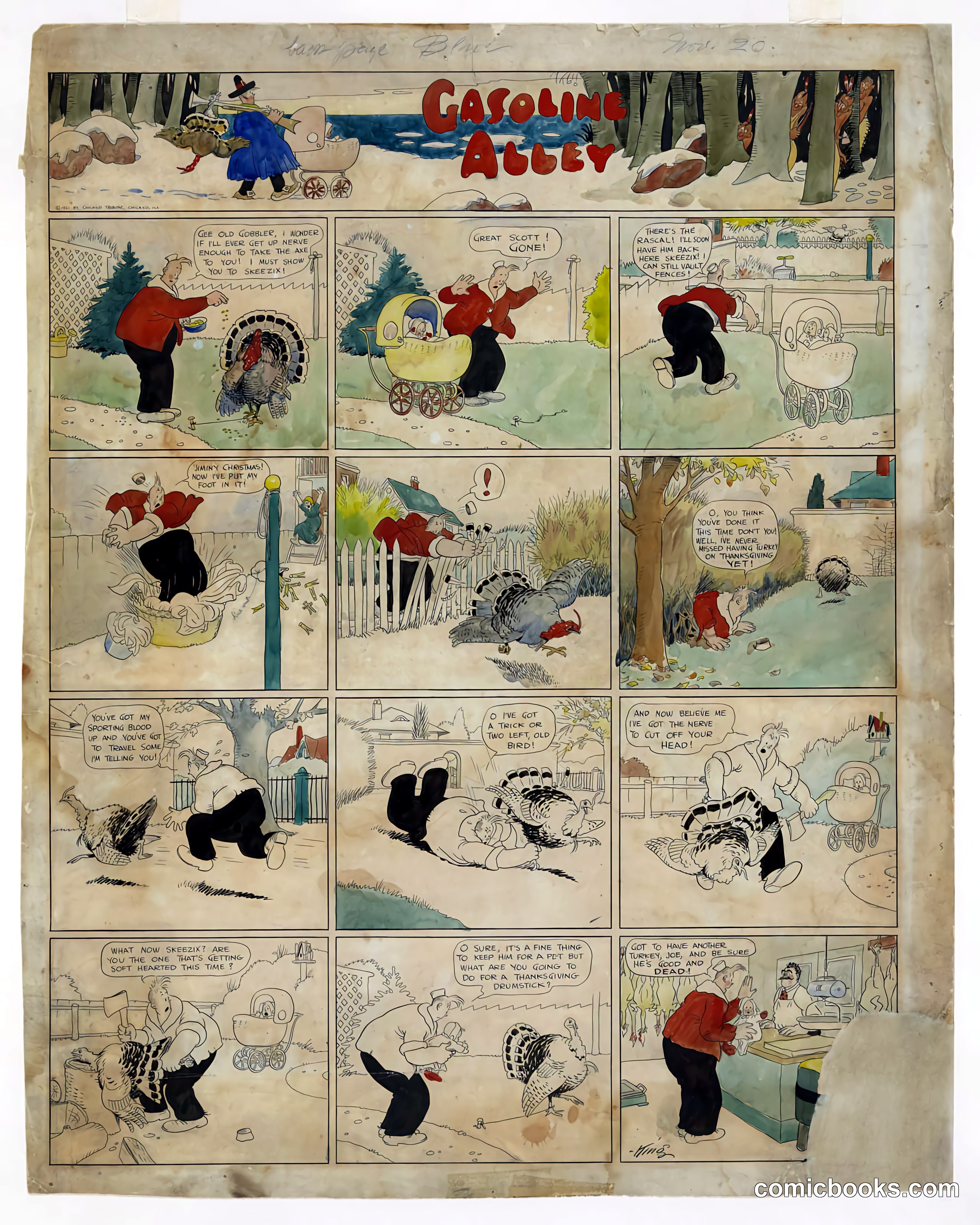
Frank King's Gasoline Alley made one of the most quietly revolutionary contributions in comics history: its characters age in real time. The strip began as a gentle feature about men who gathered in an alley to talk about their automobiles. Its transformation came in 1921, when the bachelor Walt Wallet discovered a baby boy — nicknamed Skeezix — abandoned on his doorstep.
Rather than freezing Skeezix as a perpetual infant, King let him grow up. Skeezix aged year by year, in step with the calendar and with the strip's own readers — going from baby to boy to young man to, eventually, a father himself. No comic strip had ever committed to real-time aging, and it gave Gasoline Alley a rare emotional depth: readers watched a family genuinely mature across decades, marking births, courtships, and deaths alongside their own lives.
King was also a gifted visual stylist, and his lush Sunday pages are admired for their design and warmth. In a gallery about comics reaching for more, Gasoline Alley stands out for pioneering long-form realism — the idea that a strip could quietly chronicle the passage of ordinary life, a storytelling ambition few works in any medium have matched.
About this artifact
- Creator
- Frank King
- Date
- 1921
- Rights
- Public domain — free to view, share, and reuse.
- Restoration
- Digitally restored and hosted by ComicBooks.com · high-resolution version available.
Part of our mission to preserve and restore the public-domain heritage of the medium.