
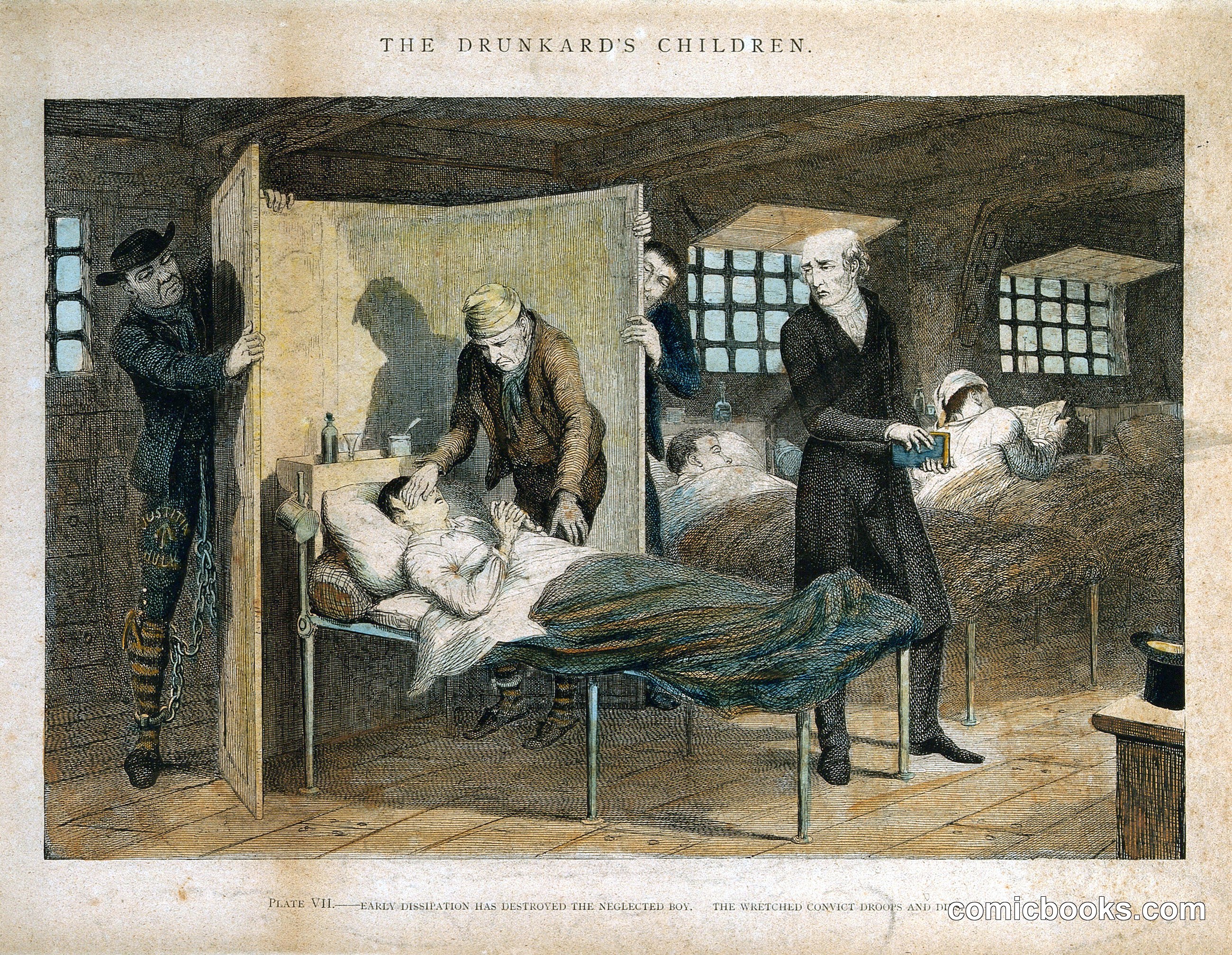
George Cruikshank's hand-coloured etching depicts the interior of what the printed caption identifies as a prison infirmary: a shackled, dissolute young man lies dying on a cot while a physician bends over him, a clergyman reads from scripture at his side, and a gaoler looks on from a doorway. The composition is theatrical and morally schematic — virtue attends, vice lies prostrate — working squarely within the Hogarthian sequence tradition Cruikshank absorbed in his youth. The Drunkard's Children (eight plates) follows his earlier The Bottle (1847) as a temperance narrative in print form: serialised image-sequences sold cheaply to mass audiences, carrying explicit social argument panel by panel. That structure — a story told across numbered plates with captions — is a direct ancestor of the comic book page. Cruikshank renders the working-class prisoner without flattery, mapping moral ruin onto physiognomy in the period's habitual conflation of poverty, vice, and bodily degradation.
About this artifact
- Creator
- George Cruikshank
- Date
- 1848
- Rights
- Public domain — free to view, share, and reuse.
- Restoration
- Digitally restored and hosted by ComicBooks.com · high-resolution version available.
Part of our mission to preserve and restore the public-domain heritage of the medium.