
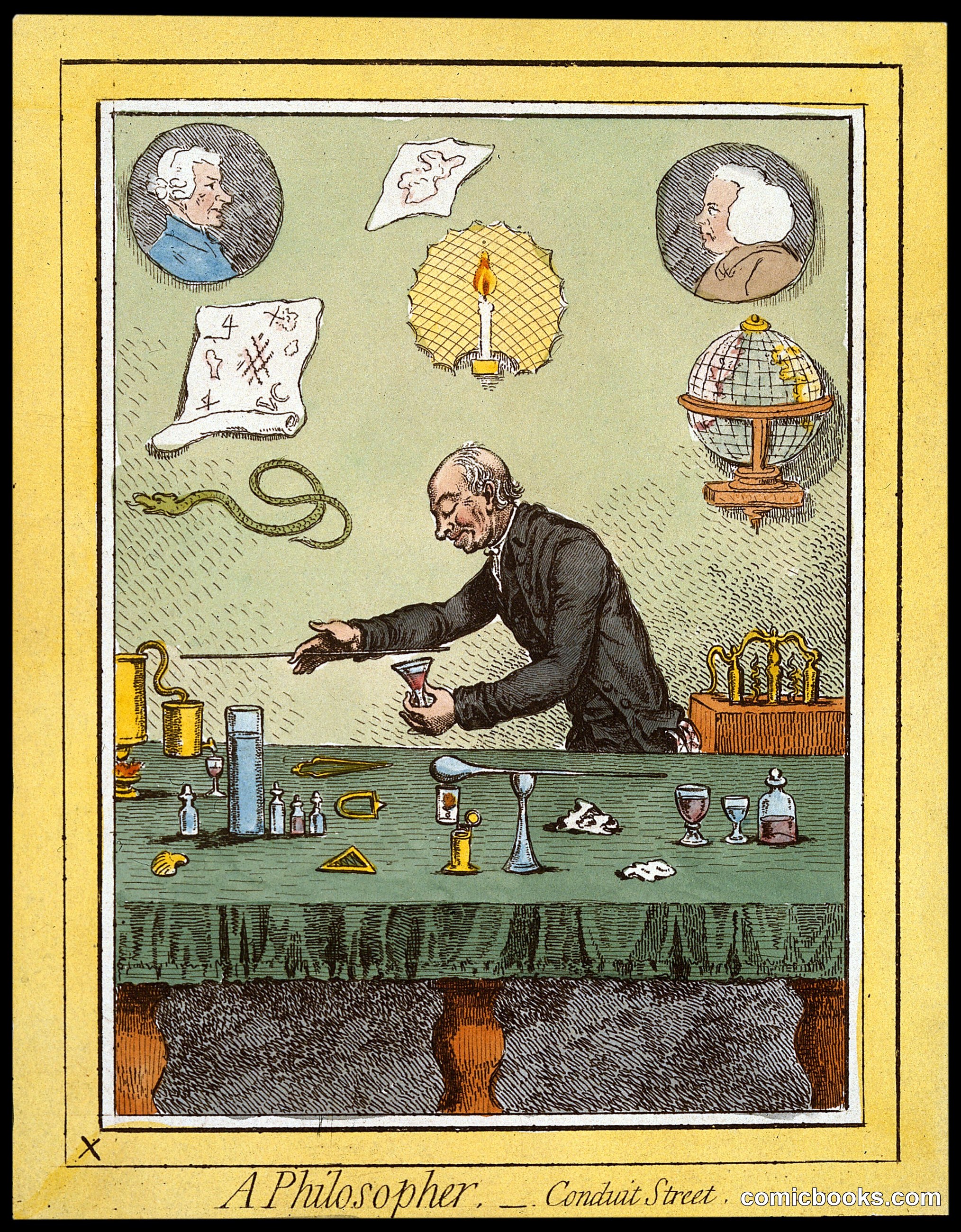
A stooped, elderly natural philosopher leans over a cluttered laboratory table, manipulating glassware with the absorbed intensity of a man oblivious to ridicule. Above him float a candle-sun, a serpent, a scroll of arcane diagrams, and two medallion portraits of apparent patrons or rivals — the visual shorthand of 18th-century learned pretension. A globe and rack of scientific instruments crowd the right corner. The caption reads simply A Philosopher — Conduit Street, locating him in a London address associated with public lecture-demonstrations. This hand-colored etching, after James Gillray, uses the era's standard class caricature of the self-important virtuoso: bony, myopic, tinkering uselessly while the symbols of his grandiosity orbit him like delusions. Gillray's line-work — sharp, economical, faintly cruel — sits squarely in the British print-satire tradition that ran from Hogarth's moralizing sequences through Rowlandson's social grotesques, producing the sequential visual storytelling and character-type shorthand that comic strips would later industrialize.
About this artifact
- Creator
- http://data.europeana.eu/agent/148259
- Date
- 1796
- Rights
- Public domain — free to view, share, and reuse.
- Restoration
- Digitally restored and hosted by ComicBooks.com · high-resolution version available.
Part of our mission to preserve and restore the public-domain heritage of the medium.