
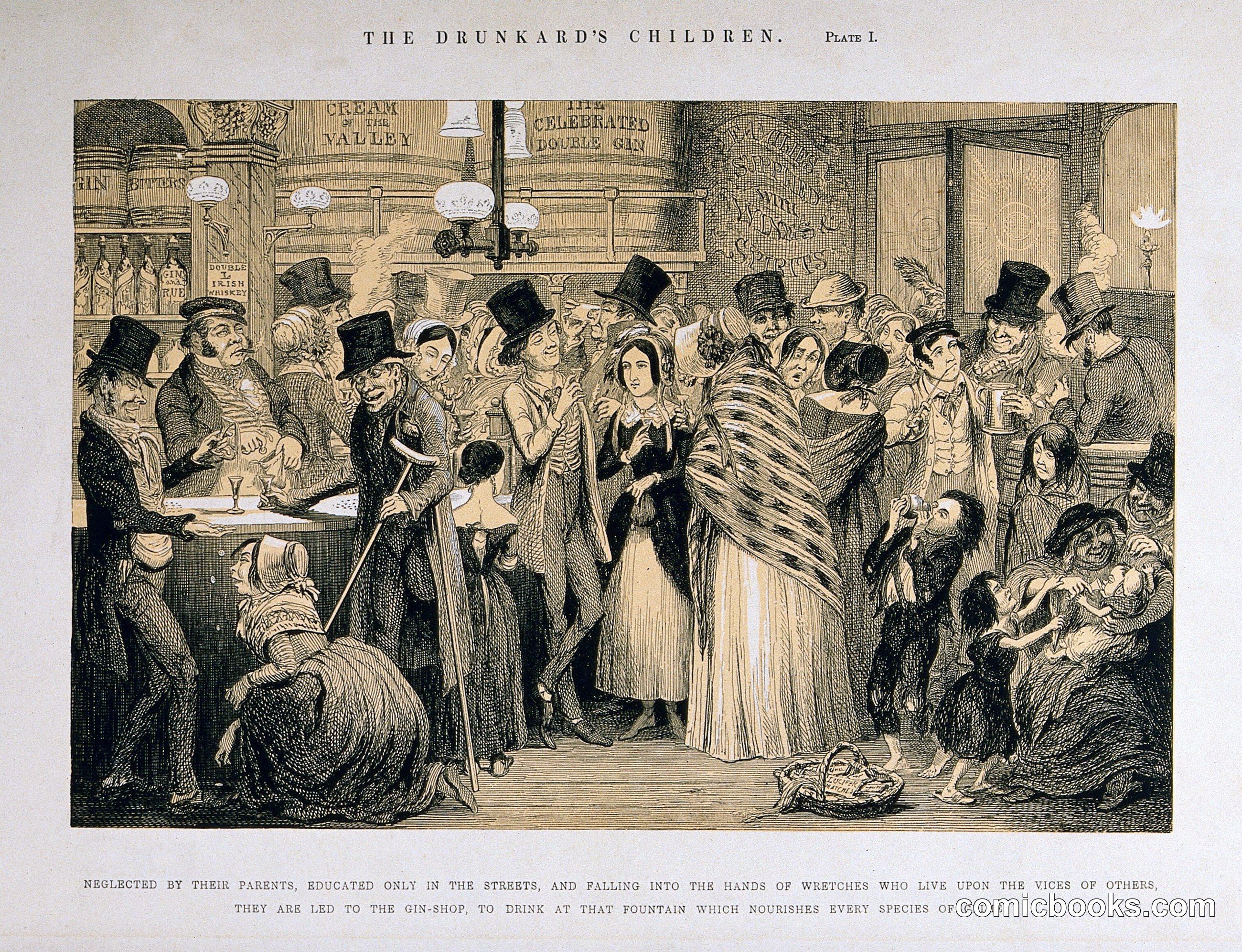
A teeming gin-shop interior crowds the plate: top-hatted men, shawled women, and ragged children press toward a bar advertising 'Celebrated Double Gin.' At center, a young woman — the drunkard's daughter — is drawn into the dissolute circle, her posture still upright but already surrounded. The caption beneath warns explicitly that neglected children, 'educated only in the streets,' are led to 'that fountain which nourishes every species of crime.' Cruikshank's etching technique — dense crosshatching, grotesque physiognomy applied heavily to the poorer figures — carries the class contempt routine in Victorian moral illustration: the poor are rendered as near-bestial, their degradation legible in their faces. This is the tradition running directly from Hogarth's Gin Lane (1751) through Gillray and Rowlandson: sequential moral narrative in print, using caricature as social argument. Cruikshank's eight-plate series structurally anticipates the comic strip — a sustained visual story told panel to panel — making it a direct ancestor of the comic book form.
About this artifact
- Creator
- George Cruikshank
- Date
- George Cruikshank, 1848
- Rights
- Public domain — free to view, share, and reuse.
- Restoration
- Digitally restored and hosted by ComicBooks.com · high-resolution version available.
Part of our mission to preserve and restore the public-domain heritage of the medium.