
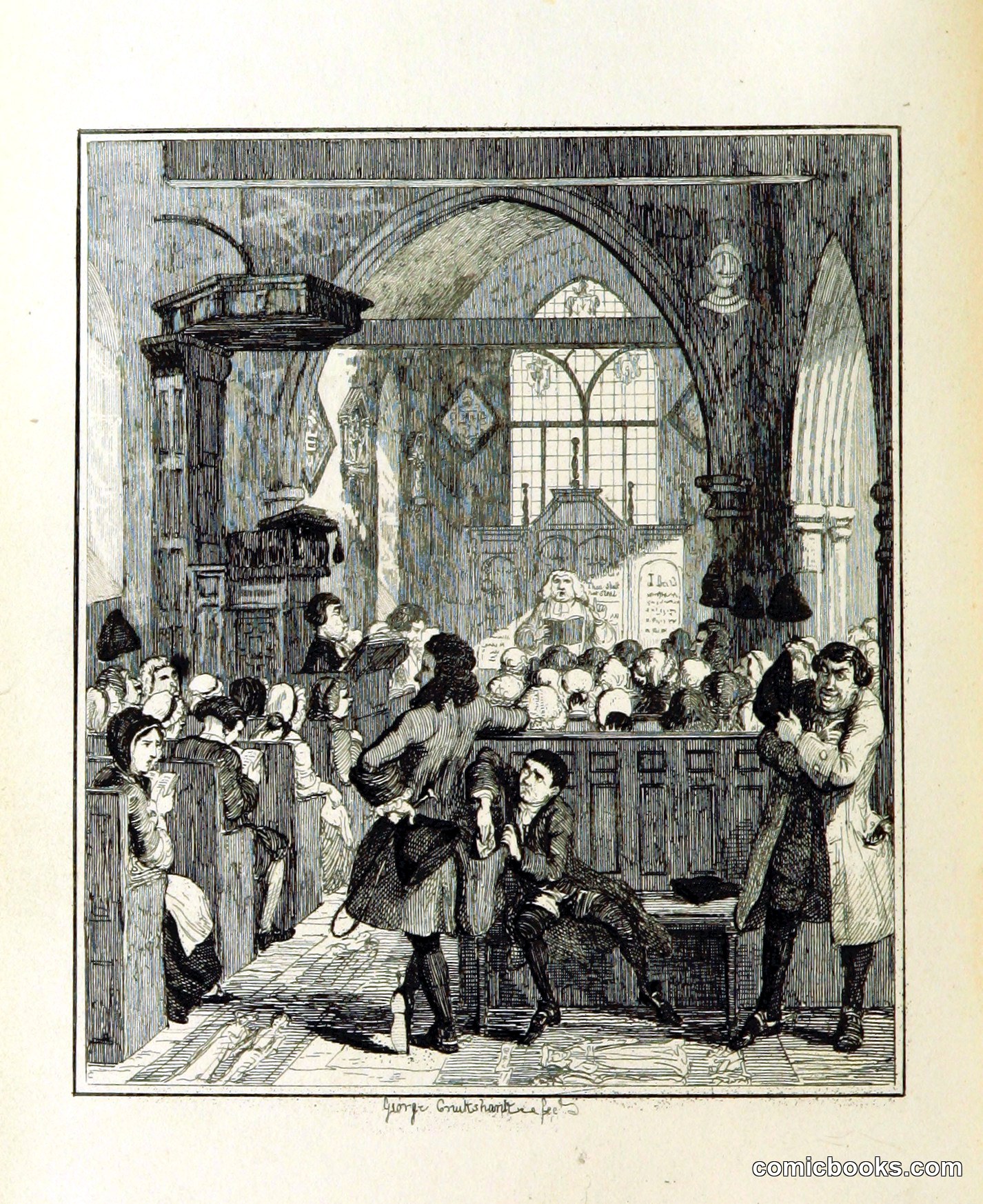
George Cruikshank's wood engraving depicts a crowded Georgian church interior — gothic arches, a pulpit canopy, leaded windows — thrown into comic disorder. A figure in the centre aisle gestures broadly while a seated man sprawls insolently; congregation members crane and jostle in the pews behind. The clergyman at the far altar reads on, oblivious. Cruikshank renders working-class Londoners with the broad physiognomy typical of his era: exaggerated jaw, rolling eye, grinning mouth — class caricature worn as entertainment, not critique. This illustration for Harrison Ainsworth's popular roguish novel sits squarely in the Hogarth-to-Gillray tradition of crowded satirical prints — morally theatrical, densely populated, compositionally centrifugal — the direct ancestor of the sequential comic page.
About this artifact
- Date
- 1854
- Rights
- Public domain — free to view, share, and reuse.
- Restoration
- Digitally restored and hosted by ComicBooks.com.
Part of our mission to preserve and restore the public-domain heritage of the medium.