
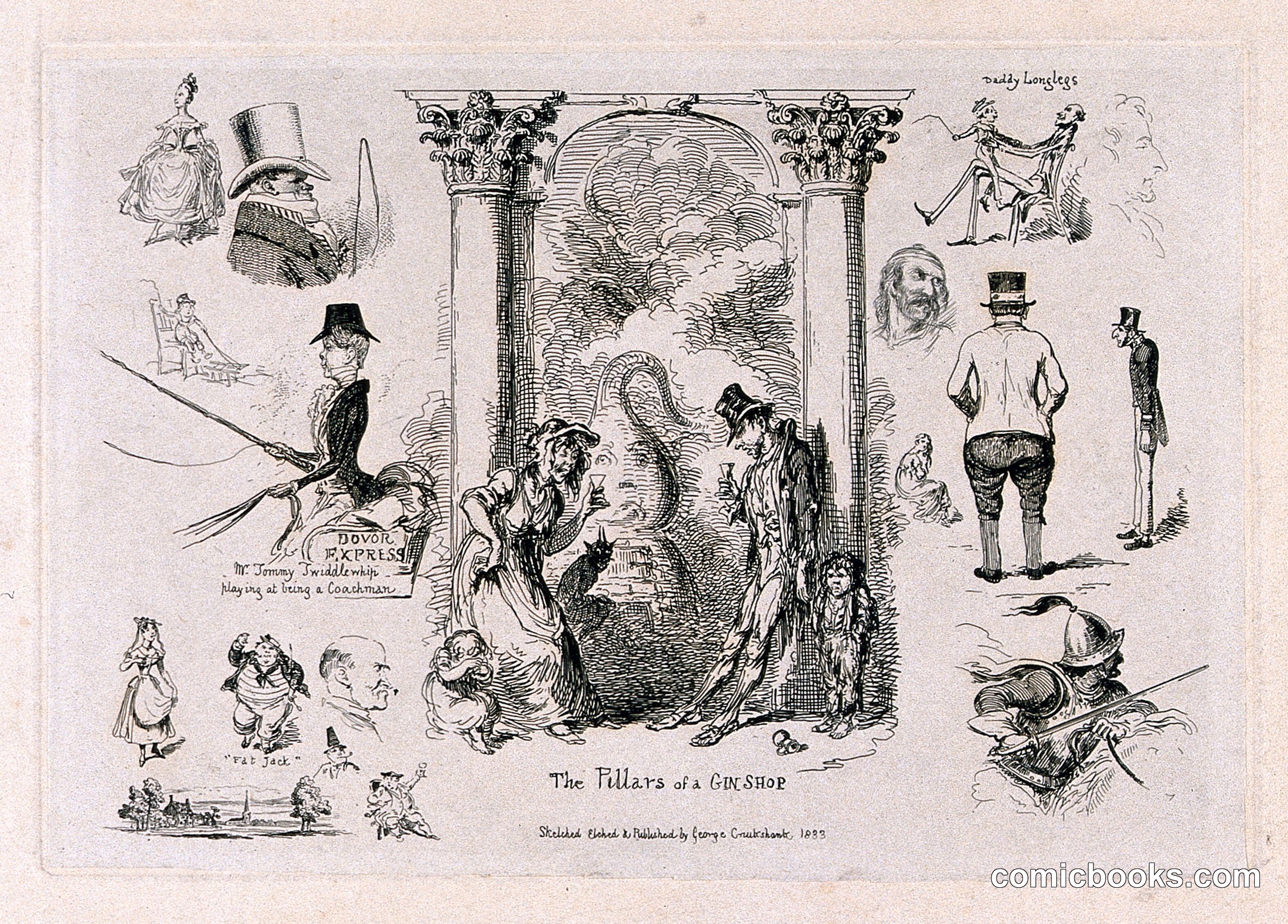
George Cruikshank's etching crowds its composition with two registers of meaning: at centre, a bedraggled woman and a stooped man prop themselves against Corinthian columns that frame a hellish distillery, a coiled serpent of smoke rising behind them and a ragged child caught between the figures—poverty rendered as architectural irony, the gin-shop dressed in the grammar of a temple. Surrounding vignettes caricature stock types: a dandified rider, grotesque drunken faces, and attenuated gentlemen whose elongated frames owe much to Gillray's anatomical cruelty. The class targeting is explicit and unsentimental—working-poor bodies are distorted into moral emblems, a convention stretching from Hogarth's Gin Lane (1751) through Rowlandson. Cruikshank's dense page layout—multiple framed scenes sharing one sheet—directly prefigures the sequential panel grammar that newspaper comic strips would codify by century's end.
About this artifact
- Creator
- http://data.europeana.eu/agent/63272
- Date
- 1833
- Rights
- Public domain — free to view, share, and reuse.
- Restoration
- Digitally restored and hosted by ComicBooks.com · high-resolution version available.
Part of our mission to preserve and restore the public-domain heritage of the medium.