
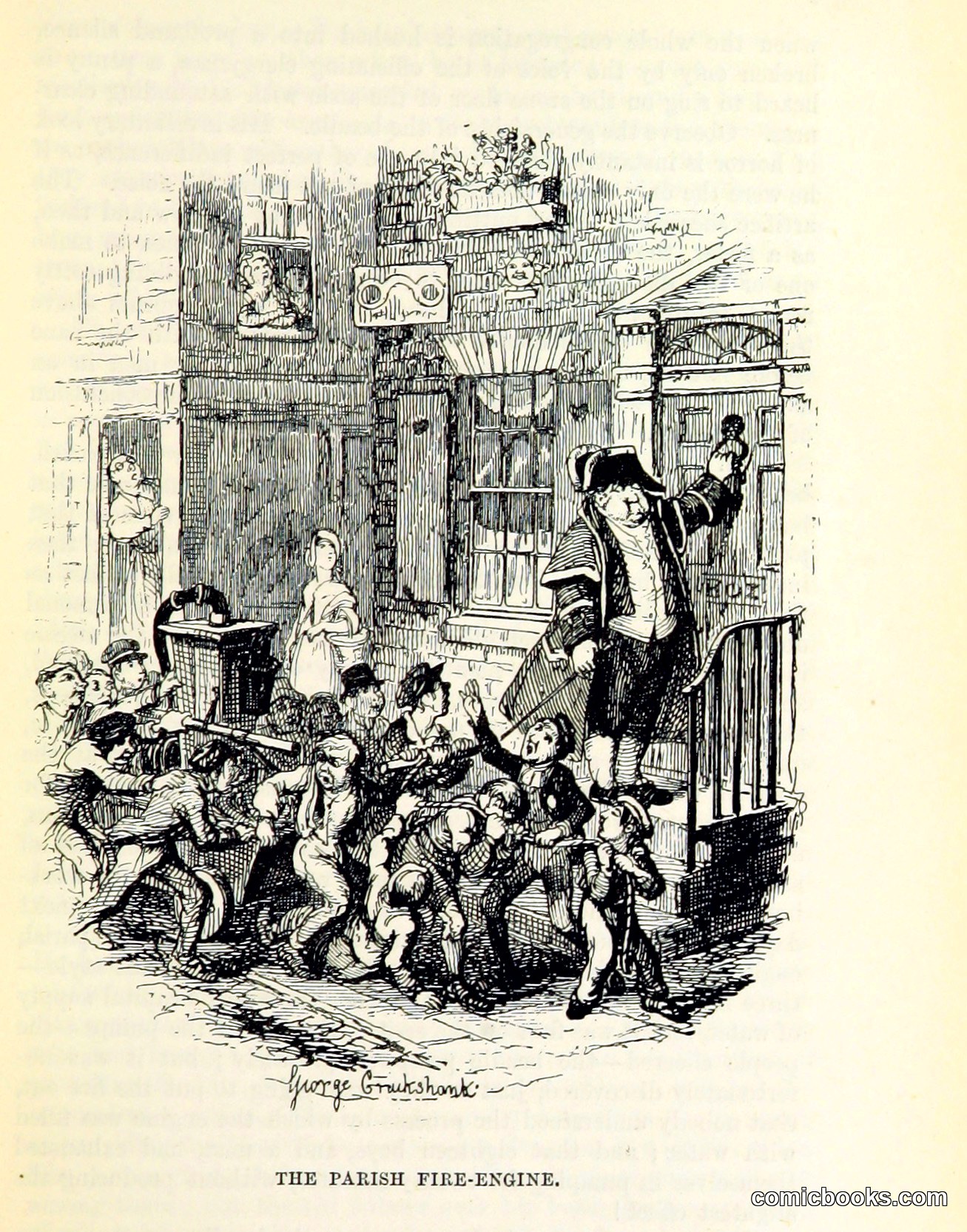
George Cruikshank, 'The Parish Fire-Engine'
· Published 1893 (illustration likely dating from Cruikshank's earlier Dickens collaboration)
A chaotic street scene erupts outside a brick tenement: a portly beadle in tricorn hat hammers at a door while a crowd of working-class children and adults—rendered with the rubbery, exaggerated limbs typical of Cruikshank's pen-and-ink line engraving—jostle around what appears to be a hand-pump engine. The figures carry the class condescension standard to Georgian-Regency caricature: the poor are comic, wide-mouthed, physically grotesque. Cruikshank inherited this vocabulary directly from Rowlandson and Gillray, transmitting it into Dickens's social fiction. That lineage—Hogarth's moral narrative sequences through the British print-shop tradition—is precisely what historians trace forward into the comic strip: sequential crowd scenes, speech implied by gesture, single-image storytelling dense enough to reward close reading.
About this artifact
- Date
- Published 1893 (illustration likely dating from Cruikshank's earlier Dickens collaboration)
- Rights
- Public domain — free to view, share, and reuse.
- Restoration
- Digitally restored and hosted by ComicBooks.com.
Part of our mission to preserve and restore the public-domain heritage of the medium.