
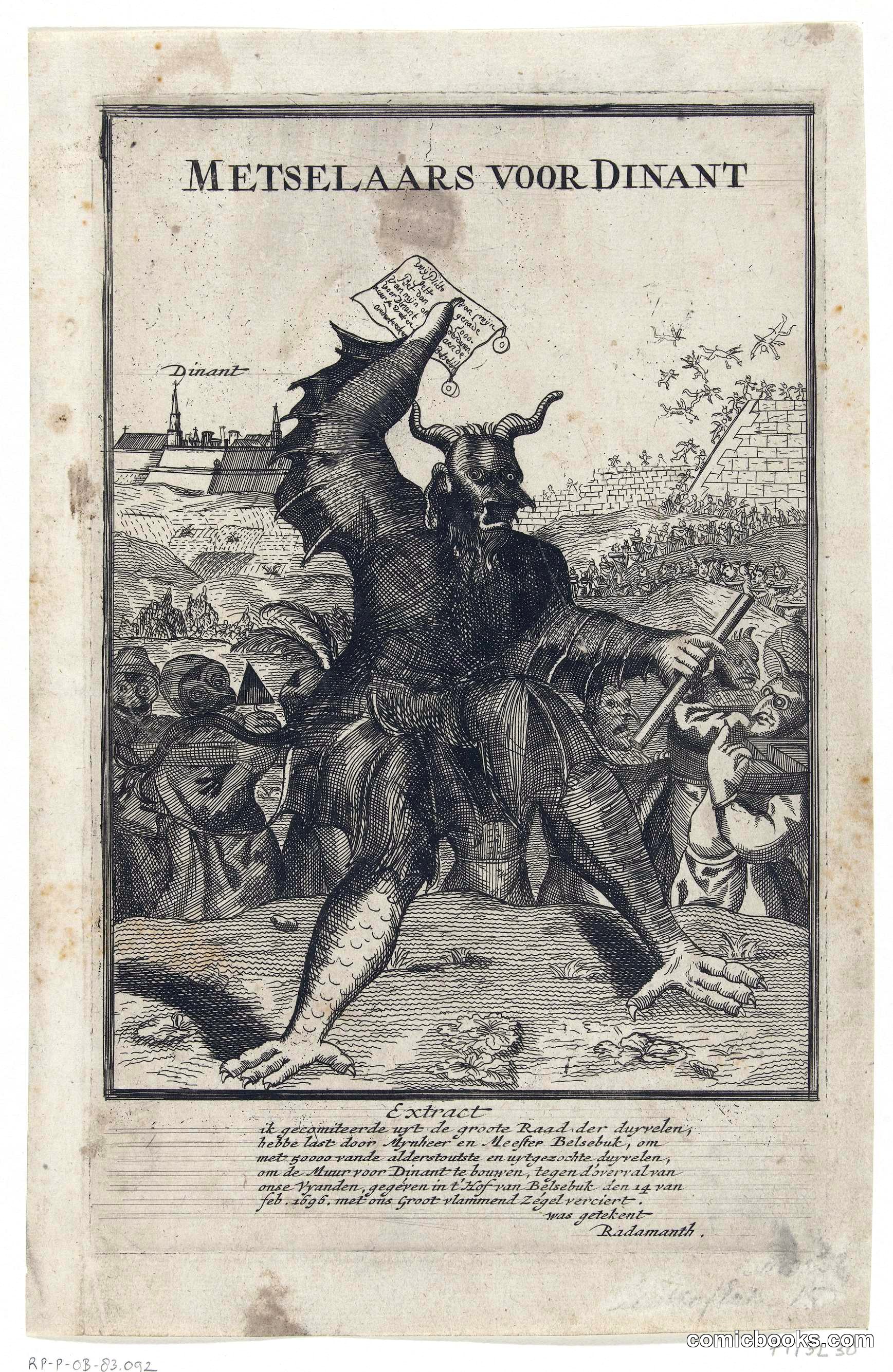
This Dutch etching satirizes the mason's guild of Dinant through a grotesque demon-figure holding architectural plans above a crowd of workers and soldiers. The print belongs to a tradition of Northern European political and occupational satire that emerged in the 16th–17th centuries, preceding Hogarth and the later caricaturists. Through exaggerated anatomy, chaotic composition, and symbolic imagery, the artist mocks guild pretension and labor disputes in a post-war context. The etched line work and dense cross-hatching typify period printmaking technique. Such sheets circulated widely among merchants and educated viewers, establishing visual satire conventions—grotesquerie, social observation, moral commentary—that would evolve through Gillray and Daumier into modern cartooning and sequential art.
About this artifact
- Date
- 1696
- Rights
- Public domain — free to view, share, and reuse.
- Restoration
- Digitally restored and hosted by ComicBooks.com.
Part of our mission to preserve and restore the public-domain heritage of the medium.