
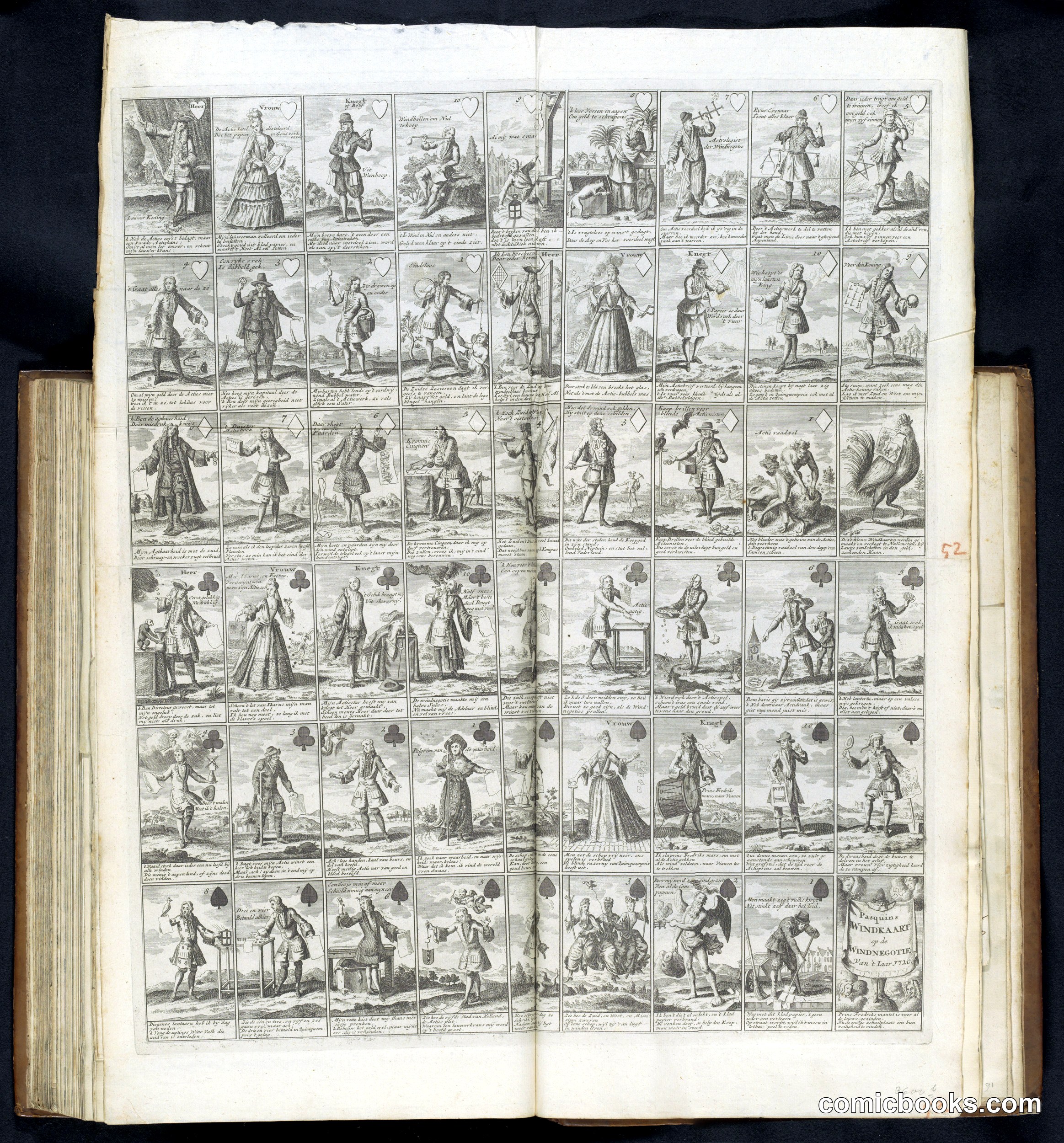
This Dutch engraved broadsheet mocks the South Sea Bubble and other financial schemes through a grid of playing-card figures—nobles, merchants, and fools—each labeled with satirical commentary. The format descends from German Bilderbogen picture-sheets: serial vignettes with explanatory text below, designed for mass distribution and public comprehension of complex corruption.
The print reflects early-eighteenth-century satire's reliance on type and emblem. Playing-card suits organize the composition; costume and posture signal social rank and moral character. This visual language—character as caricature, narrative through sequential frames—would become foundational to nineteenth-century political print culture and eventually to the modern comic strip. The work captures a moment when printmakers recognized that visual seriality could expose fraud and folly to a broad, semi-literate public.
About this artifact
- Date
- 1720
- Rights
- Public domain — free to view, share, and reuse.
- Restoration
- Digitally restored and hosted by ComicBooks.com · high-resolution version available.
Part of our mission to preserve and restore the public-domain heritage of the medium.