
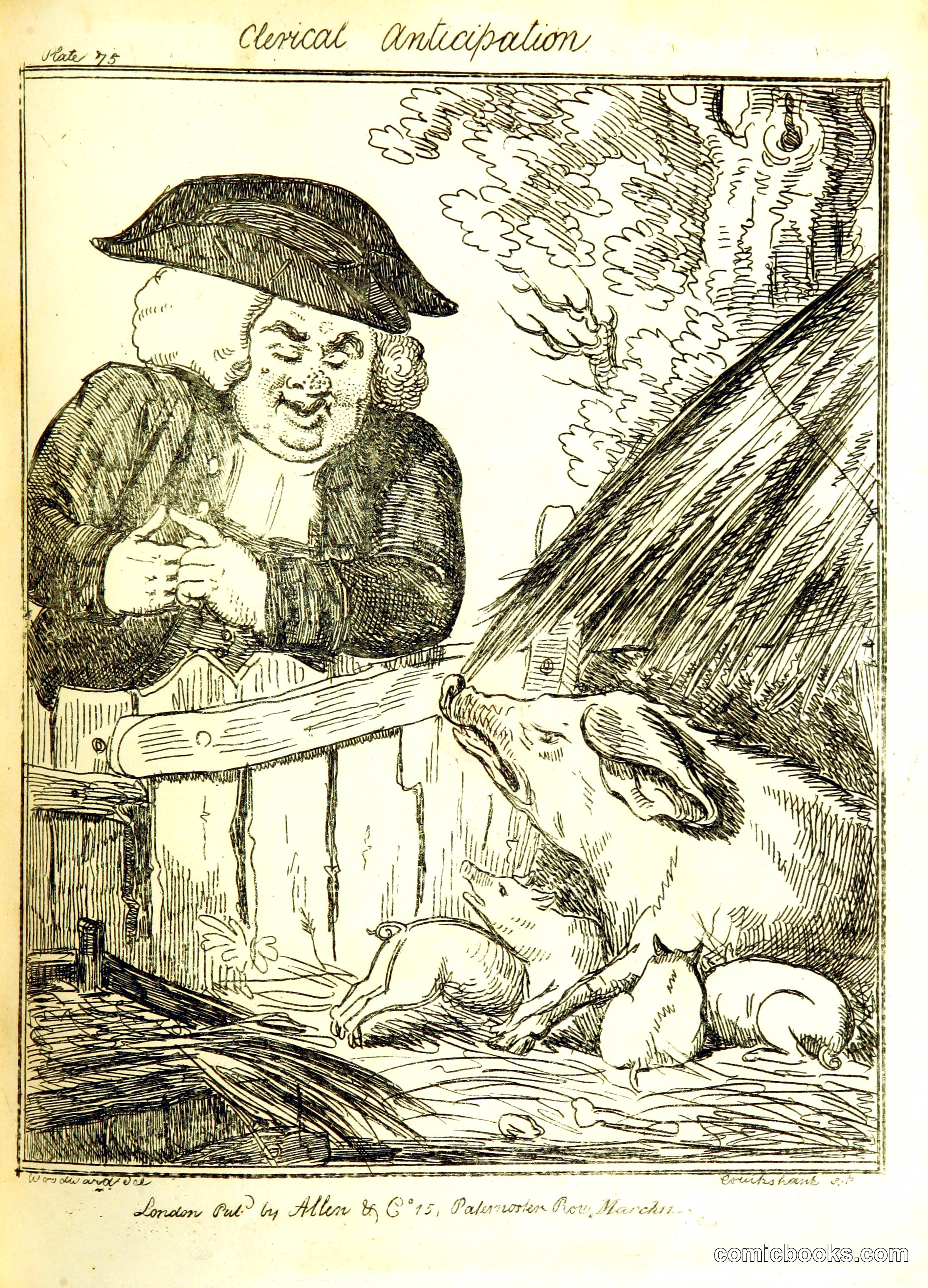
An etching by J. Cruikshank — likely Isaac Cruikshank, father of the more famous George — shows a corpulent clergyman in tricorn hat and clerical bands leaning over a sty fence, rubbing his hands in naked greed as a sow and piglet crane upward toward him. The satire is class and institutional: the fat parson eyeing livestock he expects as tithes or glebe income was a stock comic type, the Church of England's country clergy being widely resented for extracting produce from parishioners regardless of their poverty. Cruikshank's line is confident and economical, the cleric's jowled leer rendered with the exaggerated physiognomy that defines the Gillray–Rowlandson tradition — that culture of London print-shop caricature whose sequential, character-driven visual storytelling flows directly into the comic strip.
About this artifact
- Date
- 1807
- Rights
- Public domain — free to view, share, and reuse.
- Restoration
- Digitally restored and hosted by ComicBooks.com · high-resolution version available.
Part of our mission to preserve and restore the public-domain heritage of the medium.