
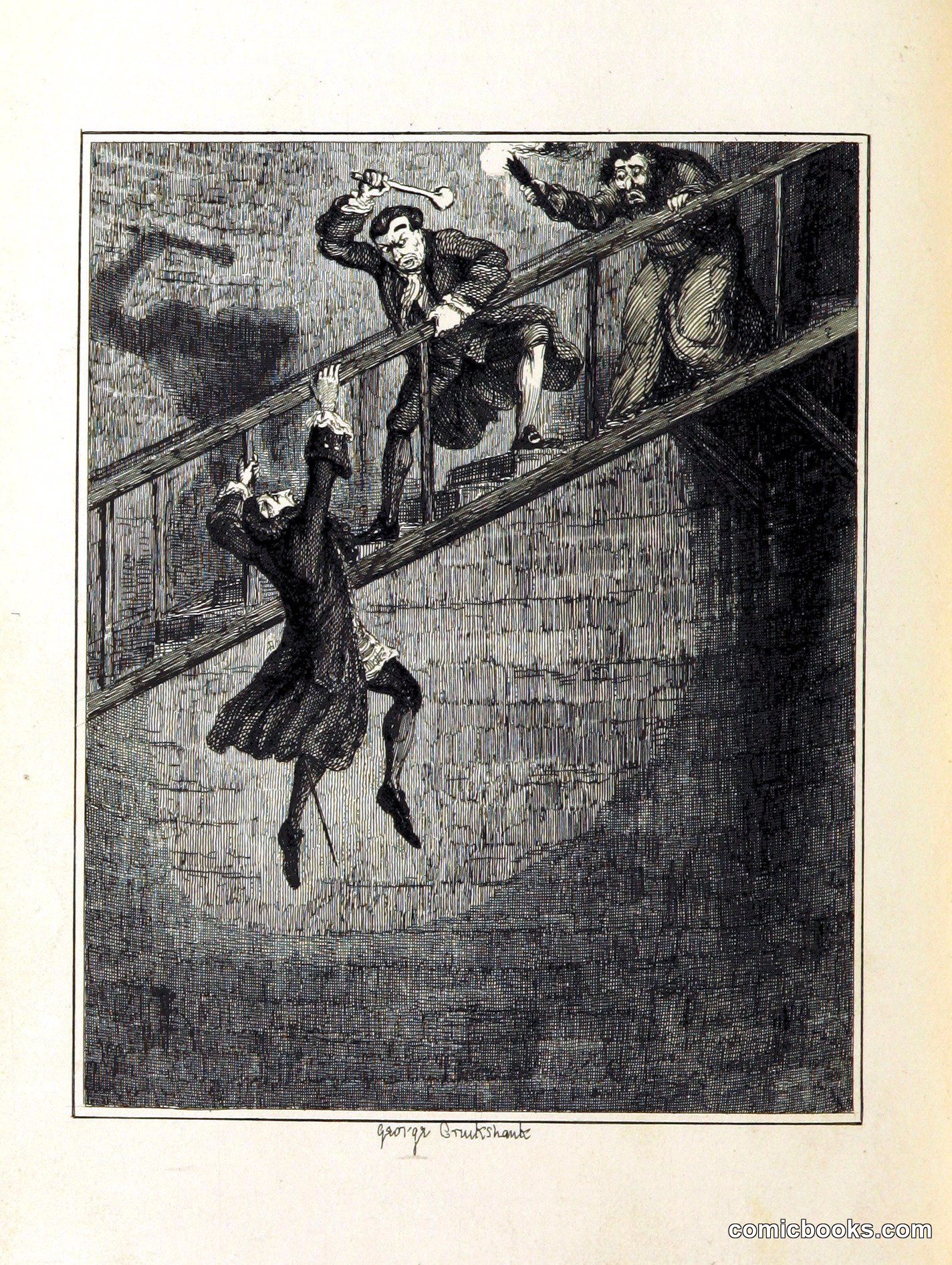
George Cruikshank's steel engraving depicts a desperate scene on a wooden staircase or scaffold against a brick wall: a figure dangles by his hands from the rail while a pursuer above raises a club to beat him loose, a third man watching from the upper landing. The cross-hatched chiaroscuro and exaggerated facial grimaces are characteristic of Cruikshank's mature line work, heir to the Rowlandson and Gillray tradition of expressive caricature. That tradition — from Hogarth's sequential moral prints through the German Bilderbogen picture-sheets — is the direct ancestor of the comic strip. Illustrating Harrison Ainsworth's romanticized criminal, Cruikshank's images helped make Jack Sheppard a Victorian pop-culture phenomenon, blurring the line between illustrated novel and proto-sequential narrative.
About this artifact
- Date
- 1854
- Rights
- Public domain — free to view, share, and reuse.
- Restoration
- Digitally restored and hosted by ComicBooks.com.
Part of our mission to preserve and restore the public-domain heritage of the medium.