
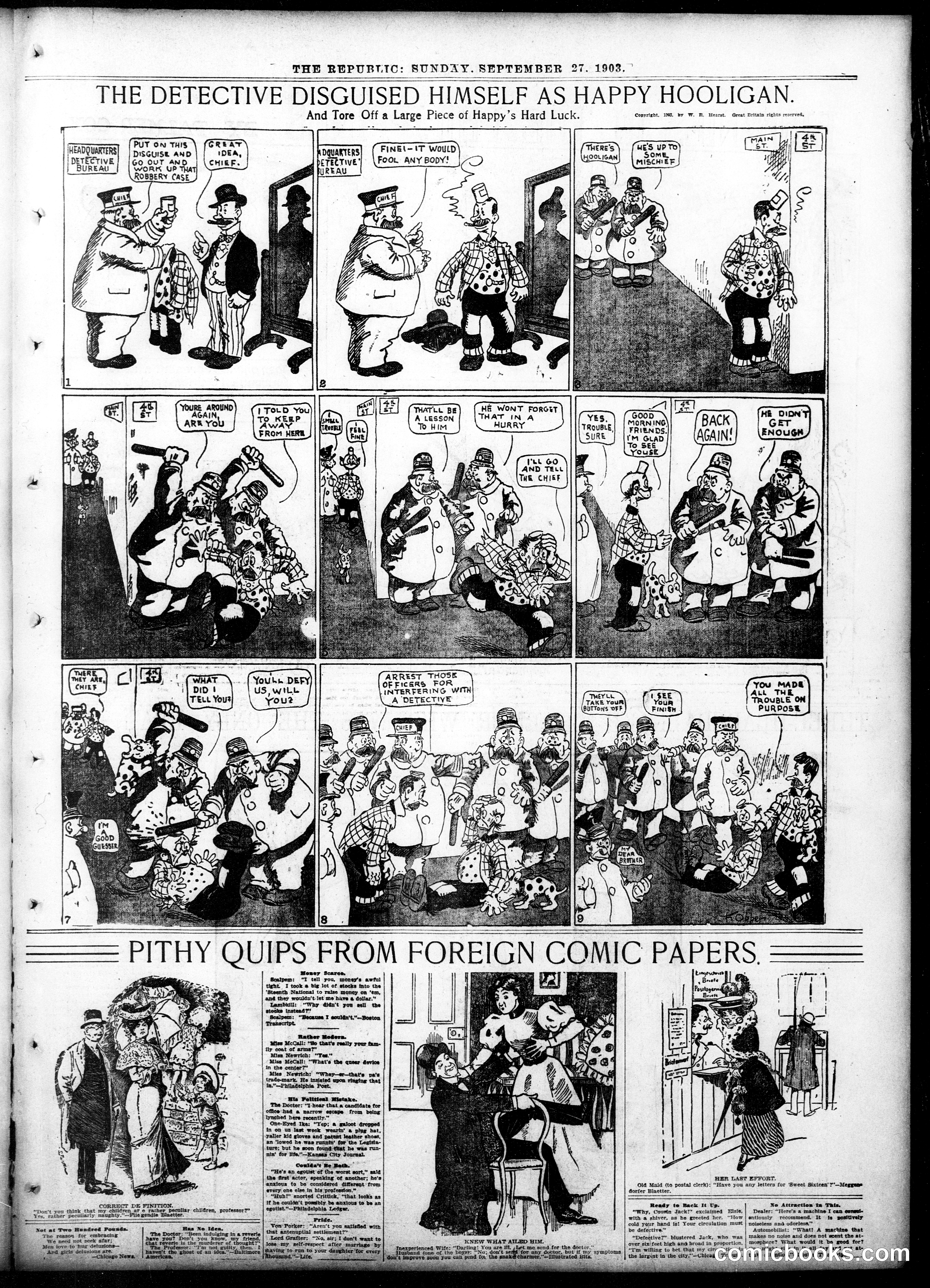
Nine panels across three tiers follow a detective who disguises himself as Happy Hooligan—the lovable tramp in battered tin-can hat and patched suit—to crack a robbery case. The gag turns on the disguise being too convincing: the detective gets beaten, arrested, and humiliated alongside the real Happy before his chief finally recognizes him. Frederick Burr Opper's linework is loose and kinetic, characters tumbling through urban street corners with rubbery exaggeration. Launched in 1900 in Hearst papers, Happy Hooligan ran until 1932, making Opper one of the first cartoonists to sustain a recurring cast across years of Sunday pages. Those pages—with their multi-panel sequences, speech balloons, and weekly continuity—were the direct material ancestor of the comic book format that would coalesce in collected form by the 1930s.
About this artifact
- Date
- September 27, 1903
- Rights
- Public domain — free to view, share, and reuse.
- Restoration
- Digitally restored and hosted by ComicBooks.com · high-resolution version available.
Part of our mission to preserve and restore the public-domain heritage of the medium.