
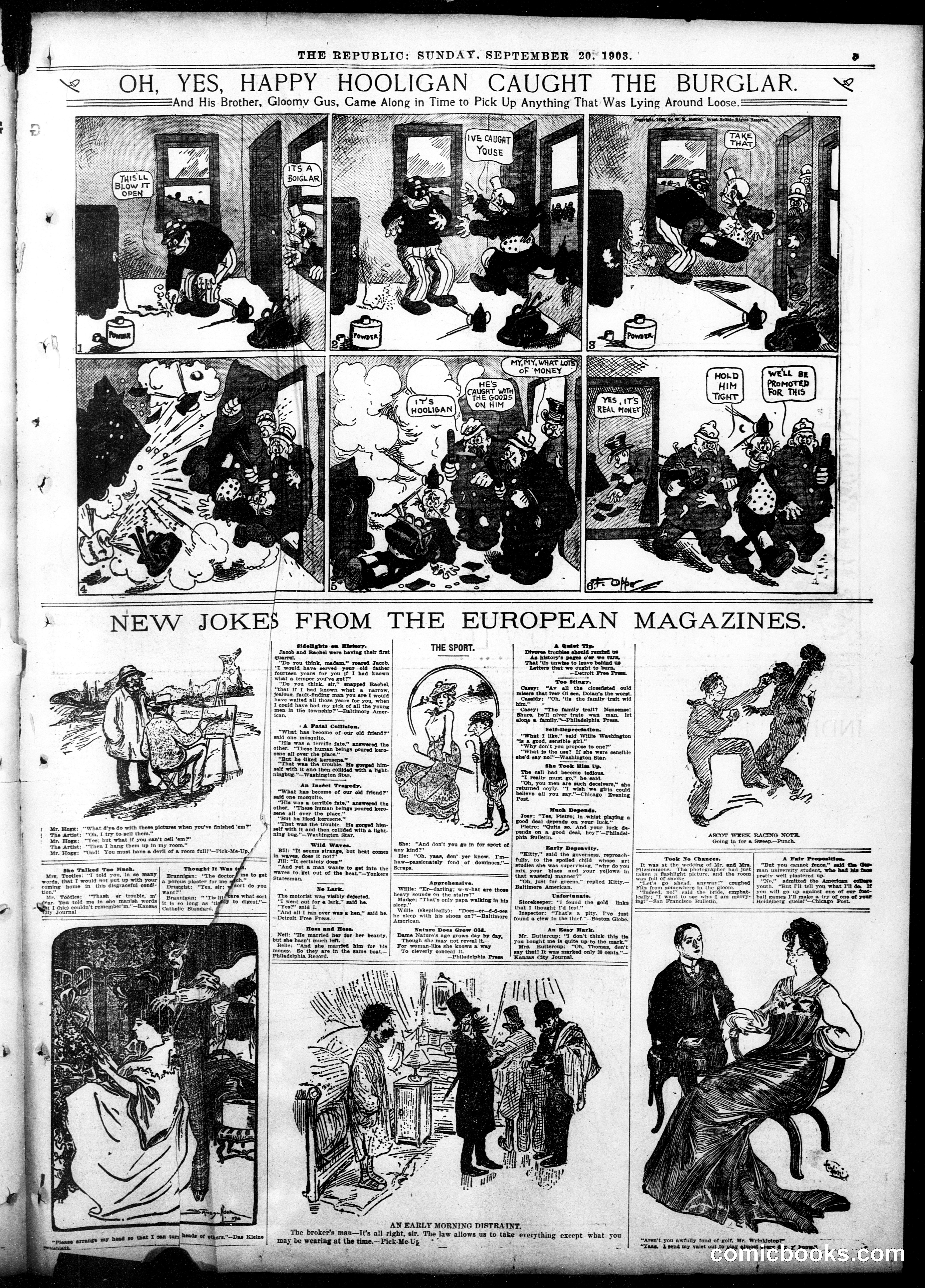
Six panels across two tiers tell a slapstick chase: Hooligan, the tin-canned tramp created by Frederick Burr Opper, stumbles upon a burglar mid-robbery, subdues him with an explosion of powder, and is promptly arrested by police who mistake him for the culprit — his perpetual fate. Speech balloons pop with colloquial shouts; staging moves left-to-right with cinematic clarity. Opper launched Happy Hooligan in 1900 for Hearst's syndicate, and strips like this one exemplify what scholars now recognize as the foundational grammar of sequential art: recurring characters, panel-to-panel causality, and integrated dialogue. The Sunday supplement — printed in color for mass circulation — was the direct ancestor of the comic book format that would be codified by the 1930s.
About this artifact
- Date
- September 20, 1903
- Rights
- Public domain — free to view, share, and reuse.
- Restoration
- Digitally restored and hosted by ComicBooks.com · high-resolution version available.
Part of our mission to preserve and restore the public-domain heritage of the medium.