
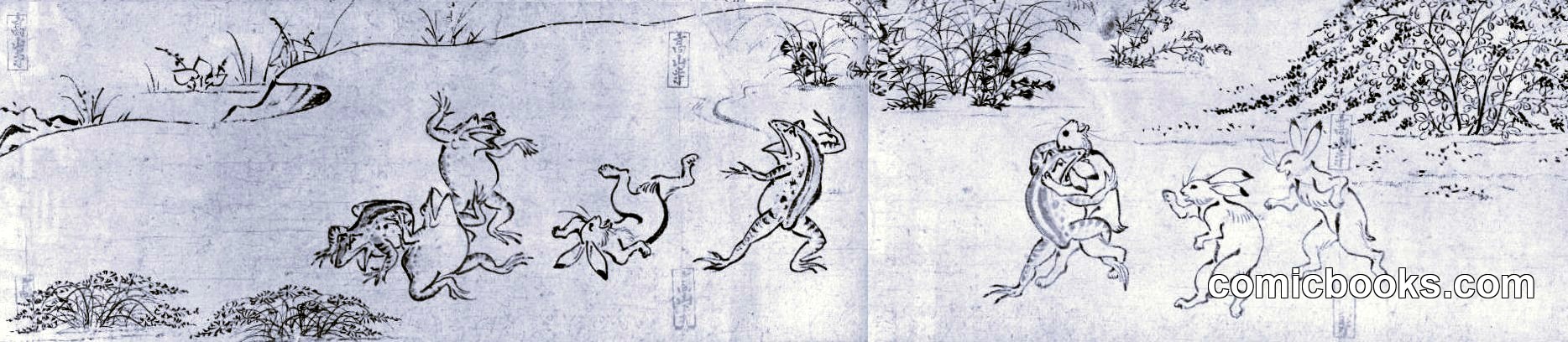
Chōjū-giga — the frog and the hare
attributed to Toba Sōjō · 12th–13th c.
The pairing of the frog and the hare is emblematic of everything the Chōjū-giga does best. Across the scrolls these creatures recur as protagonists in a running animal comedy, and their encounters have become the images most often reproduced when the work is invoked as the wellspring of manga.
What the scene captures is character through motion. A frog's braced stance, a hare's tumbling recoil, the arc of a body caught mid-fall—each is set down in a rapid, unhesitating line that reads as clearly as any modern comic panel. There is no text to lean on; the drawing alone tells us who acts and who reacts, who triumphs and who is undone.
Traditionally credited to Toba Sōjō and preserved at Kōzan-ji, this imagery embodies the affectionate satire at the heart of the scrolls: by casting animals as people, the artist gains license to mock human vanity while keeping the whole affair light. It is comedy drawn in motion—the earliest note of a very long song.
About this artifact
- Creator
- attributed to Toba Sōjō
- Date
- 12th–13th c.
- Rights
- Public domain — free to view, share, and reuse.
- Restoration
- Digitally restored and hosted by ComicBooks.com · high-resolution version available.
Part of our mission to preserve and restore the public-domain heritage of the medium.