
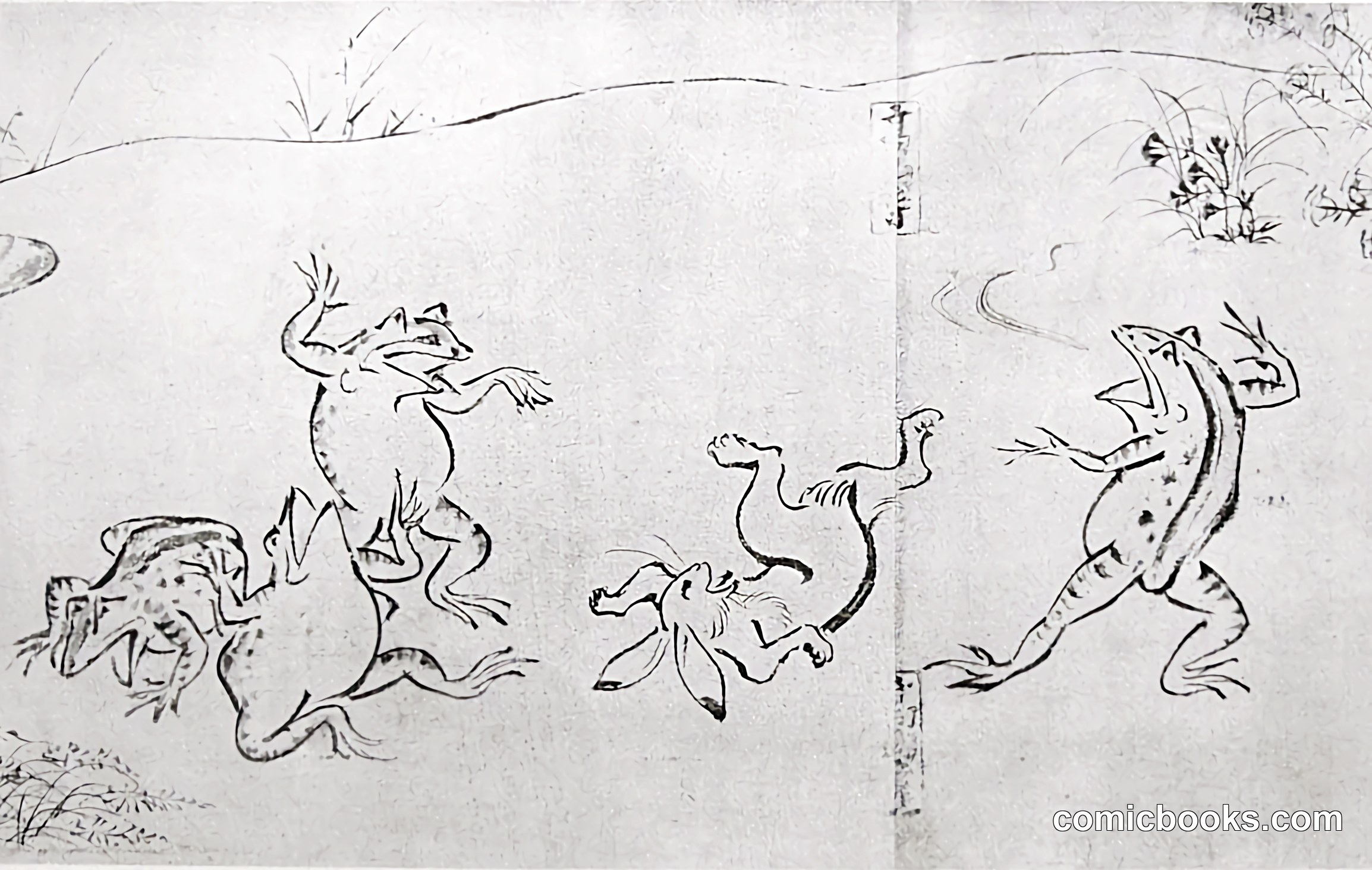
Chōjū-giga (Scrolls of Frolicking Animals)
attributed to Toba Sōjō · 12th–13th c.
The Chōjū-jinbutsu-giga survive as a set of ink-on-paper handscrolls held at Kōzan-ji temple near Kyoto and designated a National Treasure of Japan. Read in the traditional manner—unrolled from right to left, a stretch at a time—they present animals engaged in recognizably human pursuits, rendered in a swift, spare monochrome line without color or, in the most famous scroll, any accompanying text.
Authorship has long been attributed to the priest-painter Toba Sōjō (Kakuyū), yet scholars now regard the attribution as traditional rather than documented, and the surviving scrolls as the product of multiple artists working across the twelfth and thirteenth centuries. Their lasting fame rests less on who held the brush than on what the brush achieved: purely visual, sequential storytelling and gentle social caricature.
It is on the strength of exactly these qualities that the scrolls are so often called the earliest ancestor of manga—narrative, motion, and humor carried by drawing alone.
About this artifact
- Creator
- attributed to Toba Sōjō
- Date
- 12th–13th c.
- Rights
- Public domain — free to view, share, and reuse.
- Restoration
- Digitally restored and hosted by ComicBooks.com · high-resolution version available.
Part of our mission to preserve and restore the public-domain heritage of the medium.