
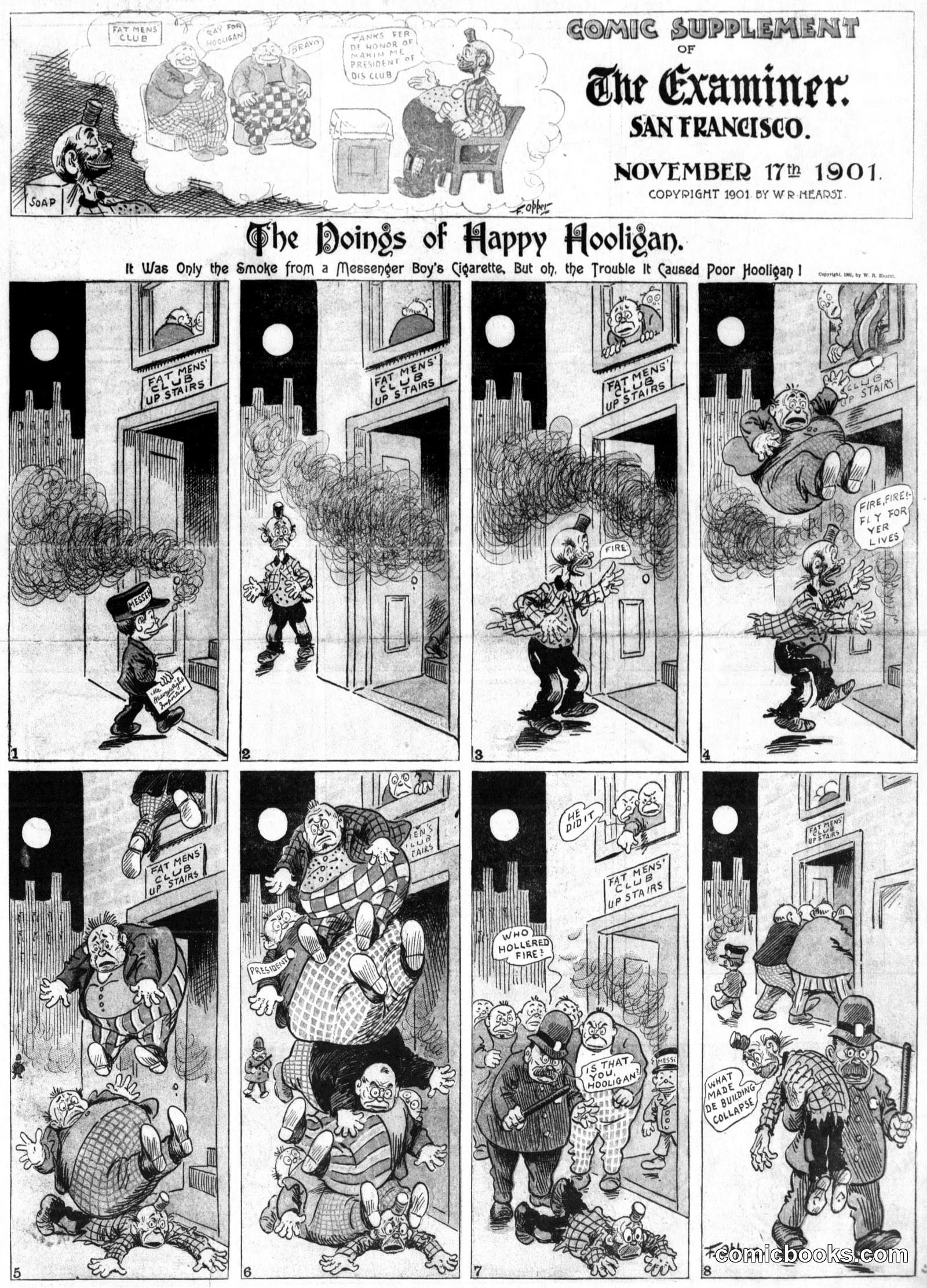
Eight panels follow the tin-canned tramp Happy Hooligan past the Fat Men's Club on a smoky night. A messenger boy's cigarette fills the doorway with billowing black scrawl-lines; Hooligan, mistaken for the source, shouts "Fire!"; portly club members cascade down the stairs in a tumbling heap (panel 6 is a magnificent pile of checkered suits and flailing limbs); the angry members blame Hooligan in panel 7, and a policeman escorts him off in panel 8. Opper's strip, syndicated by Hearst from 1900, ran in Sunday color pages that were the direct ancestors of the comic book — sequential panels, speech balloons, a recurring character defined by his costume. The visual grammar invented here became the industry's foundation.
About this artifact
- Date
- Frederick Burr Opper, 1901
- Rights
- Public domain — free to view, share, and reuse.
- Restoration
- Digitally restored and hosted by ComicBooks.com.
Part of our mission to preserve and restore the public-domain heritage of the medium.