
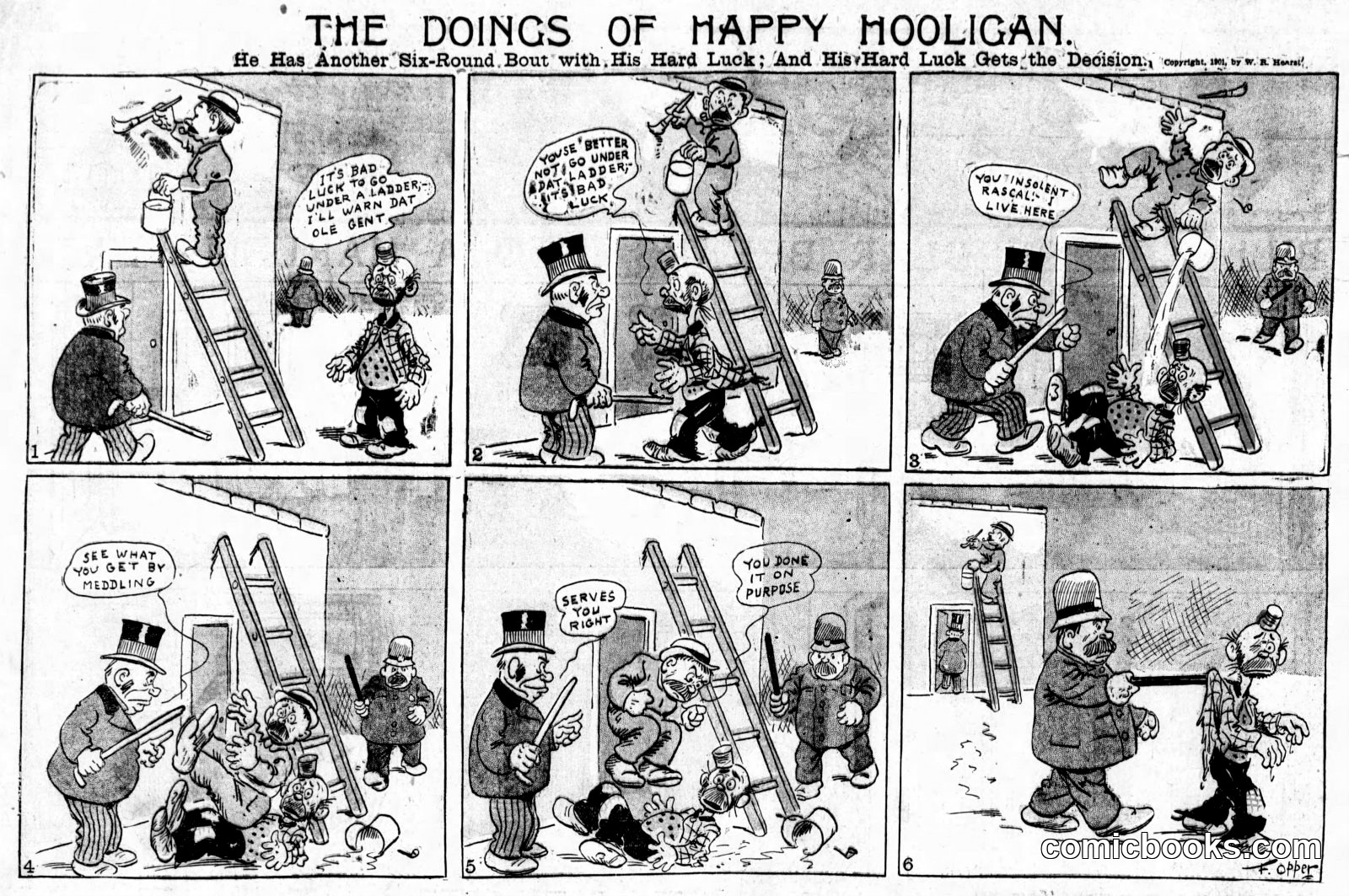
Six panels follow Happy Hooligan, a good-natured tramp in a tin-can hat, as he tries to warn a pompous gentleman not to walk under a painter's ladder. The gentleman ignores him, the painter stumbles, paint cascades, and the ladder collapses — Happy takes the blame and the beating anyway. Opper's brushwork is loose and kinetic, dialogue delivered in phonetic vernacular speech balloons. Launched in New York Journal Sunday pages in 1900, Happy Hooligan ran for over two decades, syndicated nationwide. These Hearst Sunday supplements — full-color, multi-panel, recurring-character pages — directly trained readers in the sequential visual grammar that would define comic books when anthology reprint collections began appearing in the 1930s.
About this artifact
- Date
- Frederick Burr Opper, 1901
- Rights
- Public domain — free to view, share, and reuse.
- Restoration
- Digitally restored and hosted by ComicBooks.com.
Part of our mission to preserve and restore the public-domain heritage of the medium.