
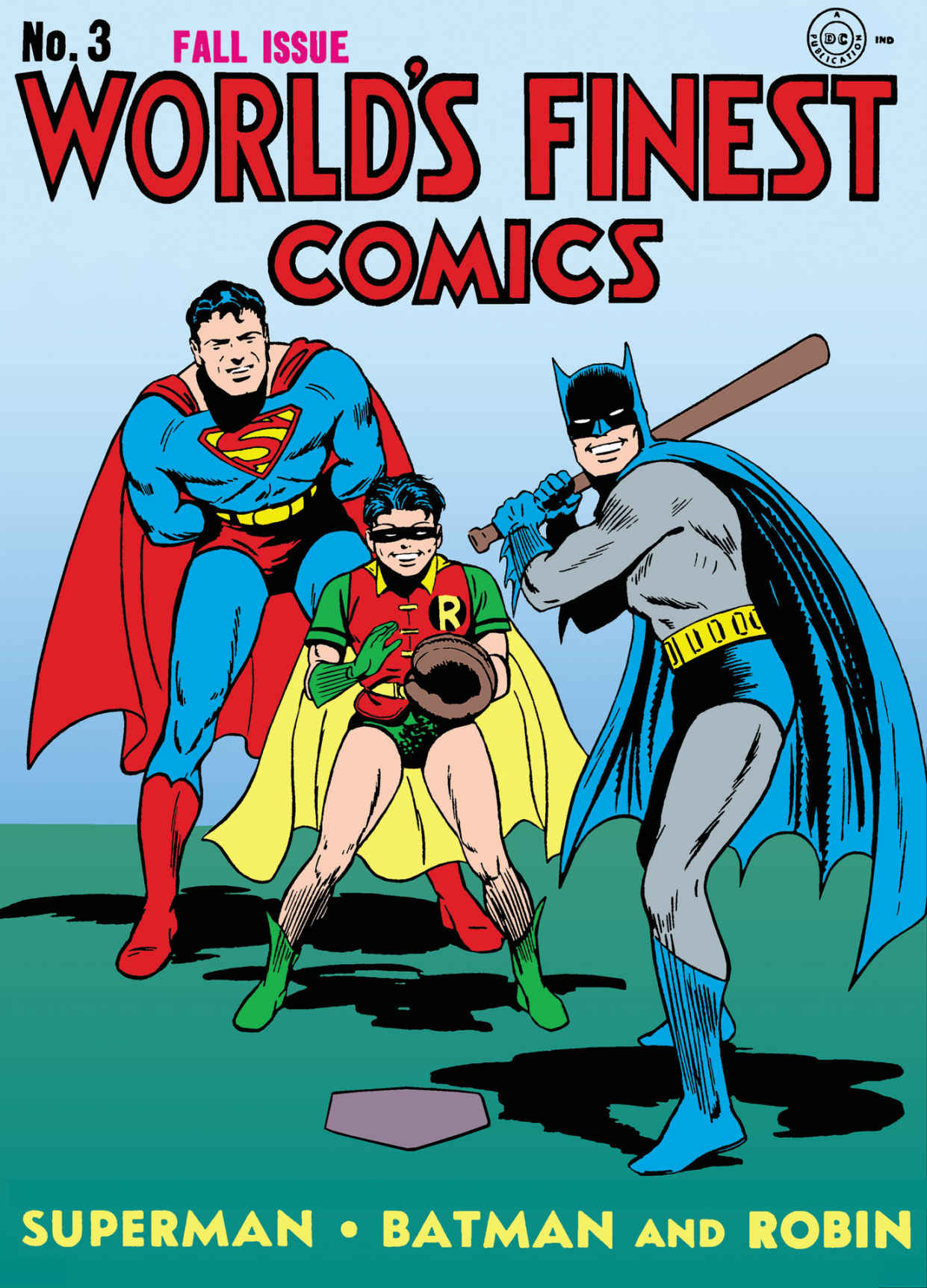
World's Finest Comics #3
☆ Be the first to review + Add to your collection — Join freeWorld's Finest Comics #3 (Fall 1941) earns its place in DC history above all as the debut of the Scarecrow — Dr. Jonathan Crane — one of Batman's most enduring and psychologically rich antagonists, introduced here in full origin form in a story titled "Riddle of the Human Scarecrow." The Scarecrow brought something new to the Batman rogues' gallery: a villain whose entire methodology was fear itself, mirroring Batman's own psychological arsenal and making him philosophically distinct from the gangsters and gimmick-criminals of the era. As a thick 100-page quarterly anthology, the issue also marked the Sandman's entry into the World's Finest rotation and contained the final appearance of Johnny Thunder in the series, cementing it as a transitional moment in DC's Golden Age lineup. The Scarecrow made only two appearances in the 1940s before fading away, yet the character's bones — a disgraced psychology professor who weaponizes fear — proved durable enough to anchor a Silver Age revival and eventually become a cornerstone of Batman's mythology across comics, film, animation, and games.
In "The Case of the Death Express," World's Finest Comics #3 (1941) delivers a thrilling mystery as Wes and Dian attend the opera, only to witness a shocking backlash against a dazzling performance. The story unfolds with Creig Flessel’s art and Chad Grothkopf’s inks, revealing a sinister scheme where the Sandman uncovers a racketeer manipulating audiences through blackmail. Fred Ray’s dynamic cover captures the intrigue, setting the stage for a classic adventure with a twist.
When Wes and Dian attend the opera to hear a beloved singer, they’re stunned by the sudden wave of boos from the audience—despite a flawless performance. Sandman soon uncovers a sinister scheme orchestrated by Mr. Growlick and Mr. Walsh, who are blackmailing star performers into paying for fake audience approval.
ComicBooks.com Value
Show all 17 grades ▾
This exact issue on ebay
CGC 7.5 ▾ $16,499–$16,999 2 listings
CGC 4 ▾ $6,050 2 listings
CGC 1.8 ▾ $3,250–$3,300 2 listings
CGC 0.5 ▾ $1,950–$1,950 2 listings
CGC ▾ $899–$2,495 4 listings
Raw / ungraded ▾ $2–$5,200 9 listings
Read it digitally
Sell my copy
Have this issue — or a whole collection? Get a fair offer from us, skip the marketplace fees and the hassle.
We Buy Collections ▸History
The issue was edited by Whitney Ellsworth and published as the third entry in the World's Finest quarterly series, which had launched as World's Best Comics #1 before DC switched the title with issue #2 — reportedly to avoid trademark conflict with an existing publication. The Batman feature, "Riddle of the Human Scarecrow," was scripted by Bill Finger with pencils credited to Bob Kane (signed) and secondary figure work by Jerry Robinson, inked by George Roussos; the Scarecrow's visual design drew on Washington Irving's Ichabod Crane from The Legend of Sleepy Hollow, both for the lanky silhouette and the alter-ego name Jonathan Crane. The cover artist attribution has been a point of long-running debate: historian Les Daniels attributed it to Jerry Robinson in his 1995 book, while both Archives reprint series credit Fred Ray, and collector Craig Delich documented that Jack Burnley personally verified Fred Ray as the cover artist when Burnley visited him in 1989.
Trivia · 8 facts
- First appearance and origin of the Scarecrow (Dr. Jonathan Crane), created by writer Bill Finger and artist Bob Kane, in the story "Riddle of the Human Scarecrow."
- The Scarecrow's character concept — a fired psychology professor who turns the mechanics of fear into a criminal enterprise — as well as his lanky appearance and surname were directly inspired by Ichabod Crane from Washington Irving's The Legend of Sleepy Hollow.
- The issue marks the Sandman (Wesley Dodds, with supporting character Dian Belmont) beginning his run in the World's Finest series, in a story titled "Crime Visits the Opera."
- This is the final appearance of Johnny Thunder (with Daisy Darling and Thunderbolt) in the World's Finest series.
- The 100-page anthology also includes a Superman story ("The Case of the Death Express," scripted by Jerry Siegel, art by Leo Nowak), a Zatara story ("Magic Casts Its Vote," scripted by Gardner Fox, art by Joseph Sulman), a Crimson Avenger story featuring Lee Travis and Wing, a King Standish story, and a Lando story, among others.
- Interior art credits include Bob Kane and Jerry Robinson on the Batman feature, Creig Flessel, and George Roussos as inker/letterer; the cover is credited to Fred Ray (contested — see flagged).
- The issue was edited by Whitney Ellsworth, the longtime DC editorial figure who supervised much of the Golden Age output.
- The Scarecrow's debut story has been reprinted multiple times, including in Batman: The World's Finest Comics Archives Vol. 1 (2002), The Batman Chronicles #4 (2007), Batman: The Golden Age Omnibus #1 (2016), and the dedicated collection Batman Arkham: Scarecrow (2016).
Cast · 24 characters
Full credits
Reprints
Reprinted in Limited Collectors' Edition #C-37 (1975), DC Comics: Sixty Years of the World's Favorite Comic Book Heroes #[nn] (1995), Batman: The World's Finest Comics Archives #1 (2002), Superman: The World's Finest Comics Archives #1 (2004), Batman: Scarecrow Tales #[nn] (2005), The Batman Chronicles #4 (2007), The Superman Chronicles #6 (2009), Batman: The Golden Age Omnibus #1 (2016), Batman Arkham: Scarecrow #[nn] (2016), Superman: The Golden Age Omnibus #2 (2016), Batman: The Golden Age #2 (2017), Superman: The Golden Age #4 (2018)
Key issues in World's Finest Comics
Reviews
Reader reviews
No reader reviews yet.