
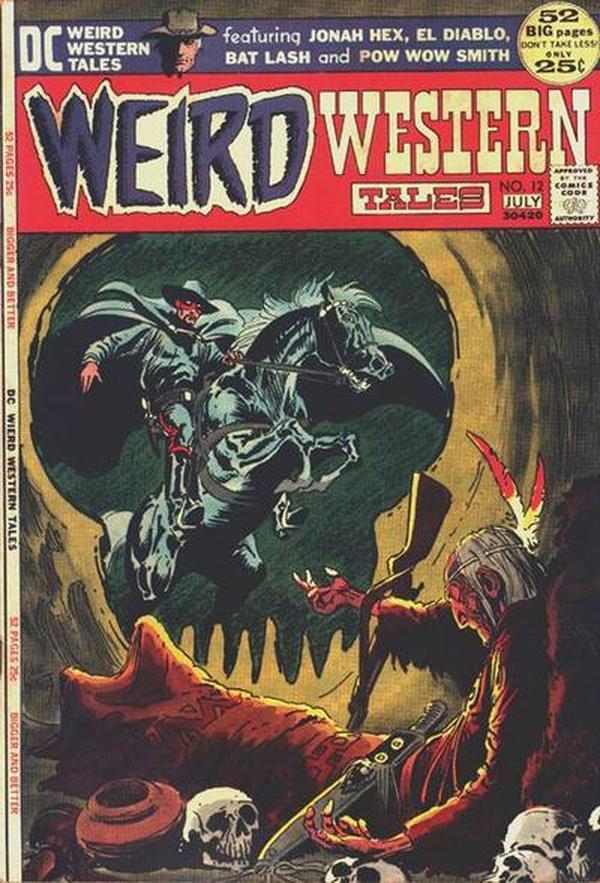
Weird Western Tales #12
☆ Be the first to review + Add to your collection — Join freeWeird Western Tales #12 is the first issue of the renamed title — DC's All-Star Western relaunched under this new banner with issue #12, continuing the original numbering and bringing Jonah Hex into his defining long-term home. Hex's third appearance here, set amid a deliberately gritty Bronze Age tone that editor Joe Orlando and writer John Albano cultivated, helped establish the scarred bounty hunter as DC's preeminent Western character and proved that morally ambiguous, post-spaghetti-western protagonists could sustain a mainstream comic. The issue also carries on the El Diablo/Lazarus Lane supernatural western feature — DC's experiment in blending Old West adventure with occult possession — marking a conscious editorial bet on horror-inflected westerns that would influence how the title was packaged for years. As the first issue of a title that ran for 59 issues through 1980 and launched Hex into his own self-titled series in 1977, this issue stands as the foundational chapter of the most durable DC Western run of the Bronze Age.
In "Promise to a Princess!", Jonah Hex rides through the harsh frontier, bound by a vow to protect the daughter of a Pawnee chief he once saved. After the tribe that sheltered him falls to a deadly epidemic spread by tainted blankets, Hex sets out on a grim path of retribution against the man who delivered them. Written by John Albano and brought to life with stark, evocative art by Tony DeZuniga, this gripping tale blends frontier tragedy with personal vengeance. The cover, a powerful portrait by Joe Kubert, captures Hex’s haunted resolve.
Jonah Hex rides into a dying camp, where he rescues Little Fawn, the daughter of the Pawnee Chief, from the aftermath of a brutal attack. Haunted by the loss of the tribe that once sheltered him, Jonah vows to track down the man behind the deadly blankets—Mr. Craig—whose cruelty has left a trail of blood and sorrow across the frontier.
In "Brothers," Bat Lash encounters a fellow bounty hunter whose past is a blank slate—his mind shattered by the murder of his parents, leaving him with no memory of his true identity or his brother. As the two men cross paths on the frontier, neither recognizes the other, and the only witness who could reveal the truth is silenced by a bullet before he can speak.
ComicBooks.com Value
Show all 17 grades ▾
This exact issue on ebay
CGC 9.6 ▾ $525–$550 2 listings
CGC 9.4 ▾ $298–$380 3 listings
CGC 9 ▾ $190–$289 2 listings
Raw — VF+ ▾ $79.2–$135 4 listings
Raw — FN/VF ▾ $39.99–$79.99 2 listings
Raw / ungraded ▾ $22.76–$297 14 listings
More listings for this title
Read it digitally
Sell my copy
Have this issue — or a whole collection? Get a fair offer from us, skip the marketplace fees and the hassle.
We Buy Collections ▸History
Editor Joe Orlando, who oversaw DC's mystery and western anthology lines, renamed All-Star Western as Weird Western Tales beginning with this issue, retaining the numbering (the predecessor had run 11 bimonthly issues from 1970 to 1972) while slightly reformatting to a 52-page giant format at a 25-cent price point. Orlando and writer John Albano had introduced Jonah Hex two issues earlier in All-Star Western #10; by the time the title changed its name, Hex was already the co-feature drawing reader attention. The El Diablo segment — written by Cary Bates with pencils by Neal Adams and inks by Bernie Wrightson — represented a notable, if brief, creative pairing, though contemporary observers noted the two artists' contrasting styles created an uneven result on the page. The cover was supplied by Joe Kubert, one of only two Weird Western Tales covers he drew for the title.
Trivia · 8 facts
- First issue of Weird Western Tales — the title continued the numbering directly from All-Star Western Vol. 2, which ran 11 issues (1970–1972) before being renamed with this issue (#12, cover date July 1972).
- Third overall appearance of Jonah Hex, in the story 'Promise to a Princess!' — written by John Albano with art by Tony DeZuniga; Hex had debuted two issues earlier in All-Star Western #10 (Feb.–Mar. 1972).
- Jonah Hex was created by writer John Albano and artist Tony DeZuniga, with editor Joe Orlando crediting himself as a co-creative contributor (per his own statement in the WWT #26 letters page).
- El Diablo (Lazarus Lane) story 'A Time to Die!' — written by Cary Bates, penciled by Neal Adams, and inked by Bernie Wrightson; one of the very few published collaborations between Adams and Wrightson.
- Lazarus Lane / El Diablo was created by Robert Kanigher and Gray Morrow, first appearing in All-Star Western #2 (Oct.–Nov. 1970); this issue is among his early continued appearances as a co-feature.
- Cover art by Joe Kubert; edited by Joe Orlando with assistant editor Mark Hanerfeld.
- 52-page giant-format issue also includes reprints: a Bat Lash story (part 2, script by Sergio Aragonés and Denny O'Neil, art by Nick Cardy, continuing from All-Star Western) and a Pow-Wow Smith story ('The Treasure of the Flaming Arrows!' with art by Carmine Infantino).
- The lead Jonah Hex story 'Promise to a Princess!' was later reprinted in Showcase Presents: Jonah Hex #1 and Jonah Hex and Other Western Tales #2, as well as in international editions (French and Swedish reprints documented in the Grand Comics Database).
Cast · 3 characters
Full credits
Reprints
↩ Reprints Western Comics #58 (1956), Bat Lash #7 (1969)
Reprinted in Tomahawk #12/1972 (1972), Tomahawk #2/1973 (1973), Tomahawk #6/1973 (1973), Tomahawk #6/1973 (1973), Brûlant #42 (1976), Jonah Hex and Other Western Tales #2 (1979), Tomahawk #2/1982 (1982), Tomahawk #2/1982 (1982), Jonah Hex #4/1986 (1986), Jonah Hex #4/1986 (1986), Choc #16 (1987), Showcase Presents: Jonah Hex #1 (2006), Showcase Presenta Jonah Hex #1 (2009), Weird Western Tales: Jonah Hex #[nn] (2020), Hopalong Cassidy #222
Key issues in Weird Western Tales
Reviews
Reader reviews
No reader reviews yet.