
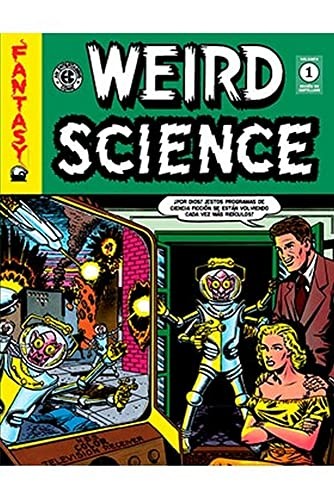
Weird Science #1
This volume collects the first issues of the 2021 Weird Science series, a Spanish-language reimagining of the classic EC Comics title. Published by Diábolo Ediciones, it presents a modern take on science fiction and horror anthology stories, featuring original creators and updated twists on vintage themes.
In "Perdido en el microcosmos," Karl’s chance encounter with a forgotten experiment leads him down a path of unintended discovery when he accidentally activates a shrinking solution tied to the work of a mysterious former mentor. As he dwindles in size, he stumbles into a hidden world where scale and reality warp—only to find Professor Dreeben, who seems to know more than he should, before vanishing once more into the unseen.
In "Experimento... con la muerte," two scientists push the limits of life and death, testing their revival process on a dog after fifteen minutes of clinical death. What begins as a controlled experiment quickly reveals a terrifying consequence: the subject returns with irreversible brain damage, raising unsettling questions about the cost of defying nature.
In "Cosas" del espacio exterior, a scientist and his assistant uncover strange metal in the desert, leading them to a shocking discovery: it's debris from a spacecraft from another galaxy. When they encounter one of the aliens—human-like but marked by a third eye hidden on its forehead—they learn the truth: the alien's kind have already infiltrated Earth, and their plan to take over is well underway.
In "La invasión de los platillos volantes," the Secretary of Defense dismisses reports of flying saucers from across America—unaware that a fleet of actual alien craft is already descending on Earth, silently closing in on the planet’s cities and skies.
In "El monstruo del meteoro," a sudden meteor strike on a rural farm sets off a chain of eerie events when a strange alien creature emerges, using hypnotic power to ensnare everyone it touches—except one, a blind woman whose perception proves uniquely threatening to the being’s plans.
In "¡La micro-raza!", a reclusive scientist observes the rise of a tiny, self-aware civilization he created, marveling as they advance from simple life forms to a complex society. As their ingenuity leads them to build weapons of unimaginable power, the scientist watches in quiet dread—knowing their triumph may also be their undoing.
In "El hombre que corrió contra el tiempo," Julius, passed over for the chairmanship of the Physics Department, turns to his Spherical Accelerator in a desperate bid to prove his worth—only to find his revenge on Bruce and Christine spirals beyond control, leaving consequences he never intended.
In "¡Sonidos de otro mundo!", a gardener pauses mid-trim when a professor stops him, claiming that plants scream in pain when harmed—especially when cut. With quiet urgency, the professor recounts how his invention lets him hear the hidden voices of trees and flowers, revealing a world of sound where nature’s suffering is real and audible.
In "La máquina que salió de la nada," Professor Donalson is summoned to his friend Dave’s home to examine a mysterious device that emerged from nowhere—something Dave claims came to him through dreams while working on a molecular wave theory. As the two confront the strange machine and its origins, the line between invention and the inexplicable begins to blur.
In "¡Pánico!", a frantic radio broadcast warns of an alien invasion from Jupiter—just as real extraterrestrial forces descend upon Earth. As the line between hoax and reality blurs, listeners scramble to decipher which threat is real, caught in a pulse of panic where the signal itself becomes the battlefield.
In the scorched aftermath of an atomic blast, Luis and Rosa cling to life aboard their fishing boat, their bodies marked by deadly radiation. Though Luis succumbs to the fallout, Rosa returns to Argenta, gives birth to their son Pedro, and dies in the arms of the nation’s leader. The boy, now radiating an otherworldly intelligence, is discovered by the President—unaware that Pedro’s mind holds the future of the country in its fragile grasp.
In "He creado un... ¡Gargantúa!", a scientist attempts to help a small man by manipulating his pituitary gland to increase his height—only for the experiment to spiral out of control. What begins as a simple procedure quickly escalates as the man grows uncontrollably, reaching a staggering 700 feet tall.
In "¡La novia del futuro!", a heartbroken man finds himself swept into an unexpected adventure when he encounters time-traveling tourists from 2150 exploring the 1950s. Drawn into their world, he uses their advanced technology to create the ideal companion—then brings her back to his own time, where everything changes in ways he never expected.
In "Retorno," a group of space travelers journey to a distant world—nine years away from their own—only to find it unchanged after half a million years. Once the cradle of their ancestors, the planet now burns under the shadow of another devastating atomic war, its surface scarred by the same endless conflict that shaped their past.
In "La última guerra del mundo," Arthur challenges Professor Harlow’s belief that humanity’s nature ensures endless conflict, arguing that even war can be a unifying force when facing an external threat. The professor counters with a thought experiment: what if a danger from beyond Earth—like an invasion from Mars—could finally bring all nations together, ending war once and for all? When that very threat arrives, the world is forced to confront the question: can unity born of fear truly last?
In "El engendro de Venus," astronauts returning from a mission to Venus carry back a seemingly harmless flower—only to awaken a terrifying creature when it blooms. The fragile beauty of the alien bloom hides a deadly secret, turning a routine journey into a race against an unseen horror.
In "Hombre y superhombre," a young man obsessed with physical strength stumbles into his brother’s experimental lab, drawn more by ambition than science. When he takes a dangerous risk with a mysterious machine meant to alter atomic mass, he gains superhuman power—but at a cost that tests the limits of his endurance and identity.
In "¡El hundimiento del Titanic!", a British physicist driven by personal loss builds a time machine to stop the sinking of the Titanic—his parents’ final voyage, and the event that saved his own life. But when he travels back, fate twists in ways he never expected, unraveling the very tragedy he sought to erase.
In "¡Divide y vencerás!", a scientist's paranoia spirals into something grotesque when he discovers his wife plans to kill him—so he turns her into a swarm of tiny, identical versions of herself, each no larger than an ant, and crushes them underfoot with cold precision. The story unfolds with chilling calm, exploring the terrifying consequences of obsession and control in a world where science bends to personal vengeance.
Find on ebay
Where to buy
Sell my copy
Have this issue — or a whole collection? Get a fair offer from us, skip the marketplace fees and the hassle.
We Buy Collections ▸Full credits
Reprints
↩ Reprints Weird Science #12 (1950), Weird Science #13 (1950), Weird Science #14 (1950), Weird Science #15 (1950), Weird Science #5 (1951), Weird Science #6 (1951), EC Archives: Weird Science #1 (2022)
Reviews
Reader reviews
No reader reviews yet.