
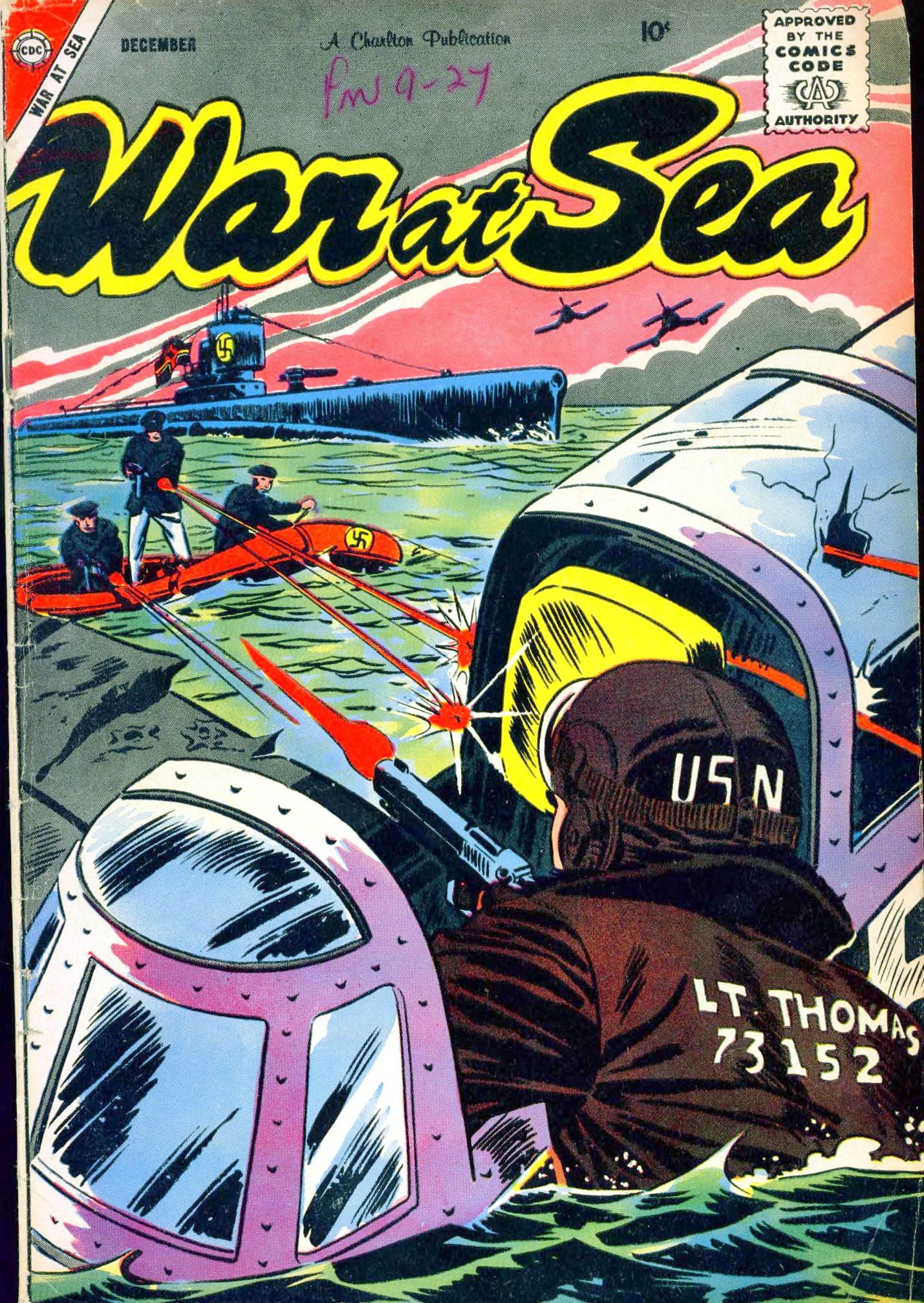
War at Sea #28
☆ Be the first to review + Add to your collection — Join freeA Japanese destroyer hunts a U.S. transport ship that has been spotted by their planes, but the American escort destroyer intercepts the Japanese vessel first at close range. In a separate storyline, a U.S. Navy diver encounters a shark underwater while on a mission, survives the encounter, and is rescued and brought to the surface for medical treatment. German saboteurs plan a covert operation, waiting for a submarine to retrieve them after they've completed their mission, while Allied forces attempt to intercept them at a designated point.
Captain Rink commands his destroyer with an iron fist, ordering his crew to abandon beards, uniforms violations, and ship mascots—but when a Japanese air attack strikes the convoy near Rabaul, a dog named Salty's frantic barking alerts the crew to a dangerous fire in the after magazine that could have spelled disaster. What begins as a clash between strict naval discipline and a sailor's devotion to his abandoned pet becomes a test of what truly matters when lives hang in the balance.
Two deep-sea salvage partners discover a dangerous enemy lurking 190 feet below: nitrogen narcosis, a mysterious condition that clouds the mind and turns allies into threats. When both Steve and Bo succumb to its grip while working to raise a sunken ship, they must confront not each other, but the terrifying effects of "The Happy Depth!" and what it costs to survive the crushing depths.
Lt. Gault of U.S. Intelligence investigates rumors that German U-boats are operating in American waters, tracing the leads to a Boston waitress's encounter with an intoxicated German sailor. When he spots suspicious men ashore and follows them to a hidden cove near Portsmouth, New Hampshire, Gault discovers a U-boat preparing to rendezvous with Nazi saboteurs returning from a mission inland. The hunt is on to capture the sub and its crew before they can slip away into the Atlantic.
When enemy ears could be listening, the U.S. Navy relies on its signalmen to keep ships in formation talking—using semaphore flags, blinker lights, and International Morse Code instead of radio. This story showcases the rigorous training and steady hands behind naval communications, where even in the atomic age, these time-tested methods remain essential to fleet coordination and survival at sea.
ComicBooks.com Value
Find on ebay
Read it digitally
Sell my copy
Have this issue — or a whole collection? Get a fair offer from us, skip the marketplace fees and the hassle.
We Buy Collections ▸Full credits
Reprints
Reprinted in Fightin' Navy #132 (1984), Marinos en Acción #74
Reviews
Reader reviews
No reader reviews yet.