
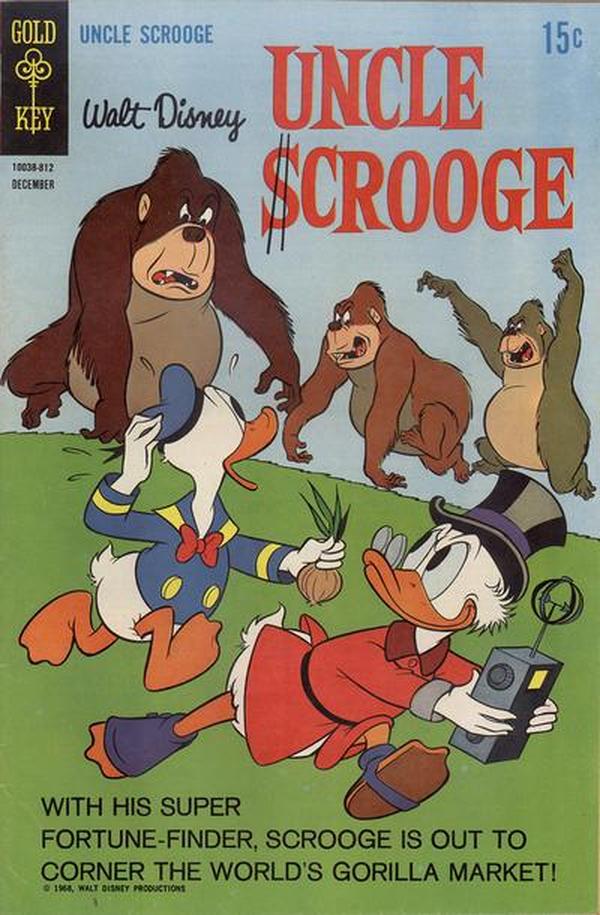
Walt Disney Uncle Scrooge #78
☆ Be the first to review + Add to your collection — Join freeWalt Disney Uncle Scrooge #78 (December 1968, Western Publishing / Gold Key) represents the series at a pivotal editorial crossroads: Carl Barks had stepped back from producing original material, and this issue—like its immediate neighbors—reprinted a classic early Barks story while folding in new work by the studio-era artists Western was developing to carry the title forward. As one of the issues sustaining the unbroken numbering run that had started with Four Color #386 in 1952, it documents how Western kept the world's most commercially successful Disney comic alive through a generational transition in creative talent. The reprinted Barks content ensured that readers encountering the duck universe for the first time in the late 1960s could still access the foundational storytelling that had defined Scrooge McDuck as an adventure protagonist rather than a simple miser.
In "The Fickle Fortune-finder," Joakim, Kalle, and Knattarna set off on a wild adventure to Africa in search of buried treasure, convinced they’re chasing a legendary hoard. What they find instead is a surprising twist—what the apes have been guarding isn’t gold or jewels, but something far more unexpected, hidden in the heart of the jungle.
ComicBooks.com Value
Find on ebay
Read it digitally
Sell my copy
Have this issue — or a whole collection? Get a fair offer from us, skip the marketplace fees and the hassle.
We Buy Collections ▸History
By the late 1960s, Carl Barks—who had written and drawn the first seventy issues of the series largely on his own—had semi-retired from comics work, with his last solo Uncle Scrooge material appearing just before this period. Western Publishing's Gold Key imprint, which had held the Disney comics license since the early 1960s under the broader arrangement Western had maintained with Disney since the late 1930s, responded by pairing reprints of early Barks Dell-era stories with new shorter material by house artists including Tony Strobl, Vic Lockman, and Phil DeLara. The GCD confirms that at least one story in issue #78 was scripted, penciled, and inked by Carl Barks (lettered by Garé Barks) and sourced from the very early Dell run, making the issue a deliberate archival presentation as much as a new publication.
Trivia · 7 facts
- Published December 1968 by Western Publishing under the Gold Key imprint, bearing the indicia title 'Walt Disney Uncle Scrooge' (Western, 1963 series).
- The issue falls in the post-solo-Barks period of the run: the first 70 issues consisted mostly of stories written and drawn by Carl Barks, with issue #71 the last to carry a Barks-written story, and subsequent Gold Key issues combining Barks reprints with new material by artists such as Tony Strobl, Vic Lockman, Phil DeLara, Jack Manning, and Pete Alvarado.
- The Grand Comics Database confirms that at least one story in #78 was fully written, penciled, and inked by Carl Barks (lettered by Garé Barks), reprinted from the Dell era of the series, and was later reprinted again in Uncle Scrooge Comics Digest #5 and in Gladstone's Uncle Scrooge #289.
- Emil Eagle—listed in the catalog's character index for this issue—made his actual first appearance in Uncle Scrooge #63 (1966) in 'The Evil Inventor,' written by Vic Lockman and drawn by Jack Bradbury; his presence in #78 has not been independently corroborated.
- Gold Key titles in this precise cover-date window (approximately April–August 1968) are known to exist with both 12-cent and 15-cent cover price variants, the latter associated with Canadian distribution; a few months later all Gold Key comics transitioned uniformly to the 15-cent price point.
- The Uncle Scrooge series maintained a single unbroken numbering scheme across all publishers from its Dell origin through the Gold Key / Western era and beyond—a continuity that makes #78 a legible chapter in one of the longest-running licensed comic book series in North American history.
- The series as a whole had been the best-selling comic in the United States in 1960, the first year circulation data was published in Statements of Ownership, a commercial peak that the Gold Key-era issues like #78 were working to sustain through the shifting newsstand landscape of the late 1960s.
Cast · 19 characters
Full credits
Reprints
Reprinted in Almanacco Topolino #148 (1969), Topolino #701 (1969), Donald Duck & Co #42/1969 (1969), Donald Duck & Co #46/1969 (1969), Donald Duck & Co #50/1969 (1969), Kalle Anka & C:o #49/1969 (1969), Walt Disney Uncle Scrooge #170 (1979), Uncle Scrooge Comics Digest #5 (1987), Walt Disney's Uncle Scrooge #288 (1994), Walt Disney's Uncle Scrooge #289 (1994)
Reviews
Reader reviews
No reader reviews yet.