
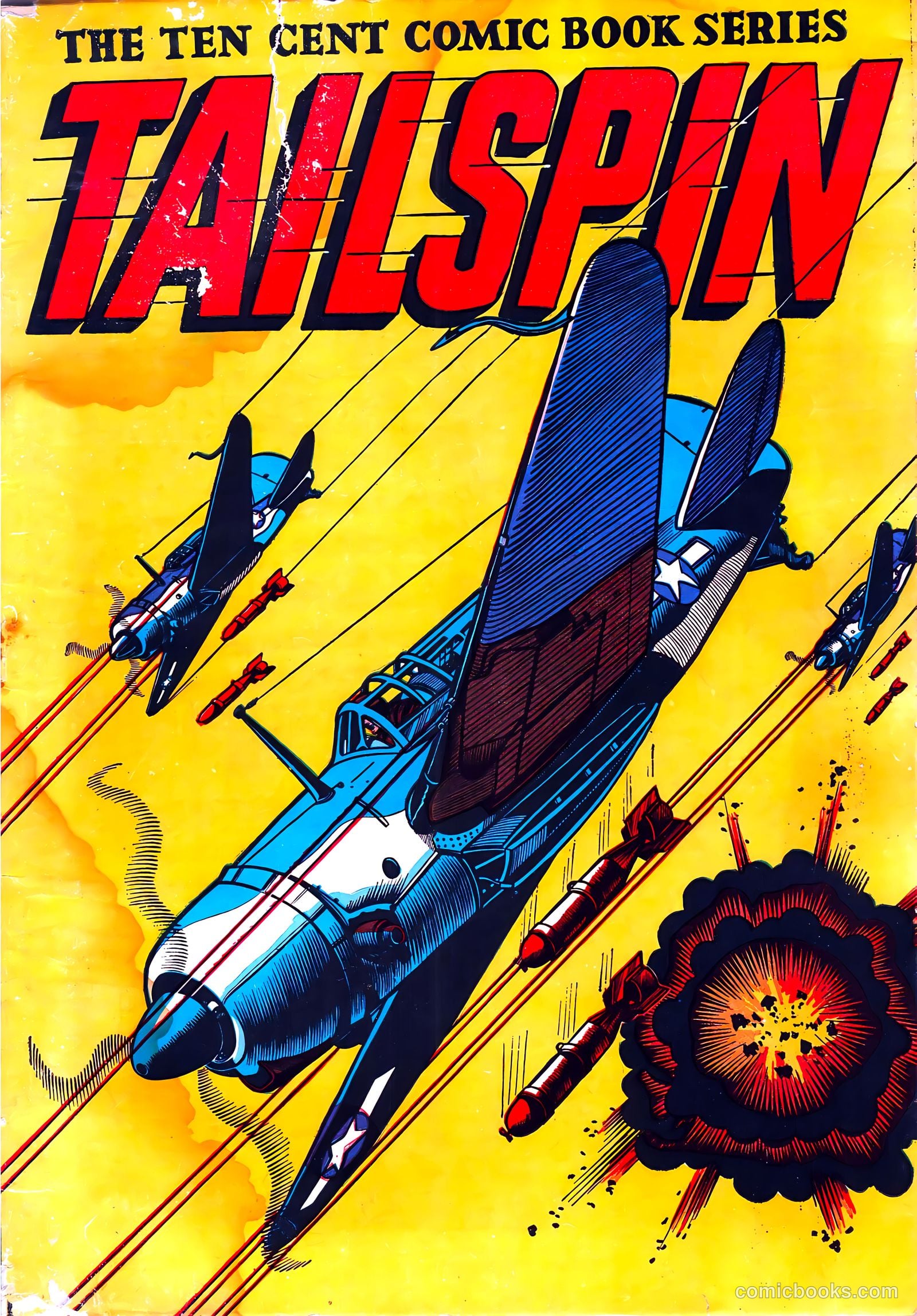
Tailspin Comics #1
☆ Be the first to review + Add to your collection — Join freeIn "Part Indian, Part Irish, 100% American," Firebird takes to the skies to stop a mysterious Messerschmitt terrorizing Allied forces, only to face a surprising foe: The Valkyrie, a woman determined to reshape the war's outcome from the cockpit. With bold art by L. B. Cole, this 1944 tale blends wartime drama and aerial combat in a story that underscores loyalty, identity, and the cost of war.
Second Lieutenant Ernest Childers, a 26-year-old Creek Indian from Oklahoma and a crack marksman since childhood, finds himself facing a critical moment when his battalion comes under heavy Nazi fire during the Italian campaign in 1944. Despite a fractured foot sustained in combat, Childers leads a small team directly toward the German machine gun nest pinning down his men, determined to turn the tide of battle. This is the true story of how a soldier of mixed Creek and Irish heritage rose to extraordinary heroism under fire.
Frank Luke, the fearless young aviator of the 27th Squadron, partners with fellow pilot Joe Wehner to pioneer a dangerous new tactic: diving on enemy observation balloons while under heavy ground fire, with his wingman covering from above. This true story from 1944 chronicles how Luke's nerve, skill, and partnership transformed him into one of America's most decorated pilots—a natural-born flyer whose reputation grew with each daring mission over the Western Front.
In a wartime sky torn by conflict, Firebird faces off against the enigmatic Valkyrie, a formidable foe piloting a custom Messerschmitt with a chilling mission: to prove that German women are just as capable in the air as their male counterparts. As the battle rages above the front lines, Firebird must confront not only a skilled pilot but the dangerous ideology she represents.
Gen. Claire L. Chennault trades his teaching career for the skies, eventually answering a call from China to build an air force capable of standing against a numerically superior Japanese enemy during World War II. Drawing on years of tactical innovation and combat experience, Chennault trains a small group of volunteer pilots—the legendary Flying Tigers—who rack up stunning kill counts over China and Burma despite impossible odds. This is the remarkable true story of how one officer's unconventional vision and determination shifted the balance of air power in the Far East.
The unsung aircraft mechanics of the Army Air Forces—the "grease monkeys"—are the backbone of military aviation, trained rigorously to inspect, repair, and maintain every plane in the fleet. From routine pre-flight checks and oil changes to complex engine overhauls and battle-damage repairs, these ground crews work with precision and pride, knowing that a single missed detail could ground a ship or cost lives. This 1944 account follows the daily operations of these trouble shooters both stateside and in active war zones, showcasing the vital expertise and courage that keeps our bombers flying.
When American aviators began perishing at sea during wartime, former Governor Gifford Pinchot of Pennsylvania set out to prove that the ocean itself could sustain marooned flyers. After weeks of research demonstrating that fish could provide both fresh water and nourishment, Pinchot's revolutionary survival method was tested and endorsed by the Navy—leading to emergency fishing kits installed across all U.S. rafts and lifeboats. This 1944 account follows three downed pilots adrift in the South Pacific as they put the governor's ingenuity to the test, learning to catch and prepare fish to sustain themselves until rescue.
This non-fiction account traces three decades of U.S. Naval Aviation from its uncertain beginnings in 1908—when the Navy first observed the Wright Brothers—through the bold early flights that proved planes could operate from ships, and into its explosive role in the Pacific War following Pearl Harbor. The story chronicles how visionary officers like Captain Chambers championed aviation against skepticism, how pilots like Eugene Ely demonstrated the feasibility of carrier operations, and how the service evolved from a handful of experimental aircraft into a formidable force now operating thousands of planes across combat, transport, and support missions in 1944.
ComicBooks.com Value
Find on ebay
Read it digitally
Sell my copy
Have this issue — or a whole collection? Get a fair offer from us, skip the marketplace fees and the hassle.
We Buy Collections ▸Full credits
Reprints
↩ Reprints Captain Aero Comics #2 [16] (1944)
Reviews
Reader reviews
No reader reviews yet.