
Strange Tales #102
☆ Be the first to review + Add to your collection — Join freeStrange Tales #102 marks the debut of Bentley Wittman, the Wizard — a tech-genius and escape artist whose envy of Johnny Storm's celebrity sets him on a path of supervillainy that would ripple through decades of Marvel storytelling. Though introduced here as a Human Torch antagonist, the Wizard would go on to found the Frightful Four, the Fantastic Four's most persistent criminal mirror-image, making this issue the quiet origin point of one of the Silver Age's most durable villain teams. The issue also represents the second installment of Strange Tales' newly launched superhero format, part of Stan Lee's early-1960s strategy of using the anthology title as a solo proving ground for Fantastic Four characters — a template that would later yield Doctor Strange and Nick Fury. In that sense, #102 is both a character-creation milestone and a small structural brick in the editorial architecture of the Marvel Universe.
Find on ebay
Read it digitally
Sell my copy
Have this issue — or a whole collection? Get a fair offer from us, skip the marketplace fees and the hassle.
We Buy Collections ▸History
Strange Tales had pivoted from its Atlas-era horror/sci-fi anthology format to superhero storytelling beginning with #101 (October 1962), built around the Human Torch as the title's headlining act. Issue #102 was produced under the division-of-labor system common at early Marvel: Stan Lee supplied the plot, his brother Larry Lieber scripted the dialogue, Jack Kirby provided pencils for the cover and lead story, and Dick Ayers handled inks — the same core team that had just launched the Human Torch serial one month prior. The backup features showcased the anthology's transition-era hybrid nature, pairing a Gene Colan science-fiction short with a pointed anti-nuclear Steve Ditko strip, reflecting the Cold War anxieties present throughout Marvel's 1962 output. Letterer credits in the Marvel Essentials reprint were later found to be in error — research by comics historians Nick Caputo and James MacKay established that the correct letterer on the lead story was D'Agostino, not Artie Simek as originally listed.
Trivia · 8 facts
- First appearance and origin of the Wizard (Bentley Wittman), a child prodigy, chess champion, escape artist, and tech-genius who becomes a professional criminal after growing bored with fame and fixating on the Human Torch as a rival.
- The lead story, 'Prisoner of the Wizard!' (13 pages, split into two parts), was plotted by Stan Lee, scripted by Larry Lieber, penciled by Jack Kirby, and inked by Dick Ayers — the same creative team as Strange Tales #101.
- The Wizard's scheme involves impersonating the Human Torch using a technological flame-suit to frame Johnny Storm for crimes, a conceit that anticipates Reed Richards building a similar device for Johnny in Fantastic Four #39 (1965) after the team loses its powers.
- The Invisible Girl (Sue Storm) assists the Torch in clearing his name and capturing the Wizard, making her a supporting player in what is otherwise a solo Human Torch anthology.
- The issue's backup features include a Gene Colan science-fiction strip ('The Secret of the Hidden Planet!') and a Stan Lee/Steve Ditko story ('Who Needs You?') centered on a military robot nearly triggering a nuclear war — an unusually pointed Cold War parable for 1962.
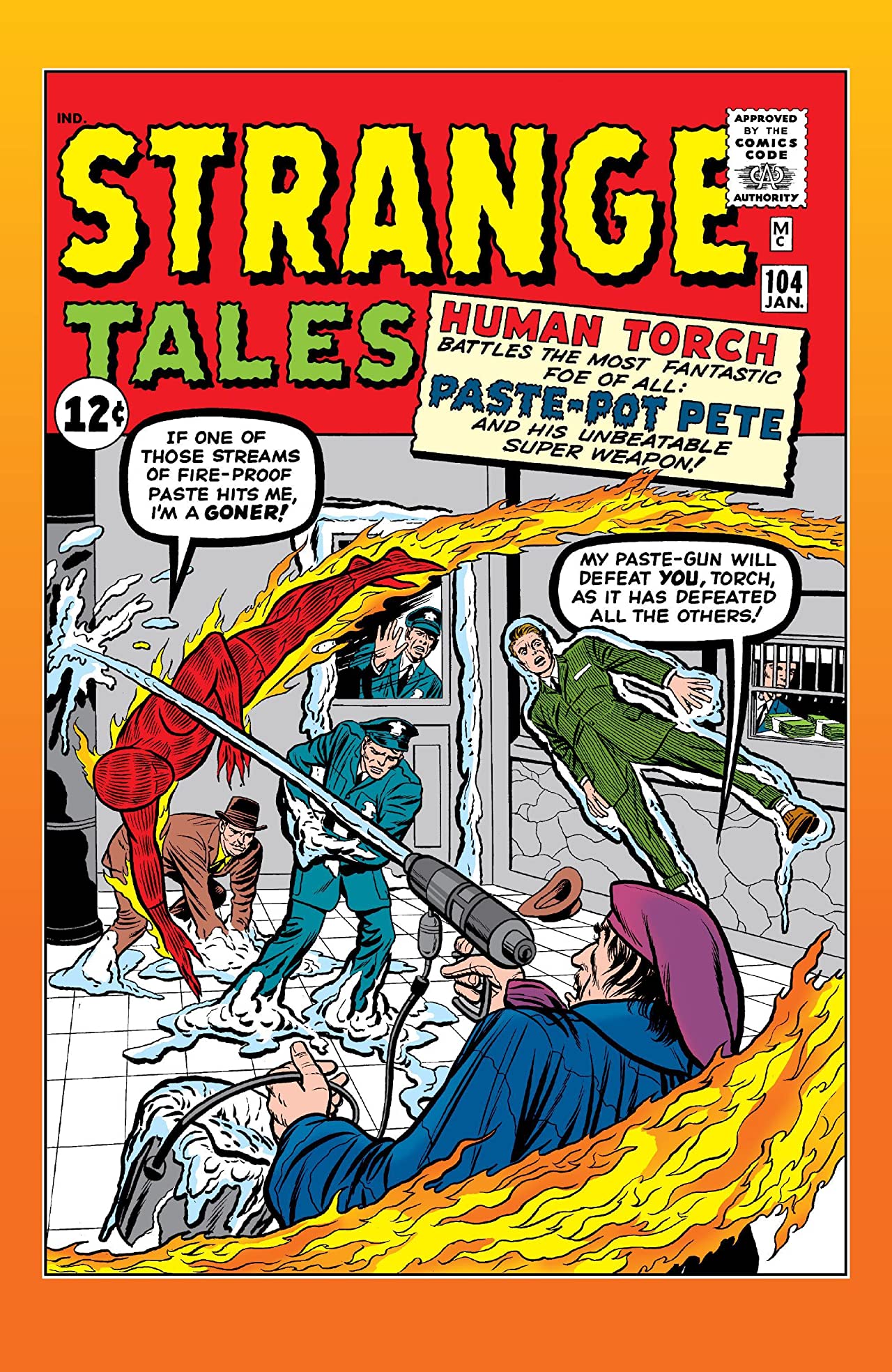
- The Wizard introduced here would go on to organize the Frightful Four alongside the Sandman, Paste-Pot Pete (later the Trapster), and Medusa — a team conceived as a criminal counterpart to the Fantastic Four and one of the FF's most recurring adversaries.
- The issue pre-dates the Wizard's better-known appearances in the Fantastic Four title proper (beginning with Fantastic Four #36, 1965), establishing this Strange Tales installment as the true point of origin for the character.
- The lead story has been reprinted in Essential Human Torch Vol. 1 (2003, black and white), Marvel Masterworks: The Human Torch Vol. 1 (2006 and 2014), and The Human Torch & The Thing: Strange Tales — The Complete Collection (2018).
Key issues in Strange Tales
Reviews
Reader reviews
No reader reviews yet.