
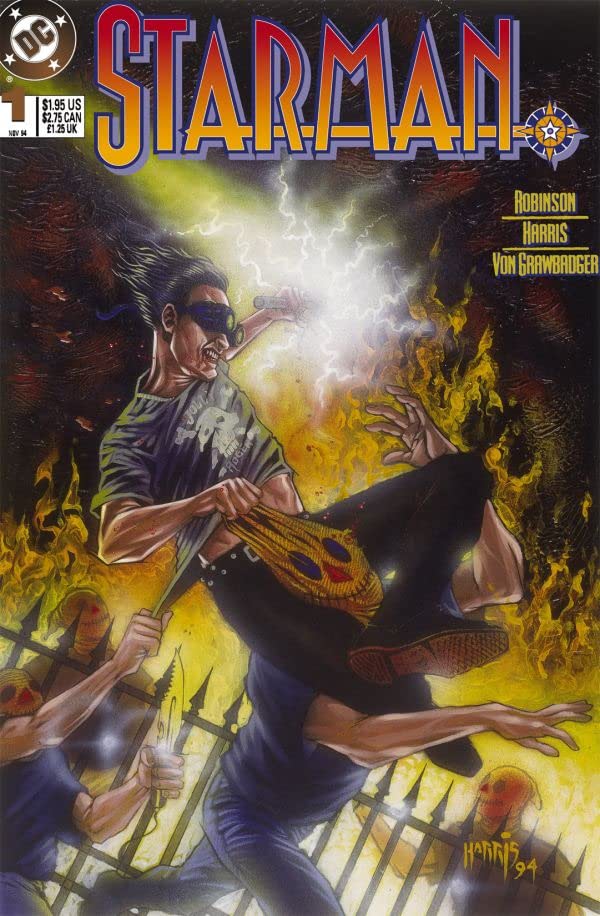
Starman #1
☆ Be the first to review + Add to your collection — Join freeStarman #1 (1994) is the second chapter of the foundational 'Sins of the Father' arc that introduced a new model for legacy superhero storytelling at DC — one built on continuity reverence, character depth, and thematic restraint rather than the bombast dominating 1990s comics. The issue formally debuts the O'Dare family as recurring allies, plants the Shade as an ambiguous, morally complex presence, and deepens the central tension of a reluctant antiques dealer forced into heroism, establishing the emotional and architectural blueprint that the series would develop for 81 issues. Robinson and Harris demonstrated that a low-powered, non-costumed protagonist rooted in Golden Age mythology could sustain a critically acclaimed run, a lesson that directly influenced the JSA revival and a generation of legacy-focused DC books. The series' insistence on treating Opal City as a fully imagined place — with its own history, police force, and social fabric — set a standard for world-building in mainstream superhero comics that remains influential.
ComicBooks.com Value
This exact issue on ebay
More listings for this title
Read it digitally
Sell my copy
Have this issue — or a whole collection? Get a fair offer from us, skip the marketplace fees and the hassle.
We Buy Collections ▸History
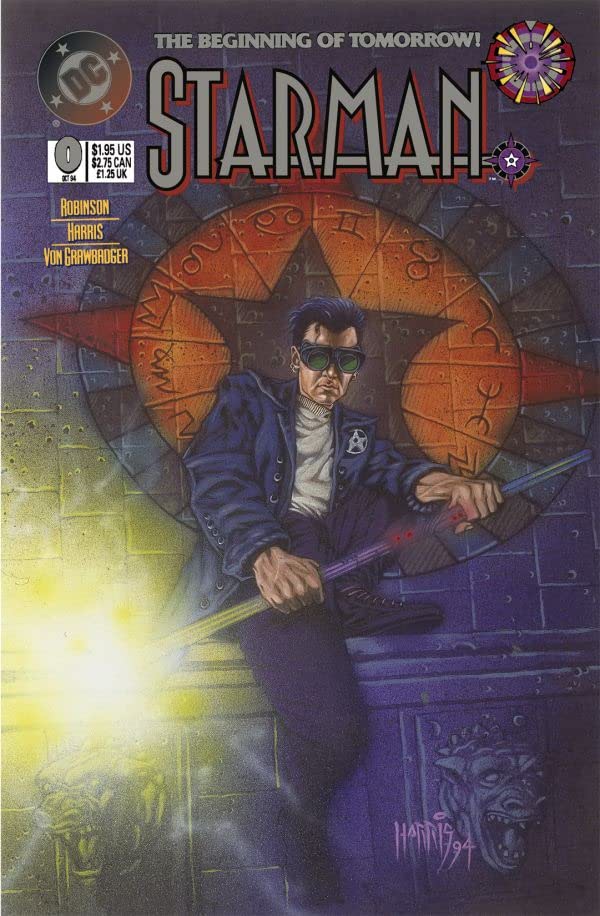
The series grew directly out of DC's Zero Hour crossover event (September 1994), where writer James Robinson and artist Tony Harris first unveiled Jack Knight in Zero Hour: Crisis in Time #1. Robinson, a British writer with a deep passion for Golden Age DC characters and collectibles culture, channeled his own obsessions directly into the protagonist — a quality noted in the series' own collected-edition introductions, where Jack is described as a dual author avatar for both Robinson and Harris. The book launched with a #0 issue in August 1994 as part of DC's line-wide Zero Hour tie-in initiative, with #1 following in September 1994; Wade von Grawbadger served as inker and Gregory Wright as colorist throughout the early run, with John Workman handling letters.
Trivia · 8 facts
- Written by James Robinson with art by Tony Harris (pencils), Wade von Grawbadger (inks), and Gregory Wright (colors); released September 20, 1994.
- Part 2 of the four-part 'Sins of the Father' arc; directly follows the events of Starman #0, in which David Knight (the new Starman) was fatally shot by Kyle, the son of Ted Knight's Golden Age arch-enemy the Mist.
- First appearance of the O'Dare family — including Hope, Mason, Matt, and Barry O'Dare — as an ensemble; the siblings are introduced when Jack meets them at the hospital after David's murder, establishing them as Opal City police officers with a generational loyalty to Ted Knight.
- The Shade (Richard Swift), a pre-existing Golden Age villain, appears here in his new role as an ambiguous Opal City guardian — protecting the museum during the 'Night of Fire' crime wave — beginning his transformation from villain to antihero that defines the entire run.
- The Mist, Ted Knight's original Golden Age nemesis, appears by telephone in this issue to taunt the grieving Ted Knight and claim credit for both David's death and the citywide riot, establishing himself as the architect of the 'Sins of the Father' conflict.
- Kyle — the Mist's son and David Knight's killer — wields the stolen Cosmic Converter Belt and leads the criminal rampage across Opal City in this issue, serving as the immediate physical antagonist.
- Jack Knight's reluctant assumption of the Gravity Rod is dramatized here: he picks it up not out of heroic ambition but to defend his mother's memory when the Mist's gang destroys the Adele Knight wing of the Opal County Museum.
- The issue is reprinted in the trade paperback Starman: Sins of the Father and in Starman Omnibus Vol. 1 (DC, 2008), making it widely accessible in collected form.
Cast · 10 characters
Full credits
Reprints
Reprinted in Starman #[1] (1996), The Starman Omnibus #1 (2008), The Starman Omnibus #1 (2012)
Key issues in Starman
Variants (1)
Reviews
Reader reviews
No reader reviews yet.