
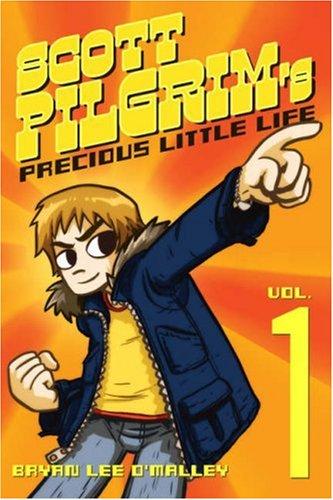
Scott Pilgrim #1
☆ Be the first to review + Add to your collection — Join freeScott Pilgrim #1 — subtitled 'Scott Pilgrim's Precious Little Life' — introduced one of the most formally adventurous voices in early-2000s North American indie comics: a digest-sized, black-and-white graphic novel that blended shōnen manga page architecture with indie-rock Toronto slice-of-life, establishing a then-rare hybrid vocabulary for the medium. The volume's third-act reveal — that the story's ordinary-seeming world operates on video-game logic, complete with coin drops and supernatural brawls — was a genuine structural surprise that recontextualized everything preceding it, a narrative trick that has influenced how genre subversion is deployed in graphic storytelling ever since. It marked the debut of Scott Pilgrim himself, as well as Ramona Flowers, Wallace Wells, Knives Chau, Sex Bob-omb, and the broader Toronto ensemble whose relationships would unfold across six volumes and eventually spawn a film, a video game, and an animated series. The series that launched here went on to win an Eisner Award, two Harvey Awards, a Doug Wright Award, and a Joe Shuster Award, while the first volume directly earned O'Malley the 2005 Doug Wright Award for Best Emerging Talent and three Harvey nominations.
In "1 Dating A High Schooler," Scott Pilgrim finds himself in a whirlwind romance with Jo, a high school student who’s way younger than him. When he brings her to meet the members of his band, Sex Bob-Omb, the mix of teenage awkwardness and rock-star energy sets off a series of chaotic, hilarious moments.
In "4 Ramona Come Closer," Scott’s hopes for a smooth date with Ramona hit a wall when both Knives and Ramona show up at his band’s gig. As the music starts, Scott is suddenly confronted by Matthew Patel, who demands a fight—only for Ramona to reveal the real twist: Scott must battle all seven of her exes, one after another.
ComicBooks.com Value
Find on ebay
Where to buy
Read it digitally
Sell my copy
Have this issue — or a whole collection? Get a fair offer from us, skip the marketplace fees and the hassle.
We Buy Collections ▸History
Bryan Lee O'Malley began developing the story in 2002, shortly after a personal breakup, while living in Toronto with a gay roommate whose personality and shared bus-riding conversations became the seed for the character Wallace Wells. The project grew out of O'Malley's desire to write a shōnen-style series — his primary manga reference at the time was Rumiko Takahashi's Ranma ½ — while channeling the Canadian indie-rock scene he loved, including the Plumtree song 'Scott Pilgrim' that gave the protagonist his name. O'Malley had already established a working relationship with Portland-based Oni Press through illustration and lettering work, and his first original OGN Lost at Sea (2003) laid the stylistic groundwork; Oni then pushed him to expand what he originally conceived as a single-volume story with one rival ex into a multi-volume series structured around 'levels and bosses,' which led to the seven-evil-exes framework. The series was formatted as a digest-sized, black-and-white original graphic novel — a format O'Malley deliberately chose both for its affordability of production and to embrace the manga aesthetic — released in August 2004.
Trivia · 8 facts
- First appearance of Scott Pilgrim, a 23-year-old Toronto slacker and bassist for the band Sex Bob-omb, alongside first appearances of Ramona Flowers, Wallace Wells, Knives Chau, Stephen Stills, Kim Pine, and antagonist Matthew Patel (Ramona's first evil ex).
- Written and drawn entirely by Canadian cartoonist Bryan Lee O'Malley; published by Oni Press in August 2004 as a 168-page, digest-sized (approximately 5" × 7.5"), black-and-white original graphic novel — the shortest volume in the series.
- The volume's title is 'Scott Pilgrim's Precious Little Life'; its Diamond order code was MAY04 2851 and its ISBN is 978-1-932664-08-9.
- O'Malley began developing the story in 2002, drawing on his own life in Toronto — his gay roommate, his band, and a personal breakup — and named the protagonist after a 1998 Plumtree song he had loved since hearing it on campus radio.
- Oni Press encouraged O'Malley to expand beyond his original single-volume concept; the seven-evil-exes structure was explicitly inspired by Dragon Ball's boss-level format and classic video games such as River City Ransom.
- The first volume earned O'Malley the 2005 Doug Wright Award for Best Emerging Talent and received three Harvey Award nominations (Best New Talent, Best Cartoonist, and Best Graphic Album of Original Work).
- The volume was reprinted multiple times; a full-color hardcover edition (colored by Nathan Fairbairn) was released in August 2012, followed by inclusion in the Scott Pilgrim Color Collection omnibus paperbacks (2019) and a 20th Anniversary hardcover box set (2024).
- The series launched here was later adapted into a 2010 Universal Pictures film directed by Edgar Wright, a Ubisoft beat-'em-up video game, and a 2023 Netflix anime series (Scott Pilgrim Takes Off) written by O'Malley with Science Saru providing animation.
Cast · 1 character
Full credits
Reprints
Reprinted in The Year's Best Graphic Novels, Comics, and Manga #[nn] (2005), Scott Pilgrim #1 (2010), Scott Pilgrim #1 (2010), Scott Pilgrim #1 (2010), Скот Пилгрим #1 (2011), Scott Pilgrim #1 (2012)
Reviews
Reader reviews
No reader reviews yet.