
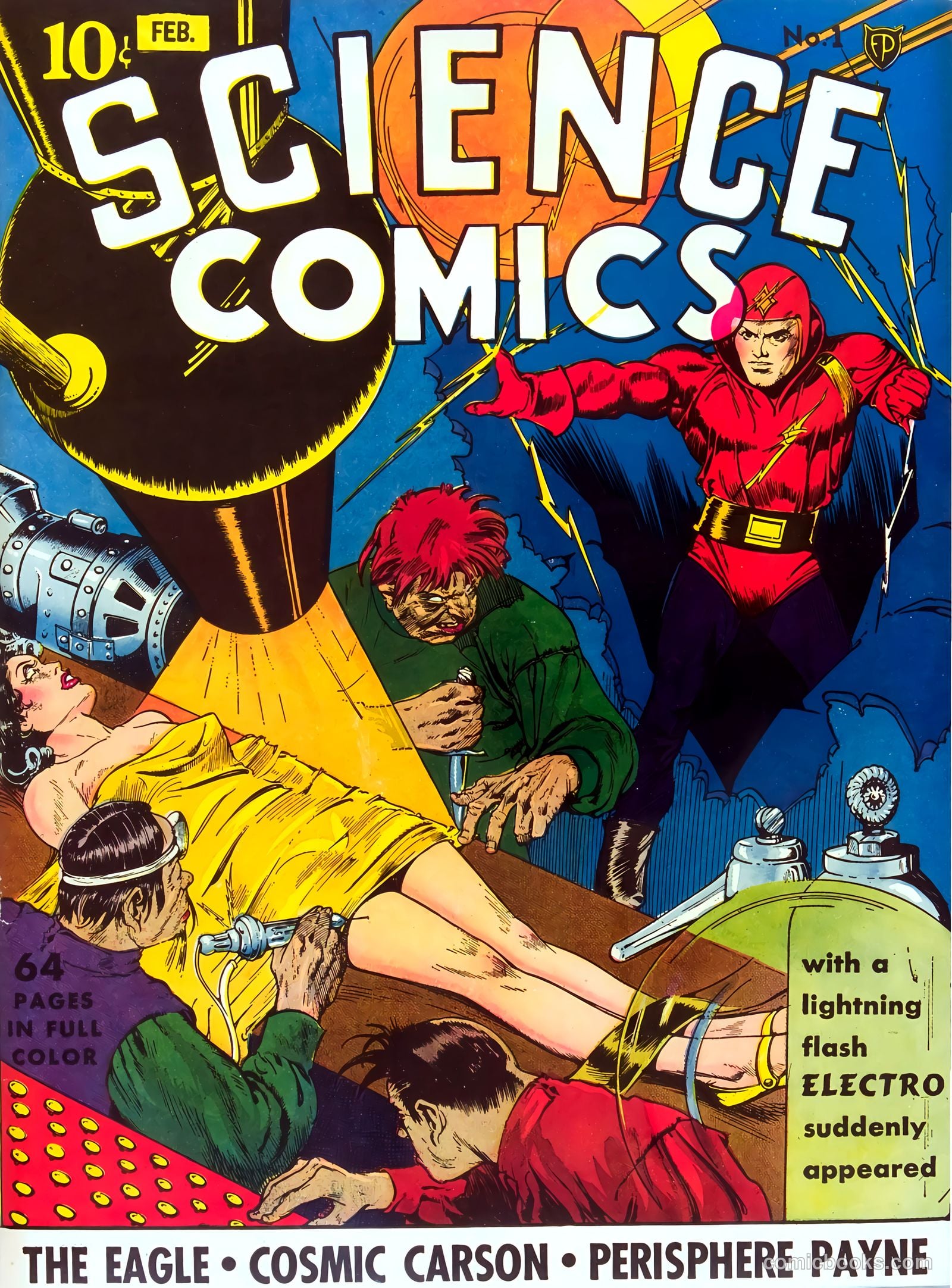
Science Comics #1
☆ Be the first to review + Add to your collection — Join freeScience Comics #1 (Fox Feature Syndicate, February 1940) is a landmark Golden Age anthology that packed an extraordinary number of first appearances into a single issue: the Eagle, Electro (who would be renamed Dynamo in the very next issue), Marga the Panther Woman, Cosmic Carson, Perisphere Payne, Navy Jones, and — notably — a super-villain named Dr. Doom, predating Marvel's iconic villain of the same name by more than two decades. The issue represents Fox's bid to rival Fiction House's Planet Comics with its own science-themed superhero anthology, and its blend of superpowered adventurers with pulp space-opera reflected a defining moment when the boundaries between science fiction and the emerging superhero genre were still fluid and actively contested. The cover by Lou Fine — widely regarded by his peers as one of the finest draftsmen of the Golden Age — is among the most visually striking of its era, and the series as a whole stands as a testament to how rapidly and ambitiously smaller publishers were building shared superhero universes in the immediate wake of Superman's debut.
An anthology featuring multiple science-fiction stories, including "The Eagle," in which a red-caped hero named Electro uses electromagnetic powers to stop a villain's plot to control America's major dams; "The Panther Woman" by James Royal, where mad physiologist Von Dorf transforms a blonde nurse into a savage black-haired beauty through an electrical generator in the African jungle, leading to her eventual capture by a giant amoeba; and "Cosmic Carson" and "Perisphere Payne," among other tales of scientific adventure and menace.
ComicBooks.com Value
Show all 16 grades ▾
Find on ebay
Read it digitally
Sell my copy
Have this issue — or a whole collection? Get a fair offer from us, skip the marketplace fees and the hassle.
We Buy Collections ▸History
Fox Feature Syndicate, founded by entrepreneur Victor S. Fox and launched out of 480 Lexington Avenue in New York City, obtained the content for its early titles through the Eisner & Iger studio — a comics-packaging shop whose roster included Lou Fine, Dick Briefer, George Tuska, Bert Whitman, and Emil Gershwin, all of whom contributed to Science Comics #1. The title was consciously modeled after Fiction House's Planet Comics, mimicking its anthology format of running characters, pulp-inflected space adventure, and eye-catching covers by Lou Fine. After the Wonder Man copyright lawsuit brought by DC, Fox parted ways with Eisner & Iger and brought on Joe Simon as editor; Simon immediately began steering the book away from its original science-fiction format toward a more conventional superhero template — a shift that accelerated the title's drift from its founding concept before the series concluded with issue #8 in September 1940.
Trivia · 8 facts
- First appearance and origin of The Eagle (Bill Powers), a scientist who discovers an anti-gravitation fluid granting him the power of flight via specially designed wings.
- First appearance and origin of Electro (Jim Andrews), an electric-powered hero who is renamed Dynamo beginning with Science Comics #2 — the name change was likely made to avoid confusion with an earlier Timely Comics character of the same name.
- First appearance and origin of Marga the Panther Woman, raised by black panthers and possessing cat-like abilities including claws; she leaves the jungle to adventure alongside her pilot boyfriend Ted Grant (unrelated to DC's Wildcat).
- First appearance of Cosmic Carson, Perisphere Payne, and Navy Jones, all debuting in this single issue alongside their origin stories.
- First appearance of a super-villain named Dr. Doom — an evil super-scientist — more than twenty years before Marvel's Doctor Doom debuted in Fantastic Four #5 (1962).
- Cover art by Lou Fine, whose draftsmanship was admired by contemporaries including Joe Simon and Jack Kirby; the cover features a bondage and hypodermic-needle motif that was a hallmark of Golden Age cover sensationalism.
- Interior art credits include George Tuska, Emil Gershwin, and Bert Whitman, all working through the Eisner & Iger packaging studio; stories were scripted by Rodney Weems and Bert Whitman.
- The series ran for only 8 issues (February–September 1940) and was published at the standard Golden Age cover price of ten cents, with 64 pages in full color.
Full credits
Reprints
Reprinted in The Complete Jack Kirby #1 (1997), Action! Mystery! Thrills! Comic Book Covers of the Golden Age: 1933-45 #[nn] (2011)
Key issues in Science Comics
Reviews
Reader reviews
No reader reviews yet.