
Rangers Comics #26
☆ Be the first to review + Add to your collection — Join freeRangers Comics #26 sits at an important juncture in Fiction House's Golden Age run, carrying both the publisher's distinctive wartime anthology format and a pivotal chapter in the Firehair serial — one of the Golden Age's most durable Western heroines. The issue introduces Liz Sullivan, a female villain whose scheme to dispossess the Dakota people sharpens the moral stakes of the Firehair feature and demonstrates Fiction House's willingness to put complex antagonists, including women on both sides of the conflict, at the center of its Western storytelling. Joe Doolin's WWII-era 'good girl' cover is widely cited by Golden Age cover enthusiasts as a standout example of his work for the publisher, placing the issue within a broader tradition that Fiction House cultivated more deliberately than almost any of its contemporaries. The Firehair story from this issue proved durable enough to be recycled into Firehair Comics #2 (Winter 1949–50), confirming its narrative weight within the character's long-running continuity.
ComicBooks.com Value
Show all 21 grades ▾
Find on ebay
Read it digitally
Sell my copy
Have this issue — or a whole collection? Get a fair offer from us, skip the marketplace fees and the hassle.
We Buy Collections ▸History
Rangers Comics launched as Rangers of Freedom Comics, an early Fiction House superhero title built around a costumed team battling a Nazi supervillain called Super-Brain. America's entry into World War II prompted the publisher to retool the series into a war anthology, and beginning around issue #5, the book wove the aftermath of the Pearl Harbor attack directly into its ongoing story framework. By 1945, under editor Jean M. Press, the title was a multi-feature anthology balancing Pacific-theater war strips against a growing Western component anchored by Firehair — a character created by the pseudonymous writer 'John Starr' and artist Lee Elias, who had debuted in issue #21 just earlier that same year. The 'John Starr' byline is a confirmed house pseudonym; the actual writer's identity has never been established.
Trivia · 8 facts
- Published by Fiction House, cover-dated November/December 1945, as part of a series that ran 65 issues from 1941 to 1952.
- Cover painted by Joe Doolin, depicting a WWII-era 'good girl' scene widely regarded by collectors and historians as one of the strongest examples of his cover work on the Rangers title.
- Interior art contributed by Howard Larsen, Lily Renee, and Lee Elias — a roster that reflects Fiction House's notable employment of women artists, with Lily Renee being one of the more prominent female comic artists of the Golden Age.
- The Firehair story in this issue features the introductory appearance of villain Liz Sullivan, whose plot to drive the Dakota off their land serves as the story's central conflict.
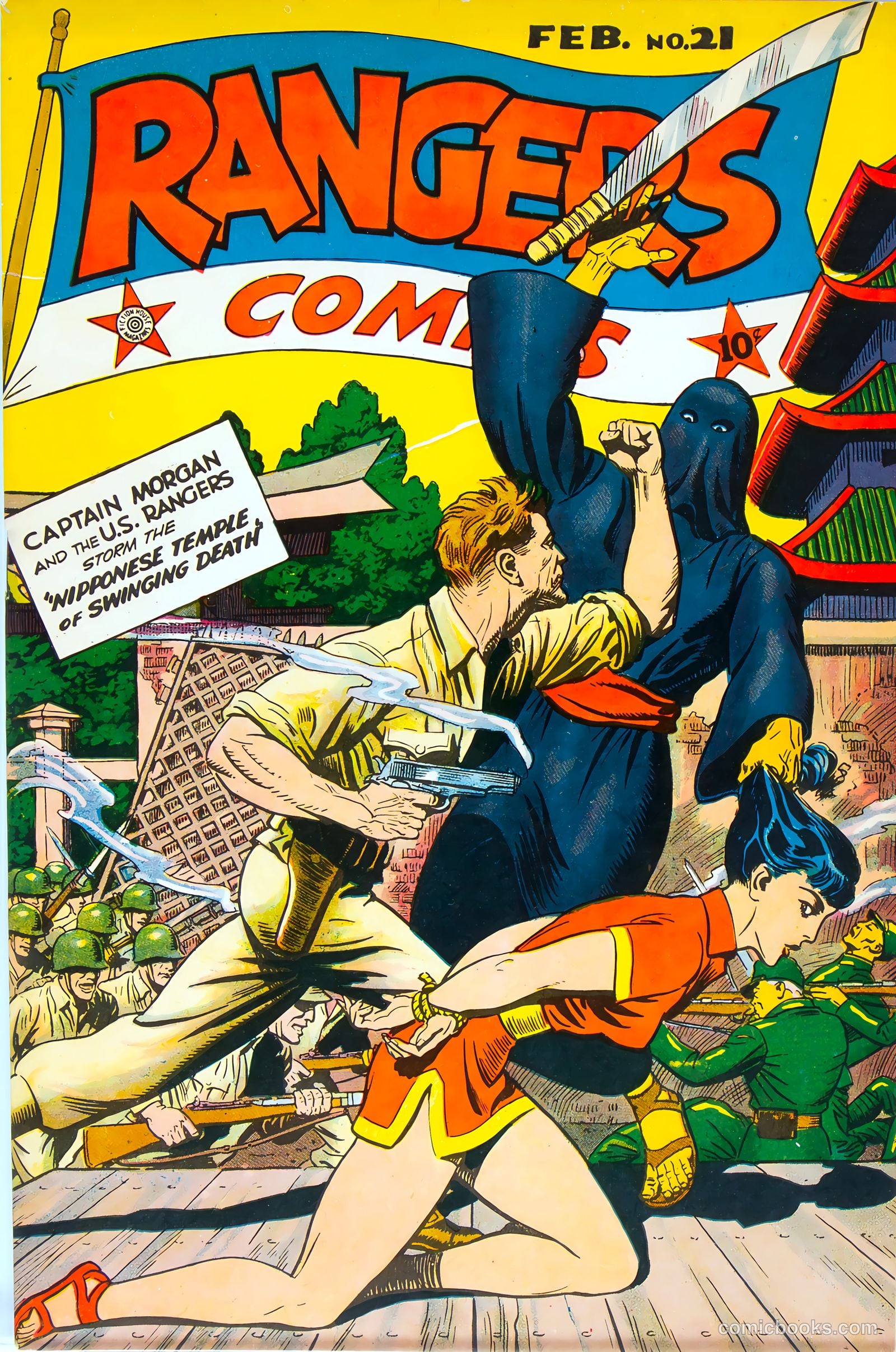
- Firehair (alter ego Lynn Cabot), the Western heroine created by 'John Starr' (a house pseudonym) and Lee Elias, had debuted in Rangers Comics #21 earlier in 1945 and appeared in every issue of the series through #65 (May 1952).
- The Firehair chapter from this issue was later reprinted in Firehair Comics #2 (Winter 1949–50), where it was combined with origin recap artwork drawn from Rangers Comics #21–23.
- The issue also contains a Pacific-theater war story in which the U.S. Rangers attempt to destroy an enemy gunship using a Chinese junk — typical of the series' grounded, WWII-contemporary storytelling.
- The series originally ran as Rangers of Freedom Comics and transitioned from a superhero format into a war-and-Western anthology following the United States' entry into World War II, with the editorial pivot beginning around issue #5.
Full credits
Reprints
↩ Reprints Kazanda the Wild Girl and the Lost Continent #[nn] (1942)
Reprinted in Firehair Comics #2 (1949), Firehair #2 (2025)
Key issues in Rangers Comics
Reviews
Reader reviews
No reader reviews yet.