
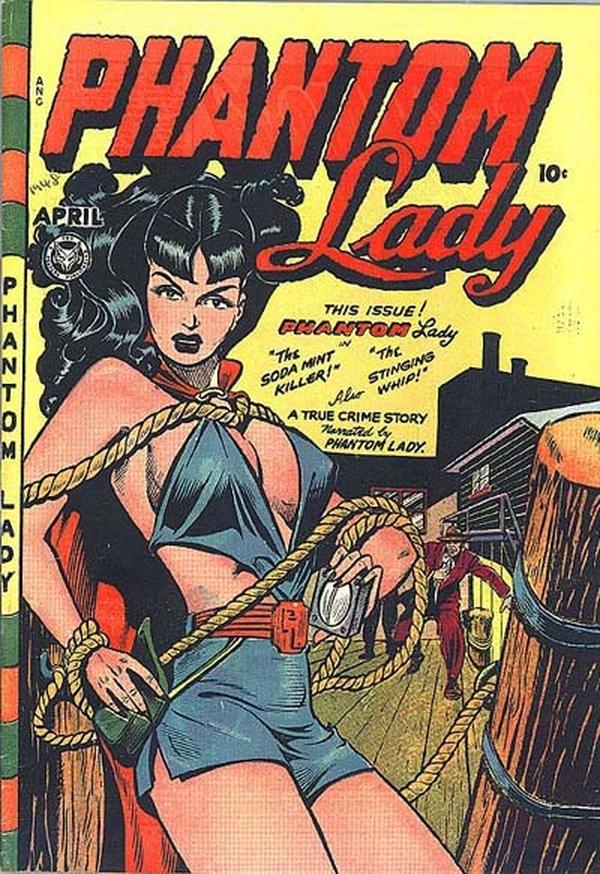
Phantom Lady #17
☆ Be the first to review + Add to your collection — Join freePhantom Lady #17 stands as the single most discussed artifact of the Golden Age 'Good Girl Art' movement, carrying historical weight that extends well beyond its 36 pages. When psychiatrist Fredric Wertham reproduced Matt Baker's cover in his 1954 polemic Seduction of the Innocent — captioning it as a sadomasochistic provocation — he inadvertently cemented the issue's place in comics history and handed future collectors an instant touchstone for the entire censorship controversy that reshaped the industry. The cover depicting Sandra Knight bound and straining against ropes became Exhibit A in the national debate that led directly to the creation of the Comics Code Authority, making this single issue a pivotal document in understanding how external moral pressure permanently altered what American comics were permitted to show. Beyond its role in that culture war, the issue is a showcase for Baker at the peak of his draftsmanship, and its notoriety helped focus long-overdue attention on its artist as one of the first known African-American creators to achieve sustained prominence in the comics industry.
In "The Soda Mint Killer!", Phantom Lady faces a deadly new threat at the Grand Fairgrounds Track, where a mysterious killer strikes during a high-stakes horse race. With Don’s jockey dead and the track under suspicion, Sandra must take the reins—riding Sugar Girl in a race that could cost her life. Written by Gregory Page and illustrated by Matt Baker and Jack Kamen, with cover art by Matt Baker, this 1948 Fox classic blends suspense and speed in a story that’s as sharp as its 10-cent cover price.
In "The Soda Mint Killer!" from Phantom Lady #17 (1948), Sandra must confront a ruthless protection racket that turns deadly when a friend refuses to pay up—leading the Phantom Lady to step in and strike at the heart of the criminal operation. With her signature blend of stealth and determination, she dives into a web of intimidation and violence, determined to bring justice to a city that’s lost its safety.
ComicBooks.com Value
Show all 21 grades ▾
This exact issue on ebay
CGC 2.5 ▾ $18,755–$20,000 2 listings
Raw / ungraded ▾ $99.99–$300 3 listings
Read it digitally
Sell my copy
Have this issue — or a whole collection? Get a fair offer from us, skip the marketplace fees and the hassle.
We Buy Collections ▸History
Phantom Lady originated in 1941 as a Quality Comics feature produced by the Eisner & Iger studio, where Arthur Peddy drew her modest early adventures. After Quality dropped the feature, Iger Studios — believing it held the rights — reassigned the character to Fox Feature Syndicate, where she debuted in Phantom Lady #13 (August 1947), a title that had simply inherited its numbering from the canceled Wotalife Comics. Victor Fox had aggressively pivoted his entire line toward Good Girl Art around this time, acquiring his own printing plant and paper mill to execute the strategy, and Matt Baker — who had trained at Cooper Union and entered comics through the Iger Studio — redesigned Sandra Knight's costume from a conservative yellow outfit into the revealing red-and-blue ensemble that became her defining look. Writer Ruth Roche scripted the Fox era stories, collaborating with Baker to push the character's postwar crime-thriller tone, and it was that creative partnership, operating inside Fox's commercially calculated gamble, that produced the issue #17 cover that would follow the medium for decades.
Trivia · 8 facts
- Cover date: April 1948; published by Fox Feature Syndicate Inc., edited by Victor Fox.
- Cover and interior art by Matt Baker; written by Ruth Roche; additional interior art by Rudy Palais.
- The issue contains three stories: 'The Soda Mint Killer!', 'The Stinging Whip!', and 'Evelyn Ellis, Queen of Gangsters' — all crime-thriller adventures rather than traditional superhero fare.
- Baker's cover image of Phantom Lady (Sandra Knight) bound to a post was reproduced in Fredric Wertham's Seduction of the Innocent (1954) as a prime example of what Wertham called harmful content, directly fueling the public and congressional pressure that resulted in the Comics Code Authority.
- Matt Baker is recognized as one of the first known African-American artists to build a successful career in the comic-book industry; he was posthumously inducted into the Will Eisner Comic Book Hall of Fame in 2009.
- The Fox Phantom Lady series (issues #13–23) continued the numbering of the defunct Wotalife Comics; there was never a Fox Phantom Lady #1.
- The cover has been reprinted in multiple reference and archival works including The Comic Book in America: An Illustrated History (Taylor Publishing, 1989), Good Girl Art (Hermes Press, 2008), and Roy Thomas Presents Classic Phantom Lady (PS Artbooks, 2013).
- Baker's redesign of Phantom Lady for Fox — dramatically more revealing costume, emphasizing the character's physicality — is the version that all subsequent publishers, including DC Comics when they revived her in Justice League of America #107 (October 1973), have primarily referenced.
Full credits
Reprints
Reprinted in The Comic Book in America: An Illustrated History #[nn] (1989), Phantom Lady #[nn] (1994), Good Girl Art #[nn] (2008), Matt Baker: The Art of Glamour #[nn] (2012), Roy Thomas Presents Classic Phantom Lady Softee #2 (2013), Roy Thomas Presents Classic Phantom Lady #1 (2013), Phantom Lady #17 (2022), Gwandanaland Comics #1366, Phantom Lady #5
Reviews
Reader reviews
No reader reviews yet.