
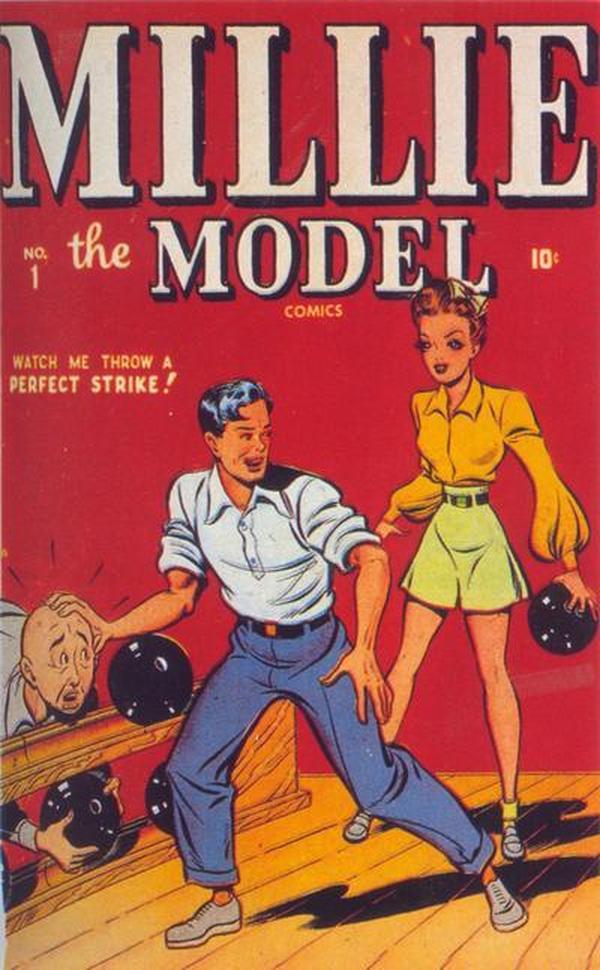
Millie the Model Comics #1
☆ Be the first to review + Add to your collection — Join freeMillie the Model Comics #1 (Winter 1945) launched what would become the single longest-running humor title in Marvel's publishing history, ultimately stretching 207 issues across three company eras — Timely, Atlas, and Marvel proper — over a continuous 28-year span. The debut introduced Millicent "Millie" Collins, a small-town girl who wins a beauty contest and sets off for New York City to break into professional modeling, making her one of comics' earliest and most durable "career girl" protagonists at a moment when postwar culture was actively reconsidering women's independence and workplace ambitions. Created by Ruth Atkinson — one of the pioneering women writer-artists in the American comic book industry — the series demonstrated that a female-led, non-superhero humor book could hold its own commercially alongside Timely's costumed heroes, eventually growing popular enough to take over the covers of several Timely anthology titles and spawn multiple spin-offs. When the series finally concluded in December 1973, its end effectively marked the close of Marvel's entire Golden-Age-rooted romance and humor boom.
In the 1945 pages of *Millie the Model Comics #1*, Millie—fresh off her hometown win in Barberton—sets off to New York City with her friend Marge, chasing dreams in the spotlight of the fashion world. With her charm and a dash of glamour, she steps into a world where style meets ambition, one runway at a time.
ComicBooks.com Value
Show all 16 grades ▾
Find on ebay
Read it digitally
Sell my copy
Have this issue — or a whole collection? Get a fair offer from us, skip the marketplace fees and the hassle.
We Buy Collections ▸History
Ruth Atkinson, already known at Timely for co-creating Patsy Walker, wrote and drew the debut issue in its entirety — the cover was a collaboration between Atkinson and Mike Sekowsky, the staff artist who would handle much of the early interior work after issue #1. The book was published under the Cornell Publishing Corporation indicia and edited by Vincent Fago, who was serving as Timely's editor-in-chief during Stan Lee's wartime military service. Atkinson's concept drew on the tradition of the working-girl comic strip — most directly Russ Westover's long-running newspaper strip Tillie the Toiler — transposing that premise into the more glamorous world of New York fashion modeling. The series passed through several distinct artistic hands over the decades: Mike Sekowsky handled the bulk of the early issues, Dan DeCarlo defined the character's enduring visual identity during a celebrated ten-year run beginning with issue #18, and Stan Lee later took over scripting duties alongside artist Stan Goldberg.
Trivia · 8 facts
- First appearance of Millicent "Millie" Collins, her best friend Marge Gregory, agency head Larry (Howard) Hanover, and photographer Clicker (Flicker) Holbrook — the core supporting cast who would persist across the entire 207-issue run.
- Created, written, and drawn entirely by Ruth Atkinson (June 2, 1918 – June 1, 1997), one of the first female writer-artists in American comic books, who had previously co-created Patsy Walker for Timely Comics.
- The cover was a joint effort by Ruth Atkinson and Mike Sekowsky; Sekowsky went on to handle most of the interior art in the early issues following Atkinson's debut.
- Published with a Winter 1945 cover date under the Cornell Publishing Corporation indicia, with an on-sale date placed in August 1945; Vincent Fago served as editor-in-chief at the time.
- The debut issue contains four stories establishing Millie's origin: she wins a beauty contest in the small town of Barberton, Ohio, then travels to New York City with friend Marge to pursue a modeling career at the Hanover Agency — notably, Millie's hair is colored brown in this first issue rather than the blonde she would become associated with.
- Millie the Model Comics #1 was one of several alliteratively titled Timely "career girl" books launched in the mid-1940s, alongside Nellie the Nurse, Tessie the Typist, and Sherry the Showgirl, representing a deliberate publishing strategy to reach female readers outside the superhero genre.
- The series earned the 1968 Alley Award for Best Romance Comic at the New York Comic Art Convention, a peer-voted industry honor, validating its decades-long dominance of the genre.
- Millie was formally integrated into the Marvel Universe via Fantastic Four Annual #3 (1965), which depicted her as a celebrity guest at the Reed Richards–Susan Storm wedding, and she was later depicted in Alex Ross's Marvels (1994) revisiting the same event.
Full credits
Reviews
Reader reviews
No reader reviews yet.