
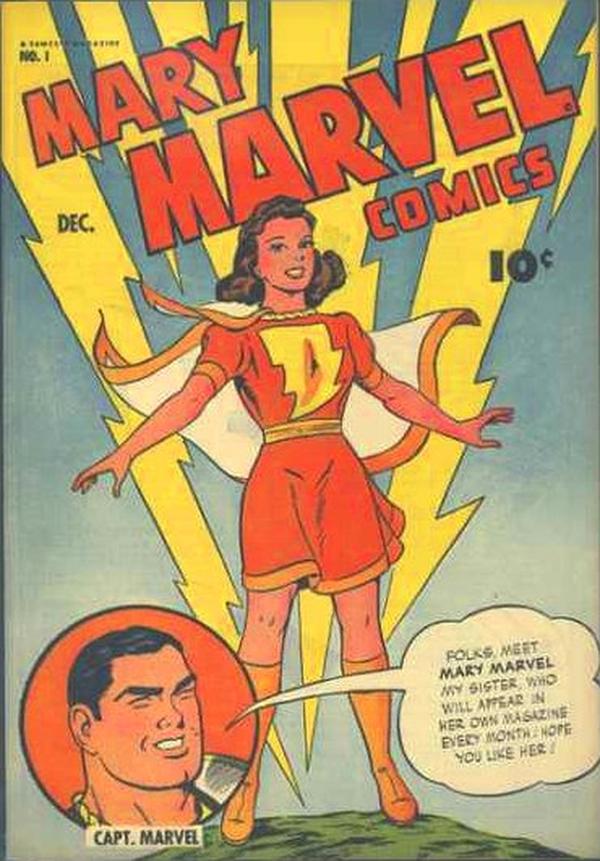
Mary Marvel #1
☆ Be the first to review + Add to your collection — Join freeMary Marvel #1 stands as one of the earliest superhero comics headlined entirely by a female character, launching a solo series for a teenage girl heroine at a time when the medium offered almost no such titles. The issue established Mary Batson as an independent protagonist who fought villains without the aid of Captain Marvel or Captain Marvel Jr., reinforcing the premise that she was a hero in her own right rather than a sidekick. Its debut also introduced Georgia Sivana — Dr. Sivana's daughter and Mary's personal arch-nemesis — giving the title its own distinct rogues' gallery separate from the broader Marvel Family mythology. According to DC's own editorial commentary, Mary Marvel was specifically the first teenage superheroine to anchor her own solo comic, a distinction the character would not repeat until The New Champion of Shazam! in 2022.
When Sivana sees his chance to strike while Captain Marvel and Captain Marvel Jr. are away, he plans to shoot a policeman—sure no one will stop him. But Mary Marvel, the World's Mightiest Girl, arrives just in time to challenge him, proving she’s no stranger to stopping villains.
In a 1945 tale from *Mary Marvel* #1, Georgia Sivana—daughter of the World's Wickest Scientist—arrives on Venus with a surprising offer: help her father achieve his dream of ruling the universe by eliminating Mary Marvel. With the Jack Binder shop's dynamic art bringing the cosmic showdown to life, this short but bold story sets up a clash between hero and villain’s kin, all on a distant world where ambition and rivalry take flight.
In "Trouble for Teacher," Mary Marvel trades her superhero duties for a day to lend a hand at Hog Hollow School—only to find that her real lesson is just beginning. With her powers and quick wit, she steps in as a substitute, turning a chaotic classroom into a moment of unexpected connection.
In "The Growth Epidemic," Mary Marvel—still new to her powers but quick to act—steps in when a sudden, citywide surge in size leaves everyone bewildered and in danger. As Mary grows alongside the others, she tracks down the source and uncovers a scheme by three greedy businessmen poisoning the water supply to exploit the chaos for profit.
ComicBooks.com Value
Show all 22 grades ▾
More listings for this title
- Arcane Comics · Shoreline, WA1 on eBay ↗
- Comic Book Station1 on eBay ↗
- JAF Comics · Bethlehem, PA1 on eBay ↗
- The 616 Comics LLC · Mantua Township, NJ1 on eBay ↗
Read it digitally
Sell my copy
Have this issue — or a whole collection? Get a fair offer from us, skip the marketplace fees and the hassle.
We Buy Collections ▸History
Mary Marvel had been created by writer Otto Binder and artist Marc Swayze for Captain Marvel Adventures #18 (cover-dated December 1942), where her design and personality were reportedly modeled by Swayze on actress Judy Garland. She quickly graduated to headlining a backup strip in Wow Comics before Fawcett editor Mercedes Shull shepherded her into her own standalone title in December 1945, with Otto Binder scripting and his brother Jack Binder handling cover art and interior pencils — an arrangement verified by P.C. Hamerlinck's research published in Alter Ego #147 (July 2017). The solo series ran 28 issues before the title's run ended in 1948, when the broader decline of superhero comics and the DC-Fawcett copyright litigation eventually forced Fawcett to shutter its superhero line entirely by 1953.
Trivia · 8 facts
- Cover-dated December 1945, published by Fawcett Publications Inc.; the indicia title on issue #1 reads 'Mary Marvel Comics,' a branding Fawcett dropped after the second issue.
- Written by Otto Binder (co-creator of Mary Marvel) with cover art and interior art by Jack Binder; edited by Mercedes Shull — the Binder brothers' collaboration on this title was confirmed by researcher P.C. Hamerlinck in Alter Ego #147 (July 2017).
- First appearance and origin of Georgia Sivana — Dr. Thaddeus Sivana's daughter and Mary Marvel's primary personal nemesis — who was created specifically as a female foil for the series.
- The issue contains four stories: 'Mary Marvel the World's Mightiest Girl Meets Sivana,' 'Mary Marvel Meets Sivana's Daughter — Georgia!,' 'Trouble for Teacher,' and 'The Growth Epidemic.'
- The cover depicts Captain Marvel introducing Mary to the reader, with an interior table-of-contents page showing Mary Marvel before the wizard Shazam alongside a scroll listing the goddesses from whom she derives her powers: Selena (grace), Hippolyta (strength), Ariadne (skill), Zephyrus (speed), Aurora (beauty), and Minerva (wisdom) — a distinctly feminine pantheon separate from Billy Batson's male mythological patrons.
- Mary Marvel is portrayed as a teenager who remains in adolescent form when transformed, unlike Billy Batson who becomes an adult as Captain Marvel — a deliberate characterization choice that distinguished her within the Marvel Family.
- The series ran for 28 issues total (December 1945 – September 1948), with annual circulation figures documented at approximately 1.5 million copies in 1946, rising to over 3 million in 1947, then declining to about 2.1 million in 1948.
- The cover of Mary Marvel #1 was later reprinted in The Amazing World of DC Comics #17 (April 1978), bringing the Golden Age issue back to reader attention during DC's stewardship of the Fawcett characters.
Full credits
Reprints
Reprinted in The Amazing World of DC Comics #17 (1978), Great American Comic Books #[nn] (2001), Mary Marvel Fanzine #7 (2007)
Reviews
Reader reviews
No reader reviews yet.