
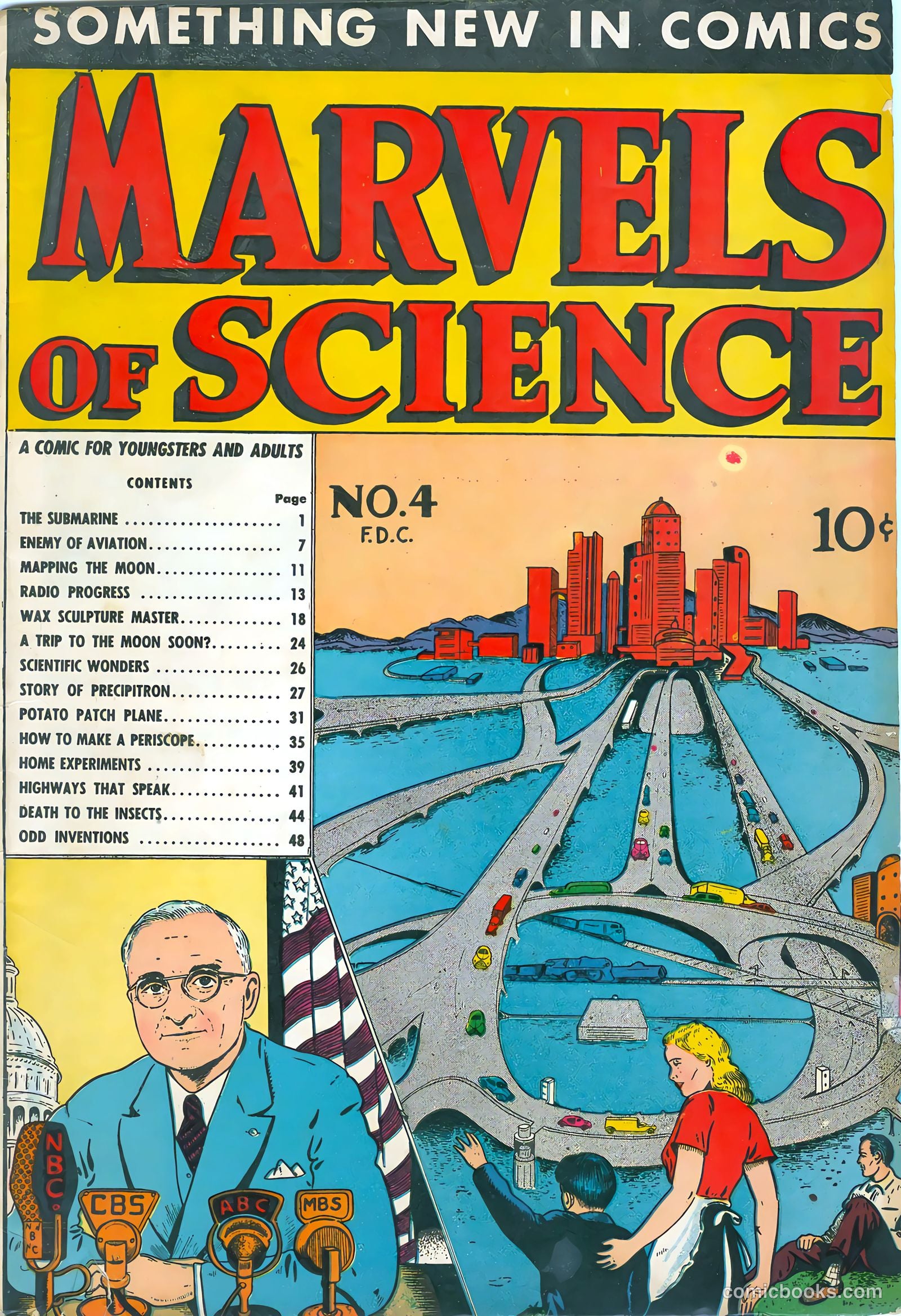
Marvels of Science #4
☆ Be the first to review + Add to your collection — Join free"Marvels of Science" #4 is an educational anthology comic covering various scientific topics and inventions. Featured content includes "Radio Progress," which traces the history of radio broadcasting from Harold Arlin's first full-time announcement at KDKA in 1921 through early sound-proofing techniques and famous broadcasts; "Precipitron: Fights Dust and Infections," explaining how the Westinghouse Precipitron device removes airborne dust particles to protect against infections; and "Home Experiments," providing step-by-step instructions for demonstrating air pressure using a can, water, and heat. The issue also contains articles on submarines, aviation, mapping the moon, wax sculpture, moon travel, scientific wonders, prescription devices, potato patch planes, periscopes, highways, insects, and odd inventions.
Explore the fascinating history and operation of the submarine, from David Bushnell's crude "Turtle" in 1776 through the diesel-powered underwater vessels that proved devastatingly effective in the recent war. This non-fiction account traces how inventors like Robert Fulton, John P. Holland, and Simon Lake transformed the submarine from an experimental novelty into a formidable weapon, then walks you through the tactics a submarine commander uses to hunt enemy ships—diving deep to avoid destroyers, launching torpedoes with precision, and executing daring escapes beneath the waves. Scientists predict even deadlier designs lie ahead, powered by jet propulsion or atomic energy.
During World War II, dense fog claimed countless RAF aircraft at British airfields, prompting Prime Minister Churchill to challenge his scientific experts to find a solution. The result was FIDO—the Fog Investigating Dispersal Operation—a revolutionary heat-based system that uses burning gasoline pipes to disperse fog and restore visibility for landing and takeoff. This 1946 account follows the development and dramatic testing of this lifesaving invention, which transformed aviation safety and continues to protect commercial air travel today.
On January 10, 1946, scientists at the Evans Laboratory in Belmar, New Jersey made history by bouncing a radar signal off the Moon and receiving it back in just 2½ seconds—the first time humanity had successfully contacted outer space. This groundbreaking achievement opens new possibilities for mapping the lunar surface and potentially other planets, using the same radar technology developed during World War II to detect enemy aircraft. The story explores how radar echoes reveal the Moon's cratered, mountainous terrain and charts the signal travel times to distant planets like Venus, Mars, and Mercury.
Radio has come a long way since Gugliemo Marconi's pioneering experiments in 1895—this five-page chronicle traces the medium's explosive growth from its first commercial broadcasts at KDKA in Pittsburgh through the golden age of the 1930s and '40s, spotlighting the personalities, technical innovations, and landmark events that shaped American popular culture. From Harold Arlin's early announcing work and the rise of beloved shows like Amos 'n Andy and Fibber McGee and Molly to live coverage of eclipses and sporting events, radio proved itself the defining entertainment and news medium of its era. The story captures both radio's triumphs and its darker moments, showing how this remarkable invention connected the nation—for better and worse.
Leopold S. Schmidt, known as "Mister Mannikin," transformed the wax sculpture trade when he proposed a revolutionary idea: using lifelike mannequins for shop-window displays. Starting as his uncle's apprentice at the famous Eden Musée, young Schmidt struck out on his own to prove his concept could work, developing a meticulous process that combined lead-pipe skeletons, clay modeling, plaster molds, and hand-painted features to create figures so striking they generated immediate orders. Today, with his family trained in every aspect of the craft—from hair selection to lacquer finishing—the 71-year-old master continues to lead a thriving American center of wax artistry, producing everything from department-store mannequins to museum-quality historical reproductions.
Daisy Allen of Oxford, England, survived an extraordinary medical feat when her heart stopped beating for fifteen minutes—only to be revived through injections that brought her back from the brink. "Scientific Wonders" showcases remarkable breakthroughs reshaping daily life, from synthetic plastic fabrics engineered to repel rain to electronic systems transmitting handwritten letters across continents in minutes, alongside the pioneering microscopy work that first revealed the hidden world of microbes.
Meet the Westinghouse Precipitron, an ingenious electrostatic air cleaner that removes up to 90 percent of dust particles and airborne infections from your home—a technology that proved its worth in wartime aircraft plants and hospitals before returning to serve everyday households. Inventor Gaylord W. Penney demonstrates how this compact machine uses charged wires and plates to capture microscopic dirt, keeping your curtains pristine and your walls clean without constant scrubbing. With production ramping up in 1946, the Precipitron promises to transform American homes and industry alike into spaces of unprecedented cleanliness and protection.
Major Alexander de Seversky's Russian aviation expertise finds new purpose in America when he and Kartveli launch their aircraft manufacturing venture from a Long Island potato patch in 1931. Follow their evolution from the amphibious SEV-3 through the P-35 and P-43, charting the relentless refinement that culminates in the P-47N-5—a long-range fighter bomber armed with radar and built to outmatch the German Messerschmidt in the skies of World War II.
Bill learns how light travels and decides to build a pinhole camera with his friend Tom in the workshop—and when they test it, Bill discovers something surprising about how the image appears. Later, Bill constructs a periscope using mirrors and everyday materials, showing Tom how reflection lets him see around corners and over obstacles without being spotted.
This 1946 science instructional story walks you through two hands-on experiments that demonstrate invisible forces at work in your own kitchen. First, you'll learn how air pressure can crush a sealed can as it cools, then you'll create carbon dioxide gas using everyday ingredients to launch a cork across the room. Both experiments reveal the remarkable power of pressure and gases—perfect for curious minds ready to see science in action.
This 1946 survey showcases ingenious safety innovations transforming American highways into smarter, more protective roads—from reflective road markers and anti-collision mirrors to experimental "talking" roadways that use tire vibrations to communicate hazards to drivers. Engineers and scientists across the country are testing devices like hydraulic lane dividers, chemical de-icers, and photo-electric speed monitors, all designed to make motoring safer and more comfortable for the motoring public.
Science has finally answered humanity's age-old battle against insect pests—a new compound called DDT promises to eliminate everything from disease-carrying mosquitoes and lice to cockroaches, fleas, and moths. Developed during wartime to protect soldiers from yellow fever and other insect-borne illnesses in theaters of war, this breakthrough discovery is now available to citizens for everyday use, from homes to farms to beaches. A monthly spraying could mean the end of the itching, disease, and crop damage that insects have inflicted on mankind for centuries.
This 1946 non-fiction feature showcases a collection of genuine oddball patents pulled straight from the U.S. Patent Office archives, each illustrated with tongue-in-cheek charm. From a contraption promising railroad comfort to an ingenious fire-escape device, these real-world inventions prove that necessity breeds creativity—even when that creativity tilts toward the delightfully impractical. A fun peek at the forgotten brainchildren of American inventors, complete with patent numbers for the curious collector.
ComicBooks.com Value
Show all 9 grades ▾
Find on ebay
Read it digitally
Sell my copy
Have this issue — or a whole collection? Get a fair offer from us, skip the marketplace fees and the hassle.
We Buy Collections ▸Reviews
Reader reviews
No reader reviews yet.