
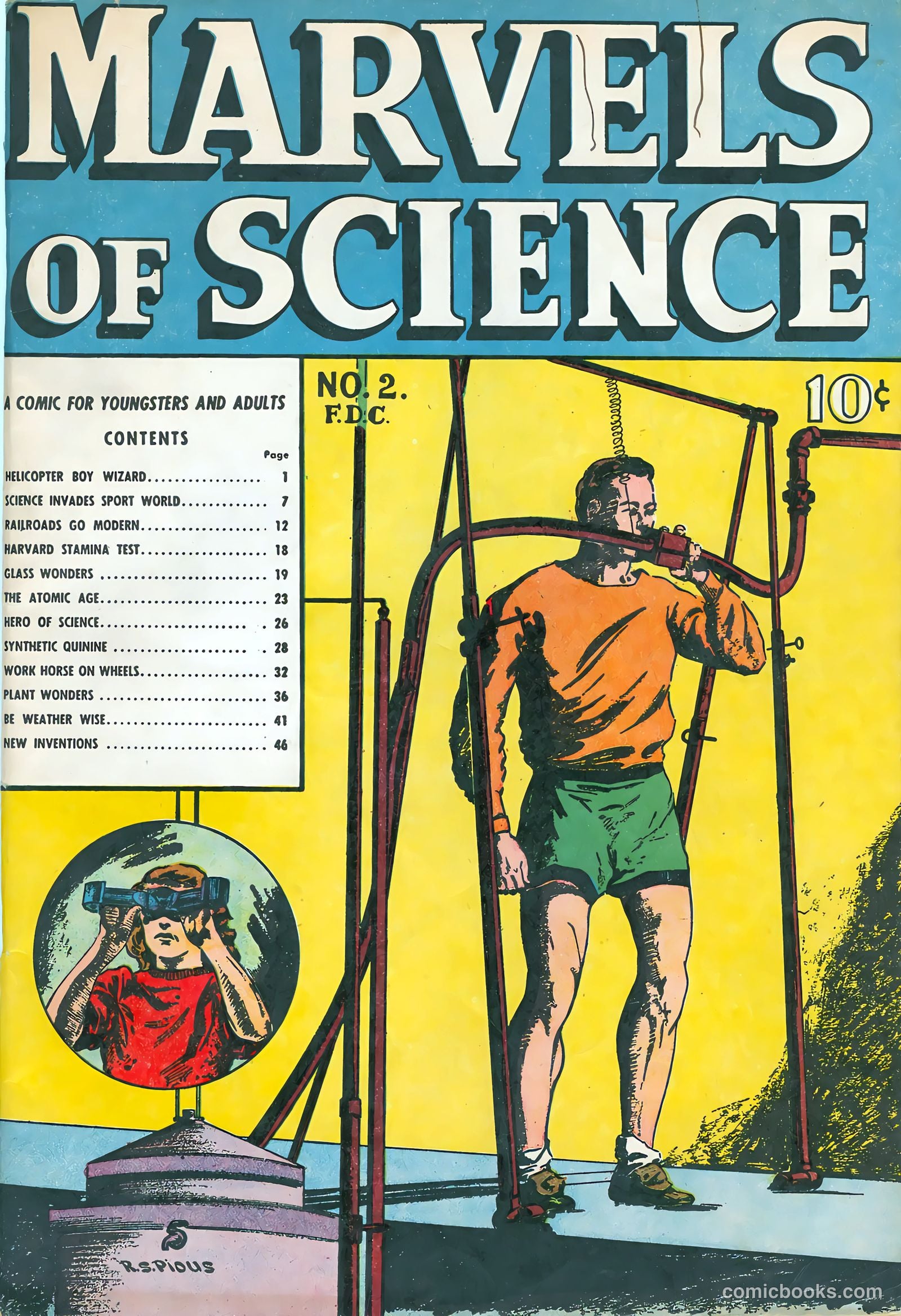
Marvels of Science #2
☆ Be the first to review + Add to your collection — Join freeAn anthology of educational science features covering modern innovations and discoveries. Stories include "Railroads Go Modern," detailing new streamliner designs like the Astra Dome sleeping cars and new stainless steel road cars in development; and "Hero of Science," chronicling Ernest Boris Chain's discovery of penicillin, the development of the antibiotic with his colleagues, its successful use in treating disease, and his receipt of the Nobel Prize. Additional features cover topics ranging from Harvard's stamina test to plant wonders and new inventions.
American railroads have transformed themselves into marvels of modern engineering, launching a fleet of streamlined trains equipped with innovations from vista-dome observation cars to luxurious sleeping compartments designed by manufacturers like Budd, Pullman-Standard, and General Motors. This six-page feature showcases the spectacular new equipment now in service and soon to arrive—from the Empire State Express and Panama Limited to experimental cars offering everything from automated diners and movie theaters to novel safety features that keep passengers comfortable and connected throughout their journey. Speed, safety, and comfort have become the watchwords of rail travel in 1946, proof that American industry and design have ushered in a new era of passenger service.
Glass has fascinated humanity since ancient times, but recent innovations have transformed it from a fragile curiosity into a modern material of staggering versatility—capable of being bent, twisted, woven, and even made elastic or bulletproof. This 1946 feature explores the history of glassmaking from the Egyptians through the craft of the skilled glass blower, then reveals the remarkable new applications that have redefined what glass can do. From heat-resistant panels to flexible fibers stronger than rope, glass has become one of the most adaptable substances available to industry and home alike.
When the atomic bomb fell on Japan in 1945, it did more than end the war—it announced the arrival of a transformative new era. This non-fiction story explores the staggering power locked inside uranium 235 and imagines how atomic energy might reshape peacetime life, from cars traveling millions of miles on a single pellet to homes heated and powered at a fraction of today's cost, even as scientists cautiously hope it might one day help conquer disease and feed the world.
Born as a wartime workhorse, the Jeep gets a peacetime makeover in this 1946 survey of American engineering ingenuity. From farms to forests to remote ranches, witness how engineers retrofitted this versatile vehicle with improved shock absorbers, faster gearing, and mechanical power—transforming it into a multi-purpose machine that threshes wheat, sprays orchards, rounds up cattle, and fights fires across the country. It's a fascinating look at how one humble vehicle became indispensable to American industry and rural life.
In this illuminating nonfiction account, discover how colchicine—a humble yellowish-white powder—transformed plant science from a curious medical remedy into an agricultural powerhouse. Starting with experiments at Cold Spring Harbor in 1937, scientists like Amos G. Avery and Albert F. Blakeslee revealed that treating seeds with colchicine doubled the chromosomes in plant cells, producing dramatically larger vegetables, flowers, and grains, with applications spreading to livestock and even fruit cultivation across North America. The story traces how this botanical breakthrough moved from the laboratory to Saskatchewan's ravaged farmland and beyond, opening doors to hybrid crops and hybrid fruits that promise to reshape agriculture and our dinner tables for generations to come.
When a young person's rained-out picnic leads to skepticism about weather forecasting, a friend working at the Weather Bureau opens the doors to show how meteorologists actually predict the forecast—walking through the instruments, techniques, and nationwide coordination that make accurate weather prediction possible.
ComicBooks.com Value
Show all 15 grades ▾
Find on ebay
Read it digitally
Sell my copy
Have this issue — or a whole collection? Get a fair offer from us, skip the marketplace fees and the hassle.
We Buy Collections ▸Full credits
Reprints
Reprinted in Catholic Comics #8 (1948), Catholic Comics #10 (1948), Catholic Comics #1 (1948), Catholic Comics #2 (1948), Catholic Comics #5 (1949), Catholic Comics #6 (1949), Catholic Comics #7 (1949), Catholic Comics #8 (1949)
Reviews
Reader reviews
No reader reviews yet.