
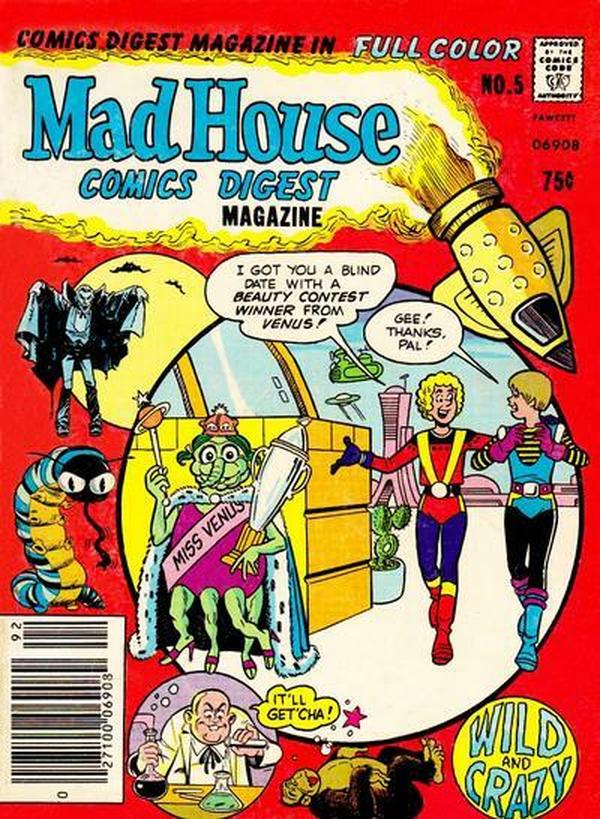
Madhouse Comics Digest #5
☆ Be the first to review + Add to your collection — Join freeIn "The Dream Team Scheme," Mr. Didit’s attempt to compose a masterpiece with Beethoven’s spirit ends in chaos when his pen explodes, splattering ink across his violin and then onto his final sheet of paper. The boys return to find the resulting blots and, with a mix of confusion and creativity, turn them into a surprise hit. A playful, offbeat tale from Frank Doyle, illustrated with signature charm by Stan Goldberg and inked by Henry Scarpelli, with lettering by Bill Yoshida, and a cover by Dan DeCarlo.
In "The Discovery of Doughnuts!" from Madhouse Comics Digest #5, Mr. Weatherbee spins a delightfully absurd tale of how the humble doughnut came to be—thanks to a clever twist from hole-seller Laslo Sforz, who repurposed an Italian breadstick in the most unexpected way. A perfectly silly origin story, served with a side of comic whimsy.
In "The Power of the Press," Jo and Clyde find themselves tangled in a farcical showdown when a mobster tries to blow up Clyde’s apartment over his exposés on rigged college sports. When Dick accidentally hits the mobster with his car and brings him home, the man’s panic escalates when he hears Clyde’s offhand advice on cooking fish—mistaking it for a gruesome fate at the hands of the Glads.
In "Dr. Bonehead's Boner," the eccentric scientist Dr. Bonehead unleashes a formula that turns insects into towering, intelligent beings—only to find his plan for criminal mayhem derailed when his creations develop their own ambitions. With a mix of mad science and mischievous wit, this four-page gem from Madhouse Comics Digest #5 delivers a delightfully absurd twist on size and smarts.
In "If Teen Agers Formed a Union," Archie imagines a world where teens organize into a powerful collective, rewriting the rules of school life with a new charter, a bold motto, and fresh benefits—like better cafeteria food and expanded dating rights. The story playfully explores what happens when teenage voices demand change, all through a lens of wry, lighthearted satire.
When Super Disguise is recruited into the Union Of Super Good Guys, his first mission takes him to the mysterious case of Super TV Repairman, who’s been wrecking televisions across the city—no clues, no motives, just broken screens. Written by an unknown hand and illustrated by an unknown artist, this seven-page 1979 satire blends superhero antics with a sharp, silly twist on media obsession.
In "Speck of Trouble," Mr. Didit’s attempt to compose a proper piece of music goes hilariously awry when his pen explodes onto his violin, sending ink splattering across his final sheet of paper. As his teenage sons return home to find the chaotic mess, they’re oddly inspired—turning what looks like a scribble into a surprising hit.
In "Lester the Hipster," a teenage space cadet named Lester finds himself unexpectedly whisked away by Martians who show off their latest weapons—only to be unimpressed. Instead of fear, Lester sees potential, riffing on how Earthlings might actually *use* such gadgets for their own wild style. The Martians, baffled by his nonchalance, conclude that Earth is too chaotic to conquer and call off the invasion.
In this zany 1979 installment from Madhouse Comics Digest #5, Captain Sprocket faces off against his most formidable adversary, Dr. Neutron, in a showdown that’s equal parts absurd and action-packed. Just as Dr. Neutron prepares to turn the hero into ice cubes, Super Sally and her team of super-heroes crash the scene with a splash of chaos and flair.
ComicBooks.com Value
Find on ebay
Read it digitally
Sell my copy
Have this issue — or a whole collection? Get a fair offer from us, skip the marketplace fees and the hassle.
We Buy Collections ▸Full credits
Reprints
↩ Reprints Archie's Madhouse #13 (1961), Archie's Madhouse #15 (1961), Archie's Madhouse #21 (1962), Archie's Madhouse #37 (1964), Archie's Madhouse #38 (1965), Archie's Madhouse #40 (1965), Archie's Madhouse #43 (1965), Archie's Madhouse #44 (1965), The Mad House Glads #84 (1972), The Mad House Glads #90 (1973), The Mad House Glads #92 (1974), The Mad House Glads #93 (1974)
Reviews
Reader reviews
No reader reviews yet.