
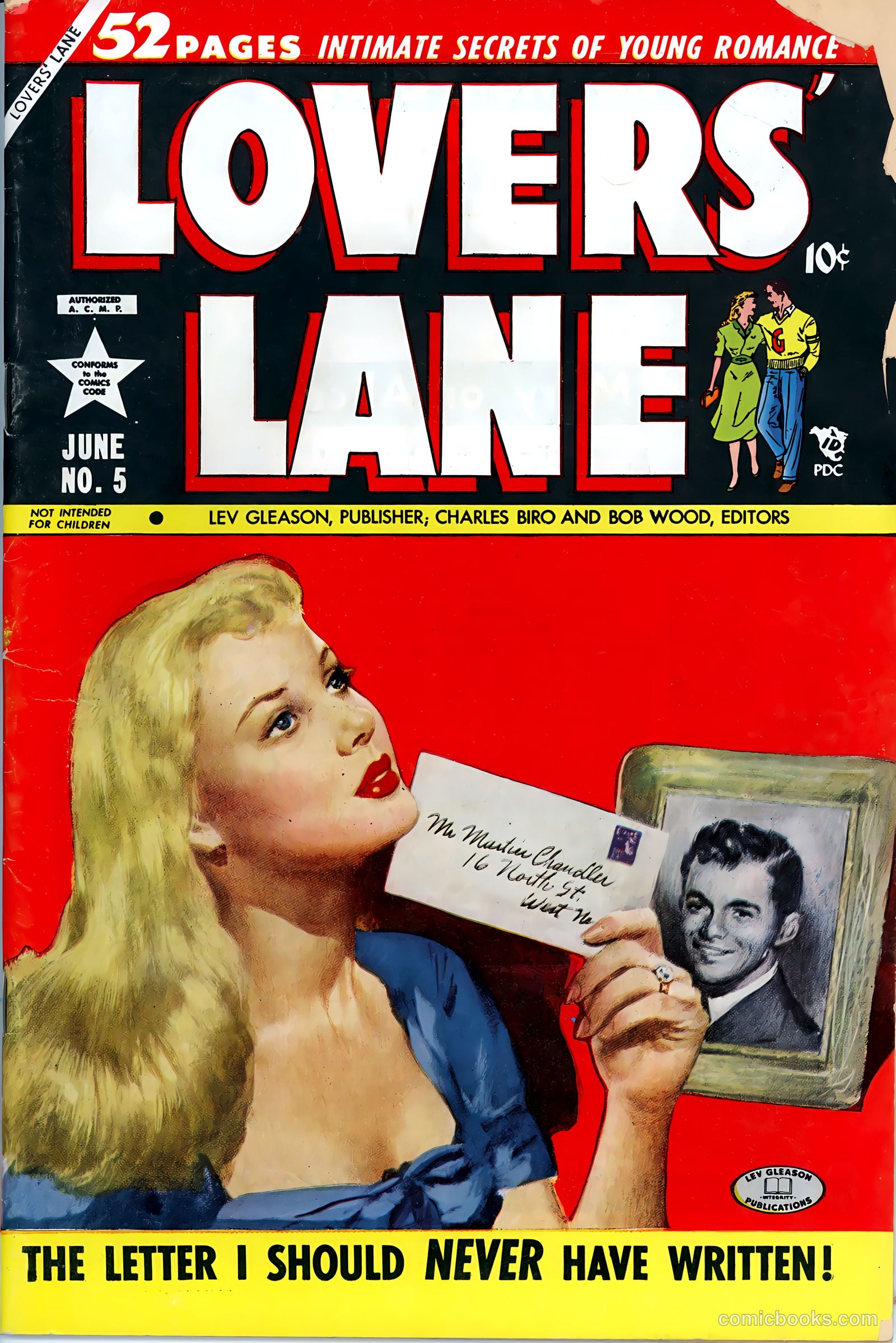
Lovers' Lane #5
☆ Be the first to review + Add to your collection — Join freeLovers' Lane #5 (1950) sits within Lev Gleason Publications' early experiment in Golden Age romance comics, a genre that had only been pioneered a few years earlier by Young Romance #1 (1947). As one of the first romance titles from a publisher better known for crime comics, the series as a whole represents Gleason's attempt to diversify his line during a period of growing public scrutiny toward crime comics. However, no corroborated evidence was found across comic history databases, key-issue trackers, or collector sources to confirm that Marilyn Monroe appears in this specific issue in any capacity — photo cover, interior feature, or otherwise — which substantially limits what can be said about its singular historical significance.
In "The Letter I Should Never Have Written," shy high school student Margie reaches out to advice columnist Ada Nevill for help navigating her insecurities, setting off a quiet but heartfelt story of self-discovery. Written by Ada Nevill and illustrated by Bart Tumey, this poignant 1950 issue captures the tender anxieties of adolescence with a sincerity that feels both timeless and uniquely of its era.
In "The Letter I Should Never Have Written," Amy finds herself torn between her fiancé Martin and a man she once loved, Barry. After impulsively writing a letter to end her engagement, she’s stunned to realize Barry isn’t who she thought he was—yet the letter is already gone. When Martin returns from their honeymoon and discovers the letter, he’s faced with a mystery that forces him to confront what the upside-down stamp might really mean.
In "Repentant Daughter," Pat’s impulsive decision to run away after her mother scolds her for dating Rod takes a sobering turn when her teacher, Miss Ellis, reveals the painful truth behind her parents’ strictness—Pat’s older sister Emily once vanished, never to return. As Pat grapples with the weight of that loss, she and Rod make amends, leading to a quiet but meaningful reconciliation with her mother, who even invites Rod to join them for dinner.
In this heartfelt true story from *Lovers' Lane #5*, Ethel, a high school student from Wildwood, New Jersey, finds her quiet romance tested by the nervous silence of her boyfriend Jim. When words fail him, a single orchid and a diamond ring delivered by messenger speak volumes—leading to a moment that changes everything.
In "Love Divided," June and Michael—children of feuding farm families—find themselves torn between love and loyalty. Despite their families’ long-standing rivalry, they choose to marry, leading to an unexpected compromise that reshapes their lives and the future of their shared land.
In this poignant 1950 installment from *Lovers' Lane #5*, shy high school student Margie turns to advice columnist Ada Nevill with a quiet plea for help navigating her feelings. Ada’s thoughtful response—encouraging Margie to open up and connect more freely—becomes a gentle, heartfelt reminder of the courage it takes to reach out.
In a sun-dappled summer of blossoms and first heartaches, 16-year-old Trudy finds herself caught between two women and a man who’s not what he seems. As her older sister Jane and the local widow Sally both try to win Paul’s affection, Trudy discovers the truth behind his charm—and learns to trust her own heart. With quiet wisdom and a touch of wit, she finds her way to Teddy, someone who matches her age, her spirit, and her future.
ComicBooks.com Value
Show all 10 grades ▾
Find on ebay
Read it digitally
Sell my copy
Have this issue — or a whole collection? Get a fair offer from us, skip the marketplace fees and the hassle.
We Buy Collections ▸History
Lev Gleason Publications launched Lovers' Lane as its first foray into romance comics after achieving notoriety with Crime Does Not Pay, the crime-comic series that dominated early 1940s newsstand culture and spawned countless imitators. Publisher Leverett Stone Gleason, already a co-founder of the Association of Comics Magazine Publishers in 1948 — a self-regulatory body that preceded the Comics Code Authority — appears to have approached the romance line conservatively at launch, with early issues featuring relatively restrained cover art before the title later shifted toward painted covers by artist Bob Fujitani and, eventually, more provocative material in its later years.
Trivia · 7 facts
- Lovers' Lane was published by Lev Gleason Publications (also credited as Comic House), a Golden Age publisher active from the late 1930s to the mid-1950s and best known for Crime Does Not Pay.
- Lev Gleason was a co-founding member of the Association of Comics Magazine Publishers in 1948, an industry self-regulatory body that was a direct precursor to the Comics Code Authority established in 1954.
- The Lovers' Lane series ran into the mid-1950s and featured a notable run of painted covers by artist Bob Fujitani during its middle period.
- Lev Gleason's launch of Lovers' Lane represented the publisher's first romance title, a significant genre pivot from its flagship crime comics output.
- The earliest confirmed Marilyn Monroe appearance on a comic book cover is Teen-Age Diary Secrets #6 (St. John Publishing, October 1949), with cover photography by Bruno Bernard — predating Lovers' Lane #5 by roughly a year.
- The next well-documented Monroe comic appearance after Teen-Age Diary Secrets #6 is Sweethearts #119 (Fawcett Publications, late 1952), which tied to her film Don't Bother to Knock.
- No entry for Lovers' Lane #5 featuring Marilyn Monroe could be located in the Grand Comics Database, Key Collector Comics, GoCollect, or in any Bleeding Cool or collector-forum discussion of Monroe's comic book history.
Cast · 1 character
Full credits
Reviews
Reader reviews
No reader reviews yet.