
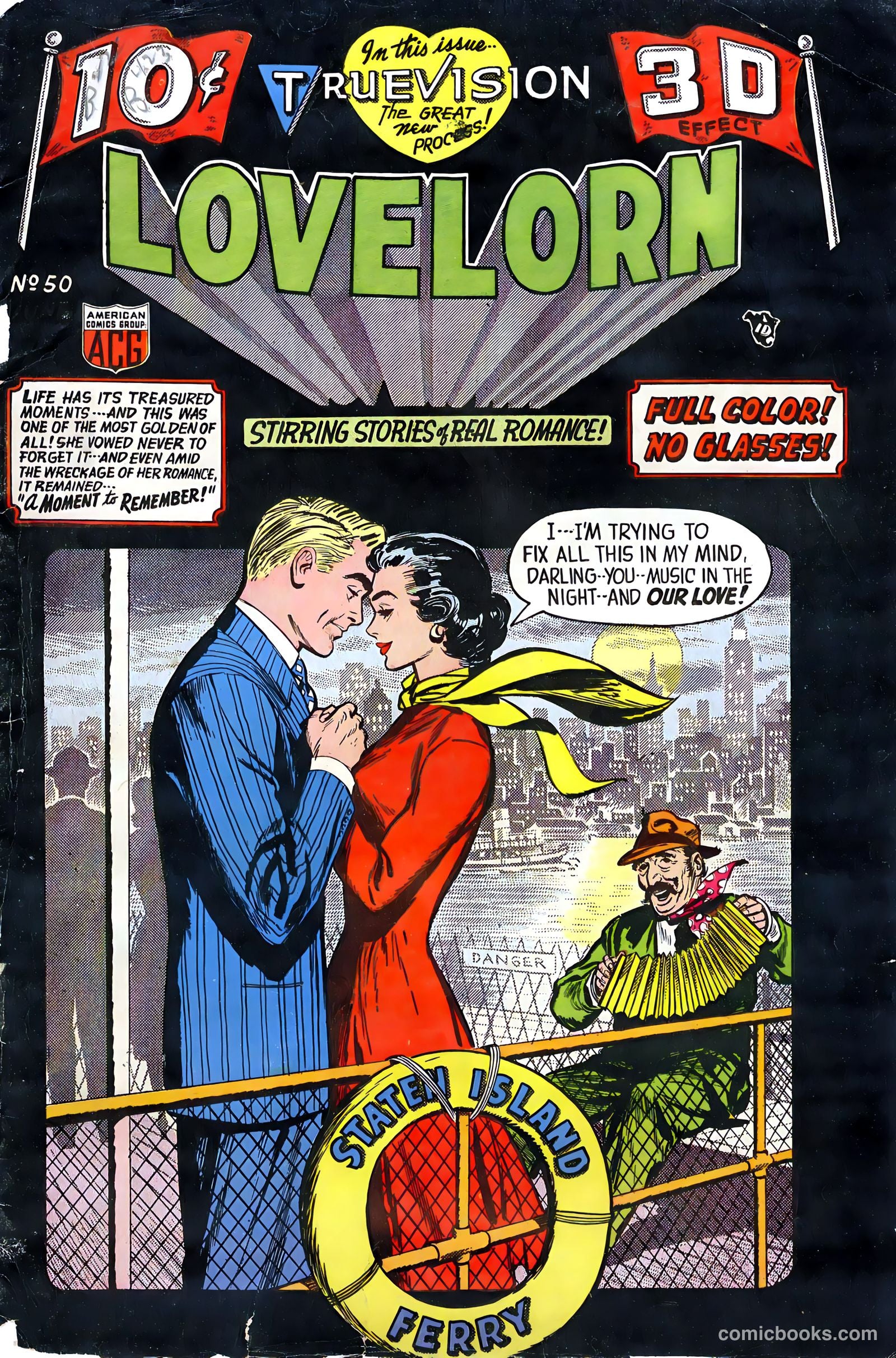
Lovelorn #50
☆ Be the first to review + Add to your collection — Join freeLovelorn #50 (June 1954) sits at one of the most consequential pivot points in American romance comics history: it arrived just two issues before ACG renamed the title Confessions of the Lovelorn with issue #52, a line-wide rebranding that was itself part of ACG's deliberate navigation ahead of the Comics Code Authority's formation in September 1954. As one of the final issues published under the original Lovelorn banner that had run since 1949, it represents the closing chapter of a five-year pre-Code romance anthology and a tangible record of the genre's tone and storytelling conventions immediately before industry-wide self-censorship reshaped what romance comics could say and how they could say it. ACG's ability to thread that needle — retaining both its horror and romance lines into the 1960s when many competitors folded — makes even a routine mid-run issue like this a document of institutional survival strategy as much as entertainment.
In "It's Getting Serious When—," Carol is anxious about her date with Henry, a man she has known only briefly, fearing he may not be the suitable match her mother desires. After an evening out discussing books, music, politics, and life, Carol realizes she is falling deeply in love with Henry and confesses her feelings, but Henry reveals he cannot marry her because he is serving a prison sentence and will only be released after one year. Despite this devastating revelation, Carol waits for his release and they are reunited, with Henry finally able to pursue their love without the shadow of his past guilt hanging over them. In a separate narrative on the final page, a woman reflects on her lifelong search for a man named Joe Emmet, whom she lost during wartime, discovering years later that he had survived and may still care for her.
Kay Evans has sworn off artists after growing up in bohemian poverty, but when she meets Don Cameron—a charming instructor at her father's art institute—she finds herself captivated despite her better judgment. As their romance deepens and Don proposes a life together, Kay faces an impossible choice: accept a future with the man she loves, or demand he abandon the painting that defines him. This 1954 story explores the tension between romance and the dreams that pull us in different directions.
Carol's been seeing Henry for only a couple of weeks, but when her mother notices how carefully she's preparing for their Saturday night date, Carol realizes her feelings might run deeper than she thought. As the evening unfolds—quiet conversation, dancing, and a kiss that leaves her breathless—Carol discovers what it means when attraction turns into something more serious.
A Swedish immigrant's dreams of a better life take a dark turn when she discovers stolen ransom money on the streets of America—and keeps it. As Karen builds a glamorous new existence with her newfound wealth, she falls for Barry, an idealistic county attorney with a spotless reputation nominated for Congress, but her guilty secret threatens to destroy both his career and their love. Torn between her past and the man she's come to care for, Karen must decide whether confession or silence will cost her more.
When Janie meets the charming Cal Webster at a party, she finally has her chance with the kind of guy she's always hoped to meet—but her relentless focus on her own flaws threatens to sabotage the whole evening. A practical lesson in the power of self-confidence and choosing to highlight your strengths instead of dwelling on what you can't change.
A wartime romance in occupied France left lawyer Joe Smith carrying a torch for Janine Roget—the girl who saved his life but refused to marry him before he returned to his unit. Now, a decade later, when the famous actress unexpectedly arrives in his hometown for a movie premiere, Joe finds himself face-to-face with the woman who's haunted every relationship since, and discovers she's been searching for him all these years. What happens when two people realize their feelings never faded, even after years of silence and separation?
ComicBooks.com Value
Show all 9 grades ▾
Find on ebay
Read it digitally
Sell my copy
Have this issue — or a whole collection? Get a fair offer from us, skip the marketplace fees and the hassle.
We Buy Collections ▸History
Lovelorn launched in August/September 1949 as one of two long-running ACG romance titles alongside Romantic Adventures, both shepherded from the outset by editor Richard E. Hughes, who served as ACG's editor from 1943 through the company's end in 1967. Hughes — born Leo Rosenbaum — ran the entire ACG line under owner Benjamin W. Sangor and business manager Fred Iger, and his editorial hand shaped the measured, comparatively restrained tone that distinguished ACG romance books from more sensationalistic competitors. By the time issue #50 went to press in June 1954, the Senate Subcommittee on Juvenile Delinquency hearings were already under way, and the industry pressure to rebrand and soften content was building; ACG's response, beginning with issue #52's cover-title change to Confessions of the Lovelorn, was already being planned in the editorial office.
Trivia · 8 facts
- Published June 1954 by American Comics Group (ACG); cover-dated the same month.
- Issue #50 is one of the final two issues published under the original 'Lovelorn' cover title before ACG renamed the series 'Confessions of the Lovelorn' beginning with issue #52.
- The series ran continuously for 114 total issues (August/September 1949 – June/July 1960), transitioning through the title change and lasting well into the Silver Age.
- Stories confirmed by Grand Comics Database data include: 'A Moment To Remember!', 'It's Getting Serious When--', 'My Guilty Secret', 'Nobody's Perfect!', and 'To Carry a Torch!'
- Edited throughout by Richard E. Hughes (born Leo Rosenbaum, 1909–1974), who served as ACG's sole editor from 1943 to 1967 and was one of the most durable editorial presences in Golden Age comics.
- The title change from Lovelorn to Confessions of the Lovelorn, which followed two issues later, was part of a coordinated ACG line-wide rebranding that also saw Romantic Adventures become My Romantic Adventures and the horror titles adjust their branding — all timed around the CMAA's formation in September 1954.
- 32 pages, full color; original cover price 10 cents — standard format for ACG romance anthologies of the period.
- Specific interior artist credits for issue #50 are not indexed in currently available public databases; the GCD lists nearby issues with artists such as Milt Knopf, Leo Morey, Bill Fraccio, Jack Abel, and Edmond Good working on the title in this period.
Reviews
Reader reviews
No reader reviews yet.