
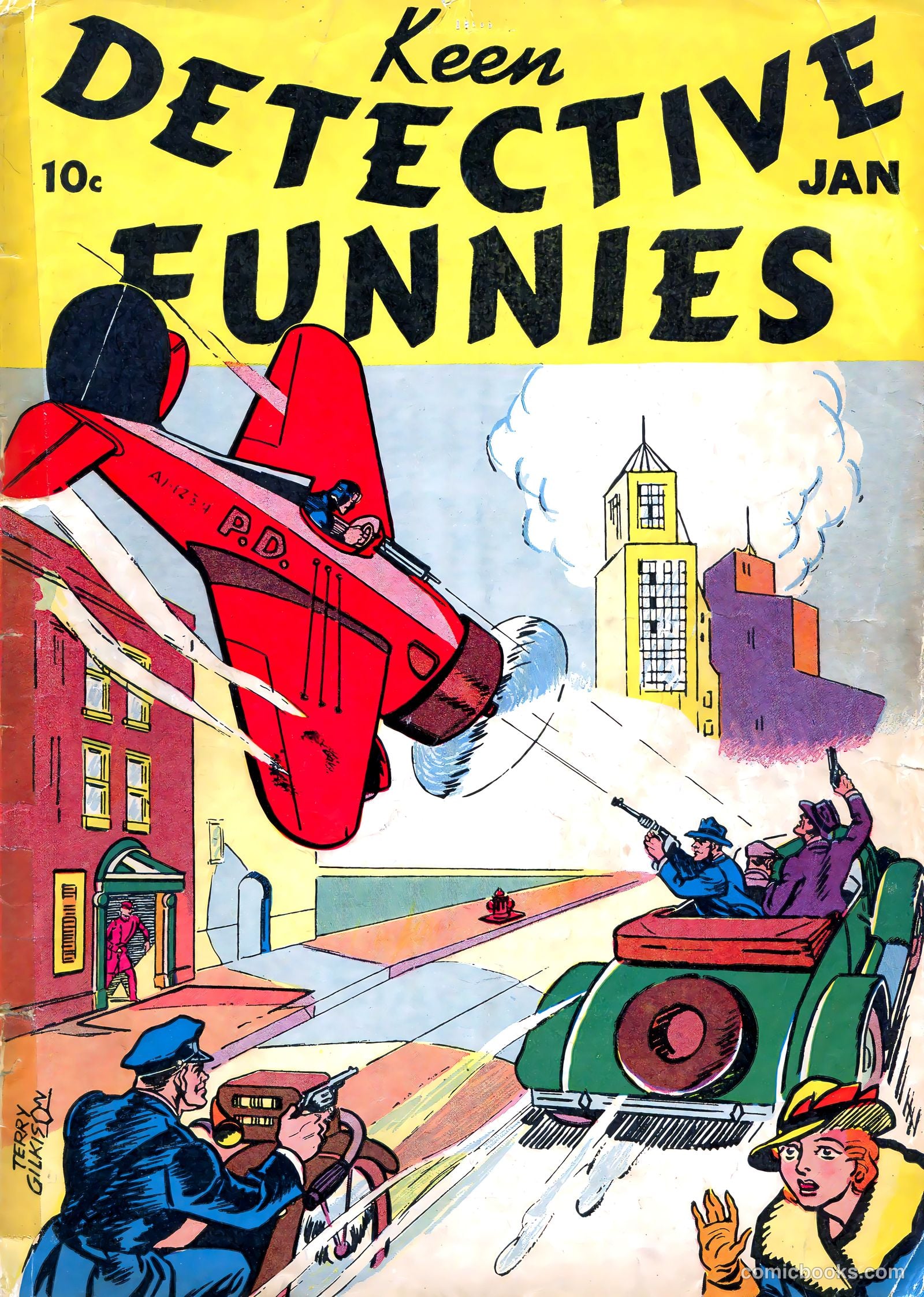
Keen Detective Funnies #1
☆ Be the first to review + Add to your collection — Join freeKeen Detective Funnies Vol. 2 #1 (January 1939) marks the opening of a new volume year for one of the earliest dedicated detective-genre comic books in American publishing history — a title that served as the direct successor to Comics Magazine Company's Detective Picture Stories and therefore represents a continuous thread of crime-comics storytelling stretching back to 1936. As the series found its footing across this volume, it became the platform from which Centaur Publications would introduce some of the most inventive characters of the early Golden Age, including the Masked Marvel and, later in the same volume, The Eye — a genuinely sui generis concept of a supernatural, disembodied crimefighting eye that influenced the genre's drift toward the uncanny. The title's evolution from a reprint-heavy anthology into a home for original serialized features documents, issue by issue, how a small independent publisher learned to develop its own creative voice during the pivotal year of 1939, when the American comic book industry was exploding outward in every direction.
"Doc's Orders" kicks off in Keen Detective Funnies #1, a 1939 10-cent gem from Centaur, where detective work meets rural suspense. With help from civilian Henry Powell, the case leads the detectives on a trail to a remote cabin in the north woods, hunting the elusive 7-11 Gang. Written, drawn, and inked by Tony Basso, the story unfolds with crisp, early comic energy, while the cover by Terry Gilkison captures the tension with a striking, period-accurate image.
Detective Thurston Hunt sets a trap at a mobster's hideout, posing as a criminal to infiltrate Doc Peters's gang and gather evidence for their planned bank robbery. When the criminals arrive, Hunt must maintain his cover while secretly coordinating with federal agents closing in from all sides. It's a high-stakes game of nerve and quick thinking as the noose tightens around one of the city's most dangerous criminal organizations.
In "The 7-11 Gang," detectives follow a trail from a bank robbery to a remote cabin in the north woods, aided by civilian witness Henry Powell. The chase unfolds through rugged terrain, where every shadow could hide the elusive gang.
Two federal agents dispatched to track down a kidnapper discover a farmhouse harboring the abducted child, but their cover is quickly blown when the criminals spot them—leading to a desperate fight for the child's safety. Terry Taylor and Walter Brown must battle their way through a dangerous gang to rescue the victim and bring the criminals to justice under the Lindbergh Law.
In the frozen north, seasoned trapper Bob Colby teams up with local guide Pierre to solve a baffling mystery: despite clear signs of mink activity, every trap remains empty. With snow-laden trees and silent woods as their only clues, the two must follow the trail of prints to uncover what’s slipping through their fingers—literally.
When two gangsters hold up the photography office of Jasper Miggs and Paul Barton, the young partner secretly snaps a picture of the robbers with a hidden camera—evidence that could solve the case. But as Sergeant Mulcahey and police photographer Duke Arche investigate, they uncover a far darker scheme than a simple robbery, one that hinges on a mysterious camera, a girl who appears from a secret door, and a deadly betrayal rooted in addiction and desperation. The truth behind Miggs' death and Barton's true nature will force the officers to piece together clues hidden in plain sight—from stained hands to dilated pupils to the sinister purpose of that "camera of crime."
A young man drawn to a mysterious woman on a remote island becomes entangled with the dangerous criminal known as the Swamp Rat, who rules the swamplands through fear and violence. When the girl's true connection to the villain is revealed, a desperate struggle in the quicksand forces an unexpected resolution that clears the way for a new beginning.
ComicBooks.com Value
Show all 22 grades ▾
Find on ebay
Read it digitally
Sell my copy
Have this issue — or a whole collection? Get a fair offer from us, skip the marketplace fees and the hassle.
We Buy Collections ▸History
Keen Detective Funnies was launched by Centaur Publications in July 1938 as the company's first wholly new title, inheriting both its subject matter and some of its story inventory from the Comics Magazine Company's Detective Picture Stories — a lineage so direct that the title's numbering actually picks up where Detective Picture Stories left off, beginning at Vol. 1 #8 rather than #1. Centaur was owned by Joseph Hardie and Fred Gardner, and the title was edited by Lloyd Jacquet, the former DC Comics art director who simultaneously ran Funnies, Inc., one of the era's most influential comic-book packaging studios. The Vol. 2 #1 issue (January 1939) arrived at the moment Centaur was actively transitioning away from reprinted inventory material and toward original stories; researchers note that the earliest issues leaned heavily on reprints from Funny Picture Stories and Detective Picture Stories while Jacquet's studio ramped up original production. Centaur's titles suffered chronically from poor distribution, a structural problem that shadowed the entire run until the company ceased publication in late 1940.
Trivia · 8 facts
- Formally designated Keen Detective Funnies Vol. 2 #1, cover-dated January 1939, published by Centaur Publications Inc.; it is the 5th issue of the overall series run, which had launched in July 1938 as Vol. 1 #8.
- The series began its numbering at Vol. 1 #8 — not #1 — because it continued the issue count directly from Comics Magazine Company's Detective Picture Stories, making it an explicit institutional successor to that 1936–37 title.
- Contributing writers and artists on this specific issue include Arthur Pinajian, Terry Gilkison, Tony Basso, Robert L. Wood, Martin Filchock, Ellis Edwards, Joseph E. Buresch, and Paul J. Lauretta.
- The cover of Vol. 2 #1 depicts police officers shooting at gangsters from an aircraft — a kinetic image typical of the era's crime-pulp visual vocabulary.
- The series was edited by Lloyd Jacquet, who simultaneously headed Funnies, Inc., the packaging studio that would later supply the contents of Marvel Comics #1 (October 1939), cementing Keen Detective Funnies' place inside the most historically consequential production network of the early Golden Age.
- The series ran for 24 total issues (July 1938 – September 1940), transitioning from volume-based numbering to sequential whole numbers (#18–24) partway through its run.
- The most famous character to emerge from the title — The Eye, a supernatural disembodied crimefighting eye created by Frank Thomas — did not debut until Vol. 2 #12 (December 1939); it later spun off into its own two-issue series, Detective Eye (November–December 1940).
- Stories from Keen Detective Funnies were reprinted by Centaur's own later titles including Fantoman, Amazing Adventure Funnies, and Masked Marvel, and selected stories were also collected in AC Comics' Golden-Age Greats Spotlight #13 (Centaur Chronicles) in 2013 and #19 in 2019.
Full credits
Reprints
↩ Reprints Funny Picture Stories #4 (1937), Funny Picture Stories #6 (1937)
Reprinted in Amazing Adventure Funnies #2 (1940), Action! Mystery! Thrills! Comic Book Covers of the Golden Age: 1933-45 #[nn] (2011), Tops: The Complete Collection of Charles Biro's Visionary 1949 Comic Book Series #[nn] (2022)
Reviews
Reader reviews
No reader reviews yet.