
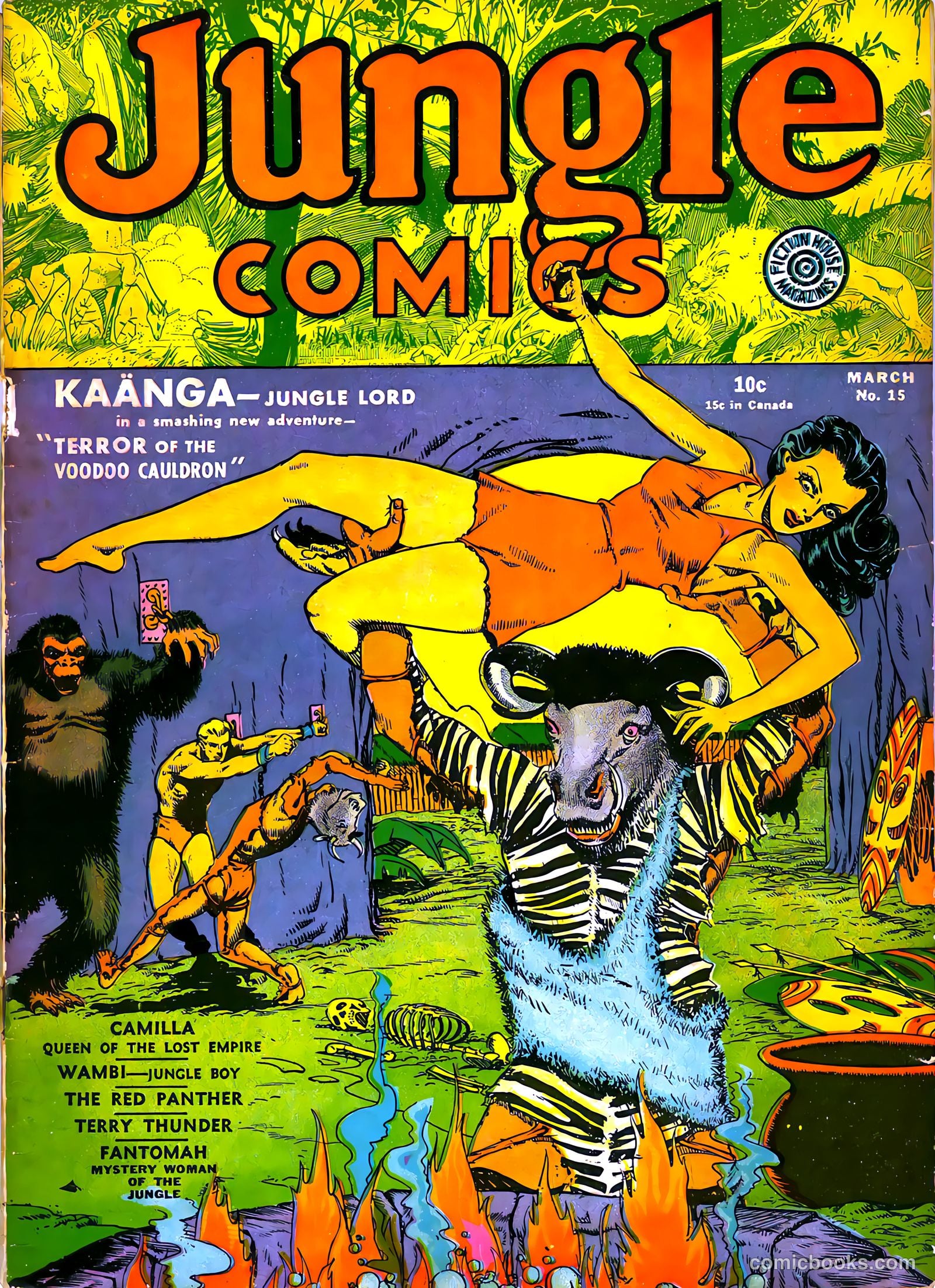
Jungle Comics #15
☆ Be the first to review + Add to your collection — Join freeJungle Comics #15 (March 1941) holds a quiet but meaningful place in Golden Age history as the final issue to contain a Fletcher Hanks–drawn Fantomah story — one of the earliest super-powered heroines in American comics. Beginning with issue #16, Hanks was replaced by a new creative team that fundamentally softened the character into a conventional jungle girl, making #15 the last installment of Fantomah's original, bizarre, skull-faced incarnation. The issue also marks a subtle but documented editorial shift in the series' visual identity: it is the first cover on which Ann Mason — Kaänga's companion — is featured more prominently than Kaänga himself, an early sign of Fiction House's 'good girl art' strategy that would define the publisher's output through the 1940s.
In "Terror of the Voodoo Cauldron," Simba's confidence wavers after overindulging during a film shoot, leaving him vulnerable when a leopard attacks—only to find redemption by protecting his pride from both tempting treats and a dangerous water buffalo. George Appel and Witmer Williams bring the jungle’s peril and pride to life with dynamic art, while Nick Cardy’s striking cover captures the issue’s eerie, high-stakes atmosphere.
Kaänga and Ann Mason stumble upon a gang of crooks plundering an ancient voodoo temple and murdering native worshippers in their search for treasure. When the criminals capture Ann and threaten her with a boiling cauldron, Kaänga must fight his way through their brutal traps—including a rogue gorilla and a pit of hungry crocodiles—to stop them and reclaim the temple's stolen jewels.
In a jungle tale from 1941, museum hunter Dana Lowe finds her prized giraffe trophy targeted by unscrupulous poachers—only for Roy to step in and stop them in their tracks.
In "Org's Giant Spiders," the would-be conqueror Org uses a jungle drum to enslave a herd of giant spiders, turning them into his monstrous army. Fantomah, ever the guardian of the wild, shatters his spell and turns the tide—before the giant spiders are returned to their natural size, Org meets a fate he won’t forget.
In this 1941 Jungle Comics tale, Simba’s pride turns against him after he’s distracted by a film crew’s treats, leaving him vulnerable during a leopard attack. When the pride faces new danger, Simba must prove himself again—this time by stopping his companions from falling for another trap, and stepping up to protect them from a charging water buffalo.
ComicBooks.com Value
Show all 21 grades ▾
Find on ebay
Read it digitally
Sell my copy
Have this issue — or a whole collection? Get a fair offer from us, skip the marketplace fees and the hassle.
We Buy Collections ▸History
Jungle Comics launched in January 1940 as part of Fiction House publisher Thurman T. Scott's aggressive expansion into comics, with early production routed through the Eisner & Iger shop. By issue #15, Malcolm Reiss served as credited editor and Gene Fawcette as art director — a creative team that had taken over day-to-day direction from the founding Eisner/Iger production arrangement. The issue was published under Fiction House's Glen-Kel Publishing Co. imprint (the indicia publisher name used across the line), with cover art by Nick Cardy and interior stories parceled among several house artists including Alex Blum, Arthur Peddy, Robert Webb, and Henry Kiefer — a typical Fiction House assembly-line workflow of the period.
Trivia · 8 facts
- Published March 1941 (on-sale date January 15, 1941) by Fiction House under the Glen-Kel Publishing Co. indicia; 68 pages, full color, cover price 10 cents.
- Cover art by Nick Cardy; the GCD notes this is the FIRST cover in the series on which Ann Mason appears more prominently than Kaänga — a significant cosmetic shift reflecting Fiction House's 'good girl art' editorial direction.
- Contains the FINAL Fantomah story written and drawn by Fletcher Hanks (under his pseudonym Barclay Flagg); Hanks' run on the character ended with this issue, after which issue #16 introduced a replacement creative team that transformed Fantomah into a more conventional jungle heroine.
- Fantomah — whose debut in Jungle Comics #2 (Feb. 1940) predated Wonder Woman and has been cited as one of the earliest super-powered comic book heroines — dispatches villain Org, who uses a jungle drum to hypnotize a herd of giant spiders, by feeding him to one of the spiders and then reducing the rest to normal size.
- The lead Kaänga story, 'Terror of the Voodoo Cauldron' (art by Alex Blum), features the introduction of a gang of criminals who loot a native temple — stopped by Kaänga and Ann Mason.
- Introduces Dana Lowe, a female museum hunter, in the Roy Lance backup strip — one of several supporting characters debuting in this issue.
- Red Panther backup story (art by Arthur Peddy) features the introduction and death of a European army officer who attempts to conquer the jungle using a tank — reflecting wartime anxieties already seeping into Fiction House jungle narratives by early 1941.
- Edited by Malcolm Reiss with Gene Fawcette as art director; other contributing artists in this issue include Robert Webb (Camilla), Henry Kiefer (Wambi), and Arthur Peddy (Red Panther).
Full credits
Reprints
Reprinted in Jungle Comics #122 (1950), Seriemagasinet #7/1950 (1950), I Shall Destroy All the Civilized Planets! #[nn] (2007), Fletcher Hanks : œuvres complètes #[nn] (2018)
Key issues in Jungle Comics
Reviews
Reader reviews
No reader reviews yet.