
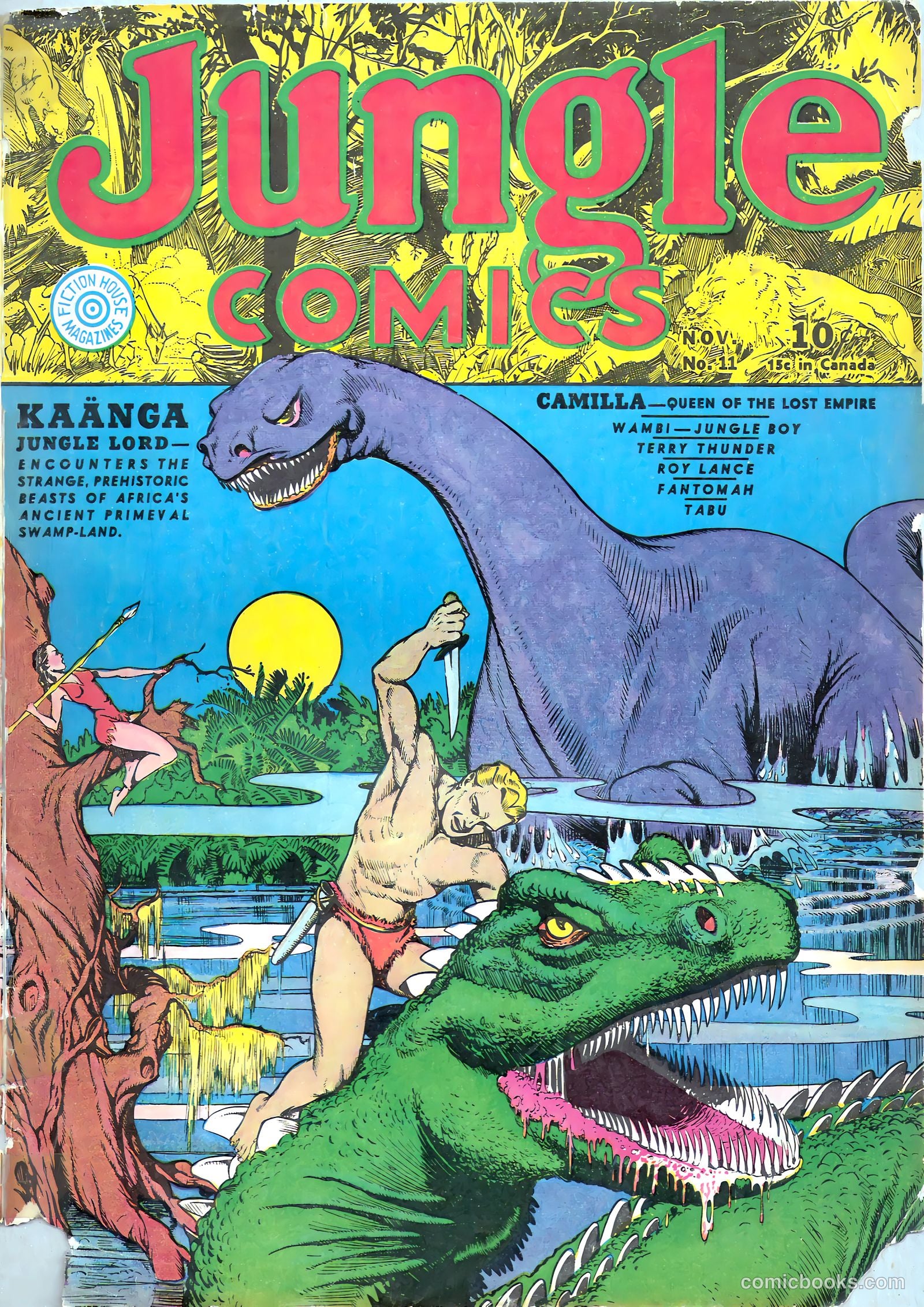
Jungle Comics #11
☆ Be the first to review + Add to your collection — Join freeJungle Comics #11 is a representative mid-run anthology from one of the Golden Age's most consistent genre titles, showcasing the full stable of Fiction House jungle characters in a single 68-page package at a moment when the line had found its confident footing. The Kaänga lead story — scripted by Red Brady and drawn by George Tuska, then only about a year into his professional career — drops the jungle lord and Ann into a lost valley of prehistoric monsters, a pulp-adventure trope that distinguished Fiction House's approach from the competition by leaning into fantastical world-building alongside straight jungle action. The issue also continues Fletcher Hanks's Fantomah feature, one of the earliest supernatural female heroines in comics, making this a document of a remarkably diverse ensemble approach to a single genre title. As the eleventh issue of a 163-issue run that spanned fourteen years, it demonstrates the editorial stability and character consistency that set Jungle Comics apart from the crowded Golden Age field.
Jungle Comics #11 is an anthology containing multiple stories. "Camilla—Queen of the Lost Empire" follows the sorceress Camilla, who uses magic to materialize in the amazing world of the evil magician Thoth and attempts to conquer it with the aid of prehistoric creatures she controls. "Fantomah" features the masked avenger confronting the villain Arco, who wields a weapon called the "Scarlet Shadow" that fires destructive rays; when Fantomah reverses the rays, Arco is blinded. "Tabu" depicts an explorer and his companion Tabu rescued from a whirlpool that had caught their boat, with Tabu explaining they were caught in the forbidden river and have entered the world of the past, where they encounter a giant brontosaurus before reaching safety.
ComicBooks.com Value
Show all 20 grades ▾
Find on ebay
Read it digitally
Sell my copy
Have this issue — or a whole collection? Get a fair offer from us, skip the marketplace fees and the hassle.
We Buy Collections ▸History
Fiction House launched Jungle Comics in January 1940 as a natural extension of its pulp magazine Jungle Stories, with publisher Thurman T. Scott having expanded the company into comics after being solicited by the Eisner & Iger packaging studio. By issue #11, Fiction House had built its own in-house bullpen of artists — including the young George Tuska, who had moved from the Chesler shop and Eisner & Iger's operation to join Fiction House staff alongside colleagues Nick Cardy, Jim Mooney, and Graham Ingels. The issue's cover was painted by Dan Zolnerowich, who provided covers for multiple issues in this period of the run, and scripts were supplied under house-name conventions typical of Fiction House's assembly-line production model.
Trivia · 8 facts
- Published November 1940 by Fiction House; cover art by Dan Zolnerowich.
- Lead Kaänga story scripted by Red Brady, with art by George Tuska — one of Tuska's earliest sustained Fiction House credits, predating his celebrated work on Captain Marvel Adventures (1941) and Crime Does Not Pay by several years.
- The Kaänga plot sends the jungle lord and Ann Mason into a valley of prehistoric creatures to escape Ann's fortune-hunting cousins Robert and Cora — an unusually domestic threat for the title.
- The Red Panther feature (script by Taylor Martin, art by Arthur Peddy) appears here, continuing the character whose name had already shifted from 'White Panther' to 'Red Panther' starting with issue #2.
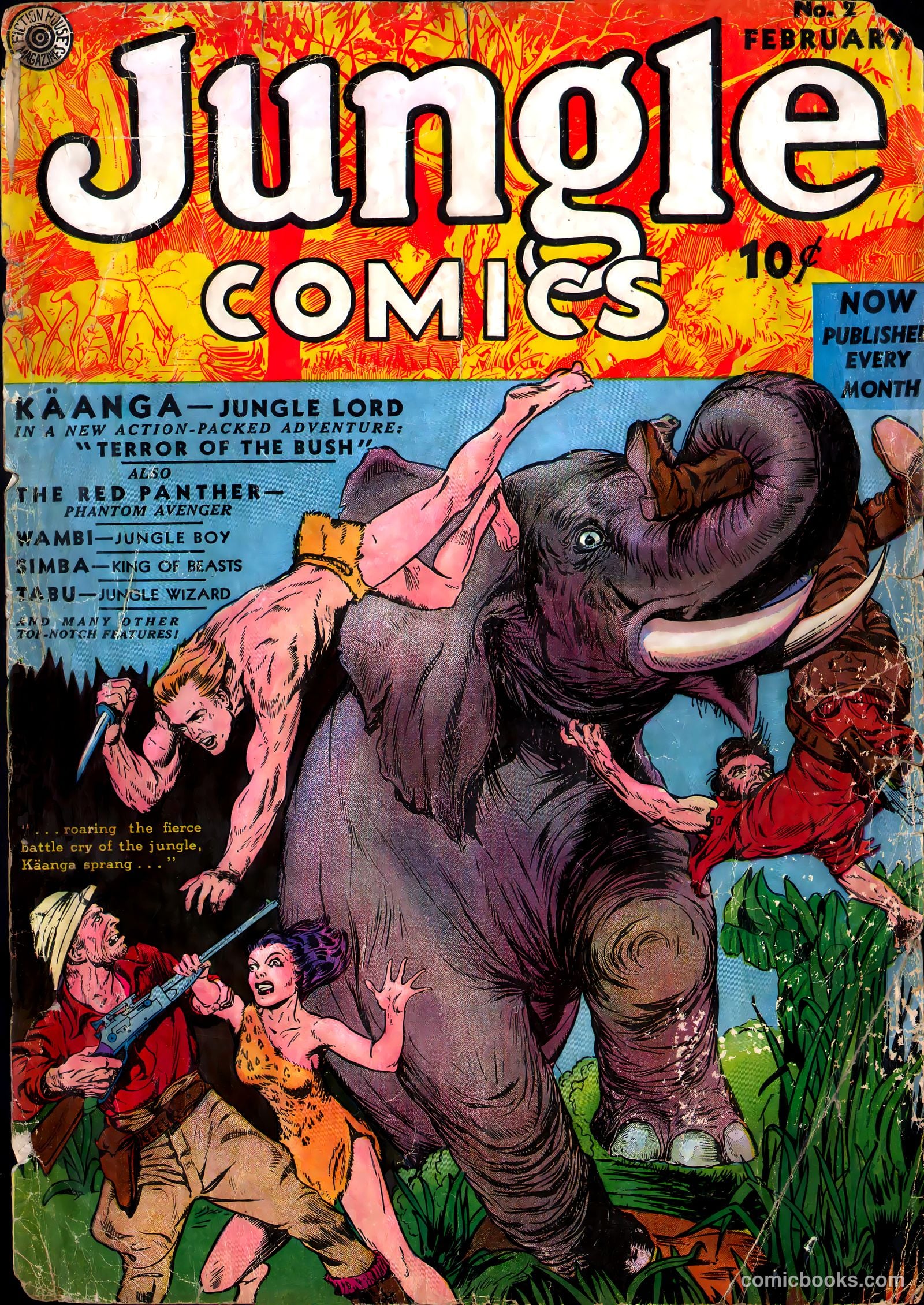
- Fantomah, one of the earliest supernatural female heroes in comic book history (debuting in Jungle Comics #2, February 1940), appears in a story scripted and drawn by Fletcher Hanks under his pseudonym 'Barclay Flagg'; the villain Arco, an ancient Egyptian mummy-scientist, uses a 'Scarlet Shadow' to blind jungle natives before Fantomah metes out punishment.
- The issue's Camilla story involves a kidnapping by the sorcerer Thoth and the introduction of the supporting character Champion, who is dispatched with a magic sword and shield to rescue her — an episode that blends jungle-adventure trappings with outright sword-and-sorcery fantasy.
- Wambi the Jungle Boy story by Henry Kiefer involves an anthropologist and his fiancée whose visit to the Monga village goes wrong — the Wambi feature ran with remarkable consistency through all 163 issues of the title.
- Jungle Comics ran from January 1940 through Summer 1954 for 163 issues total, beginning at 68 pages (as this issue is) and ending at a standard 36-page format; the character lineup remained almost entirely stable across that entire run.
Reprints
↩ Reprints Jungle Comics #134 (1951)
Key issues in Jungle Comics
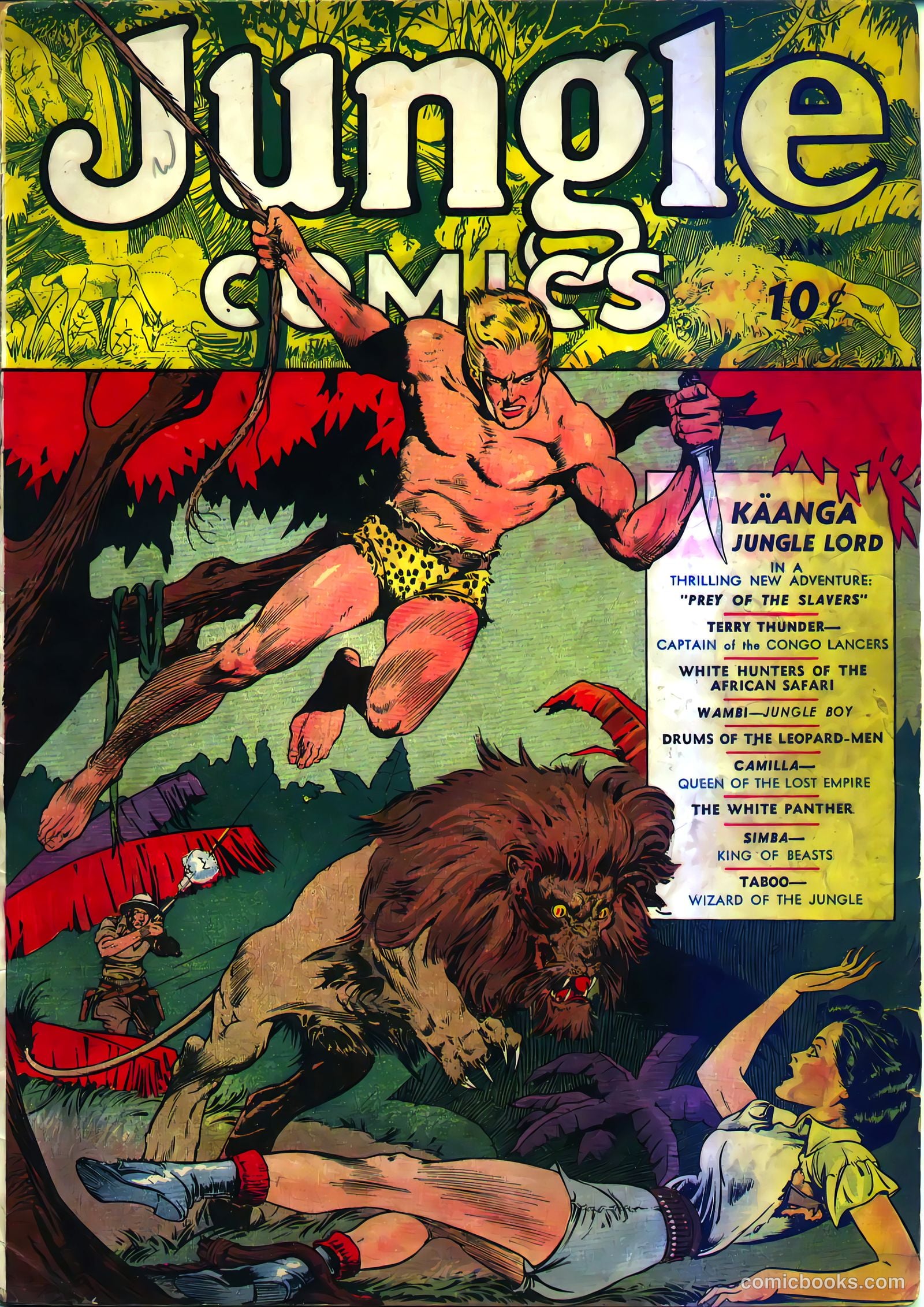
Reviews
Reader reviews
No reader reviews yet.