
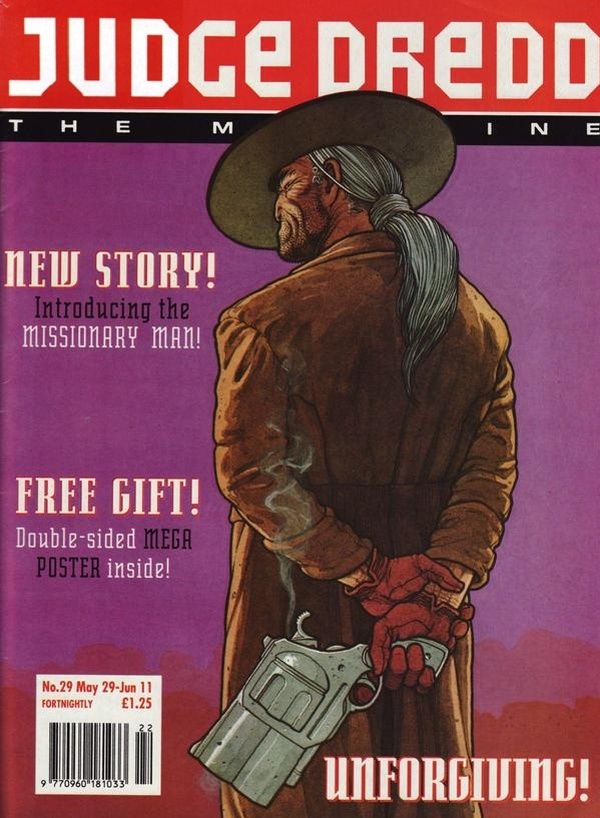
Judge Dredd the Megazine #29
☆ Be the first to review + Add to your collection — Join freeJudge Dredd The Megazine vol. 2 #29 (29 May 1993) is primarily significant as the debut of Preacher Saul Cain, the gun-toting, Bible-quoting vigilante of the Cursed Earth who headlines the 'Missionary Man' series — a character who would run across the Megazine for years before crossing over to the weekly 2000 AD. Equally notable, the issue also carries an episode of Alan Grant and Kev Walker's 'Anderson: Psi-Division — Childhood's End', a multi-part story that co-features Orlok the Assassin and pushes Psi-Judge Anderson toward her eventual resignation from the Justice Department. The combination of a major character debut and a pivotal chapter in one of the Megazine's most consequential Anderson arcs makes this issue a meaningful landmark in the 2000 AD extended universe during the publication's energetic early-fortnightly era.
ComicBooks.com Value
This exact issue on ebay
Read it digitally
Sell my copy
Have this issue — or a whole collection? Get a fair offer from us, skip the marketplace fees and the hassle.
We Buy Collections ▸History
The issue was published under Fleetway's fortnightly Volume 2 run of the Megazine, which had launched in May 1992 and dramatically expanded the output of Judge Dredd universe stories. Editor David Bishop commissioned Gordon Rennie — a Scottish writer who, by his own account, was at that time blacklisted from 2000 AD itself — to write the Missionary Man strip, and crucially assigned the debut chapter to Frank Quitely (pen name of Glasgow artist Vincent Deighan) as his first mainstream comics work, having spotted Deighan's underground Electric Soup anthology. The 'Childhood's End' serial running concurrently was written by Alan Grant and drawn by Kev Walker, both established 2000 AD figures who brought considerable craft to a story that would become one of the defining Anderson epics of the decade.
Trivia · 8 facts
- First appearance of Preacher Saul Cain (Missionary Man), an ex-Texas City Senior Judge turned fundamentalist Cursed Earth vigilante, in the debut story 'Salvation at the Last Chance Saloon' — written by Gordon Rennie.
- 'Salvation at the Last Chance Saloon' was drawn by Frank Quitely (Vincent Deighan), marking his first professional mainstream comics work outside the Glasgow underground anthology Electric Soup.
- The issue also carries an episode of 'Anderson: Psi-Division — Childhood's End' (Megazine vol. 2 #27–34), written by Alan Grant with art by Kev Walker, a multi-part story that features Orlok the Assassin alongside Psi-Judge Anderson on a mission to Mars.
- 'Childhood's End' is a significant Anderson arc: at its conclusion, Anderson lets Orlok go free and subsequently resigns from the Justice Department, with major consequences for both characters' ongoing storylines.
- The issue was published 29 May 1993 by Fleetway Publications as part of the fortnightly Volume 2 run of the Megazine, which ran to 83 issues (1992–1995).
- Megazine editor David Bishop oversaw the issue; Rennie has stated in interview that Bishop assigned Quitely to Missionary Man as the artist's first mainstream break.
- The Missionary Man stories from this era — including the debut in #29 — were later collected in a Titan Books trade paperback (2002) and a Rebellion paperback titled 'Bad Moon Rising' (2011), driven largely by collector interest in Quitely's early artwork.
- 'Anderson: Childhood's End' has been reprinted in the Judge Dredd Mega Collection and in a 2025 Rebellion volume titled 'Essential Judge Anderson: Childhood's End', edited by David Roach.
Cast · 5 characters
Full credits
Reprints
Reprinted in Missionary Man #[nn] (2011), Judge Anderson: The Psi Files #2 (2012), Judge Dredd: The Complete Case Files #19 (2012), Judge Dredd: The Mega Collection #11 (2016), Judge Dredd: The Mega Collection #64 (2017)
Reviews
Reader reviews
No reader reviews yet.