
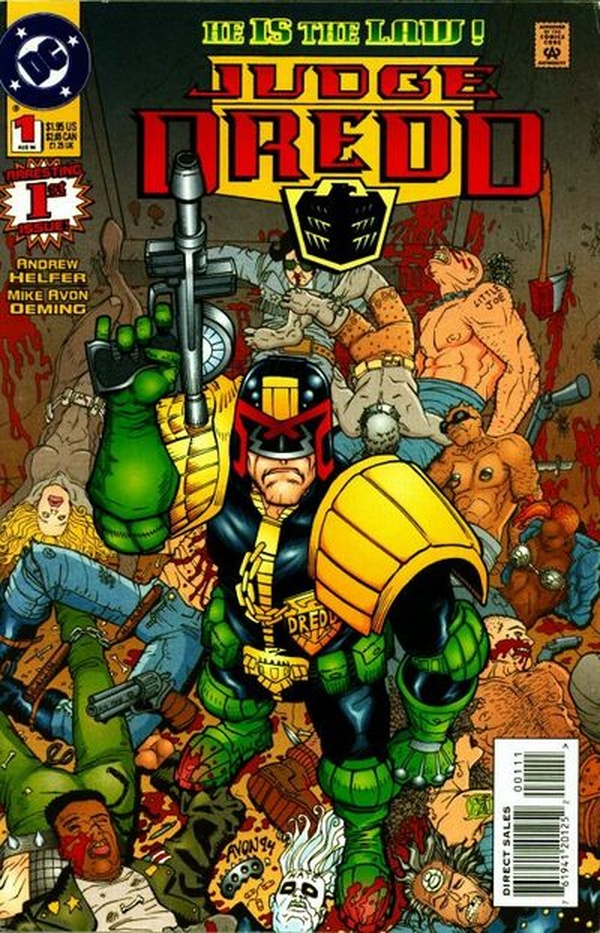
Judge Dredd #1
Judge Dredd #1 (August 1994) marks the debut of DC Comics' officially licensed, wholly original take on the 2000 AD lawman — the first time an American mainstream publisher produced brand-new Dredd stories rather than reprinting British material, a meaningful step in the character's transatlantic publishing history. Writer Andrew Helfer and artist Michael Avon Oeming constructed a deliberately remixed continuity that diverged from both the classic 2000 AD canon and the concurrent Sylvester Stallone film, most strikingly by recasting Chief Judge Fargo — an upright figure in the original — as a corrupt and villainous authority, inverting one of the strip's foundational moral pillars. The series launched alongside a companion title, Judge Dredd: Legends of the Law, creating DC's first coordinated Dredd publishing line and positioning the character for an American audience that was already primed by years of Batman/Judge Dredd crossovers. While British fans and scholars have noted that much of the satirical bite that defines the 2000 AD strip was softened in favor of a more conventional action-hero approach, the DC run remains a historically distinct artifact: an American publisher's attempt to reinterpret one of Britain's sharpest social satires on its own commercial and storytelling terms.
ComicBooks.com Value
Show all 11 grades ▾
This exact issue on ebay
Raw — VF/NM ▾ $4.92–$5.99 2 listings
Raw / ungraded ▾ $8.49–$44.65 4 listings
Read it digitally
Sell my copy
Have this issue — or a whole collection? Get a fair offer from us, skip the marketplace fees and the hassle.
We Buy Collections ▸History
DC acquired a license to publish original Judge Dredd stories during a period when the character's creator John Wagner had stepped back from the 2000 AD main strip, leaving it to younger writers whose work proved less popular with readers — Wagner himself returned to full-time Dredd duties for 2000 AD that same year, 1994. DC editor Paul Kupperberg oversaw the title, pairing veteran writer Andrew Helfer with the then-emerging artist Michael Avon Oeming, who handled both interior pencils and the cover for the debut issue, with Jimmy Palmiotti brought in as inker on subsequent early issues. The series was conceived as an entirely separate continuity from the British source material, giving Helfer latitude to build his own Mega-City One mythology; the companion Legends of the Law title, launched a few months later, actually recruited original Dredd creators John Wagner and Alan Grant for its opening issues, illustrating the uneven creative split across DC's two-pronged Dredd publishing experiment.
Trivia · 8 facts
- Cover-dated August 1994, published by DC Comics as the first issue of an 18-issue ongoing series running through January 1996.
- Written by Andrew Helfer; pencils and cover art by Michael Avon Oeming — their first collaboration on the character and the debut of the DC house style for Dredd.
- The story is titled 'He Is The Law!' and introduces several DC-continuity-exclusive characters including Mickey Mouse the Stump, Cadet Lewis, Cadet Maclean, Cadet Stevenson, Judge Burns, Judge Solomon, and Officer Becker — none of whom are part of the 2000 AD canon.
- Chief Judge Fargo appears in this continuity but is portrayed as a corrupt and sinister figure, a significant inversion of his characterization in the original British strip where he is depicted as incorruptible.
- The DC series operates in a continuity entirely separate from both the 2000 AD strips and the 1995 Sylvester Stallone film; the concurrent Batman/Judge Dredd crossovers featured the original 2000 AD version of Dredd, not the DC series version.
- Later issues of the DC run featured art by J.H. Williams III (issues #5–10 and #12), making this series an early professional credit for an artist who would go on to acclaim on Promethea and Batwoman.
- DC simultaneously published a companion title, Judge Dredd: Legends of the Law, beginning December 1994 — its first four issues were scripted by original creators John Wagner and Alan Grant, highlighting the creative contrast with Helfer's main series.
- The series was edited by Paul Kupperberg and Jason Hernandez-Rosenblatt, with coloring by Mike Danza and lettering by Bob Lappan — a full American production team with no direct 2000 AD involvement.
Full credits
Variants (1)
Reviews
Reader reviews
No reader reviews yet.