
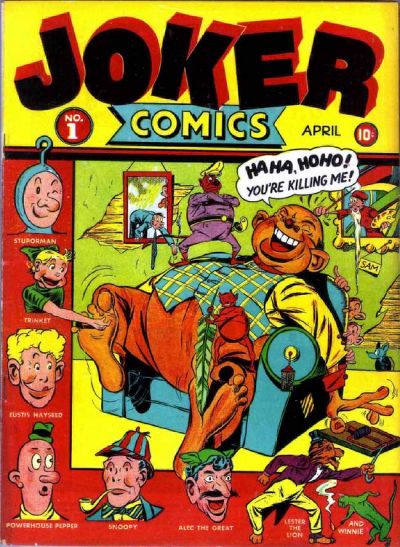
Joker Comics #1
☆ Be the first to review + Add to your collection — Join freeJoker Comics #1 (April 1942) marks the debut of Powerhouse Pepper, the character Basil Wolverton himself said he most wanted to be remembered for — a bald, superhumanly strong, good-natured boxer whose slapstick adventures were drenched in alliterative wordplay and visual gags stacked three layers deep. As one of Timely Comics' earliest dedicated humor anthologies, the issue signals a deliberate expansion of the publisher's output beyond superhero fare into screwball comedy at the height of wartime publishing. Wolverton's work here stands apart from the costumed-hero mainstream: Powerhouse Pepper wore a striped turtleneck rather than a cape, and his adventures substituted linguistic pyrotechnics and rubbery physical comedy for conventional action — a sensibility that would later influence underground cartoonists and, by Wolverton's own account, generate nearly 500 pages of stories across the following decade. The comic thus preserves the earliest expression of a Golden Age creative voice that critics, the Smithsonian Institution, and Fantagraphics have all since recognized as singular.
Dr Nutzy and Snoopy face eviction after falling behind on rent, so the eccentric inventor tries to sell his latest gadget—a device meant to detect bank robbers—to the local bank. With a mix of mad science and desperation, this 1942 comic by Art Gates (art and inks) delivers a quirky, early adventure from a forgotten corner of the Golden Age.
In this 1942 humor tale from Joker Comics #1, Dr Nutzy and his perpetually anxious sidekick Snoopy face eviction after falling behind on rent. Desperate to scrape together cash, Dr Nutzy hatches a wild plan: he tries to sell his latest invention—a device meant to detect bank robbers—to the local bank.
In this 1942 tale from Joker Comics #1, Lester the Lion—once silent behind zoo bars—finds a book on reading and writing, sparking an unexpected transformation. Now fluent, he sets his sights on a new life, boldly deciding to trade his cage for a room at the Waldorf Hotel.
ComicBooks.com Value
Show all 21 grades ▾
More listings for this title
- Samurai Comics · 4 locations4 on eBay ↗
- Arcane Comics · Shoreline, WA1 on eBay ↗
- Diverted Comics · Bakersfield, CA1 on eBay ↗
- JAF Comics · Bethlehem, PA1 on eBay ↗
Read it digitally
Sell my copy
Have this issue — or a whole collection? Get a fair offer from us, skip the marketplace fees and the hassle.
We Buy Collections ▸History
Joker Comics was launched by Timely Comics (the company that would become Marvel) in April 1942, with a cover date matching that month and an on-sale date of January 22, 1942, as recorded in the U.S. Catalog of Copyright Entries. Basil Wolverton, already a seasoned cartoonist who had been working in comics since 1938 for publishers including Centaur and Lev Gleason, handled both writing and art for the Powerhouse Pepper feature entirely on his own — the editor and colorist for the issue went uncredited. The anthology format gave Timely room to test multiple humor strips simultaneously, and the issue's roster included contributions from several other hands alongside Wolverton, reflecting the experimental, variety-show character of early Golden Age humor comics.
Trivia · 10 facts
- First appearance of Powerhouse Pepper, created entirely by writer-artist Basil Wolverton — a dim-witted but big-hearted, superhumanly strong bald boxer who debuted wearing a striped turtleneck rather than a superhero costume.
- Published by Timely Comics (predecessor to Marvel) with a cover date of April 1942 and an on-sale date of January 22, 1942.
- The issue is a humor anthology containing multiple features; confirmed strips include Stuporman (a Superman parody, here in his second appearance after Daring Mystery Comics #6), Lester the Lion & Winnie the Weasel, Eustace Hayseed, Alec the Great, Tommy Gunz, and Dr. Nutzy & Snoopy — among others.
- Stuporman's story in this issue, written and drawn by Harry Douglas, was edited by an uncredited hand; the character's costume was recolored red beginning with this appearance.
- The issue includes a text story credited to Mickey Spillane — years before Spillane became famous for his Mike Hammer crime novels.
- Cover art for the issue is credited to Mike Sekowsky and George Klein, per the Atlas Tales database.
- Powerhouse Pepper's debut story introduces the character crossing a street, nearly being struck down by a professional heavyweight, and winning a boxing championship through his inexplicable natural power — establishing the character's core comic premise of blundering, wholesome invincibility.
- The character went on to appear across multiple Timely anthology titles (Joker Comics, Gay Comics, Tessie the Typist, Millie the Model) and earned a solo title with five issues (one in 1943, four in 1948); Wolverton produced nearly 500 pages of Powerhouse Pepper stories in total.
- A Powerhouse Pepper story ('McClaw the Outlaw') was later selected for inclusion in the Smithsonian Institution Press/Harry N. Abrams hardcover 'A Smithsonian Book of Comic-Book Comics' (1981), a mark of mainstream critical recognition for the character.
- Fantagraphics published a dedicated 'Basil Wolverton's Powerhouse Pepper' collection in 1994, and additional reprints appeared via Kitchen Sink Press's Snarf #13 (1989) and Pure Imagination's Intense! (1993).
Cast · 1 character
Full credits
Reprints
Reprinted in Intense! #2 (1993), The Basil Wolverton Reader #[1] (2003)
Key issues in Joker Comics
Reviews
Reader reviews
No reader reviews yet.