
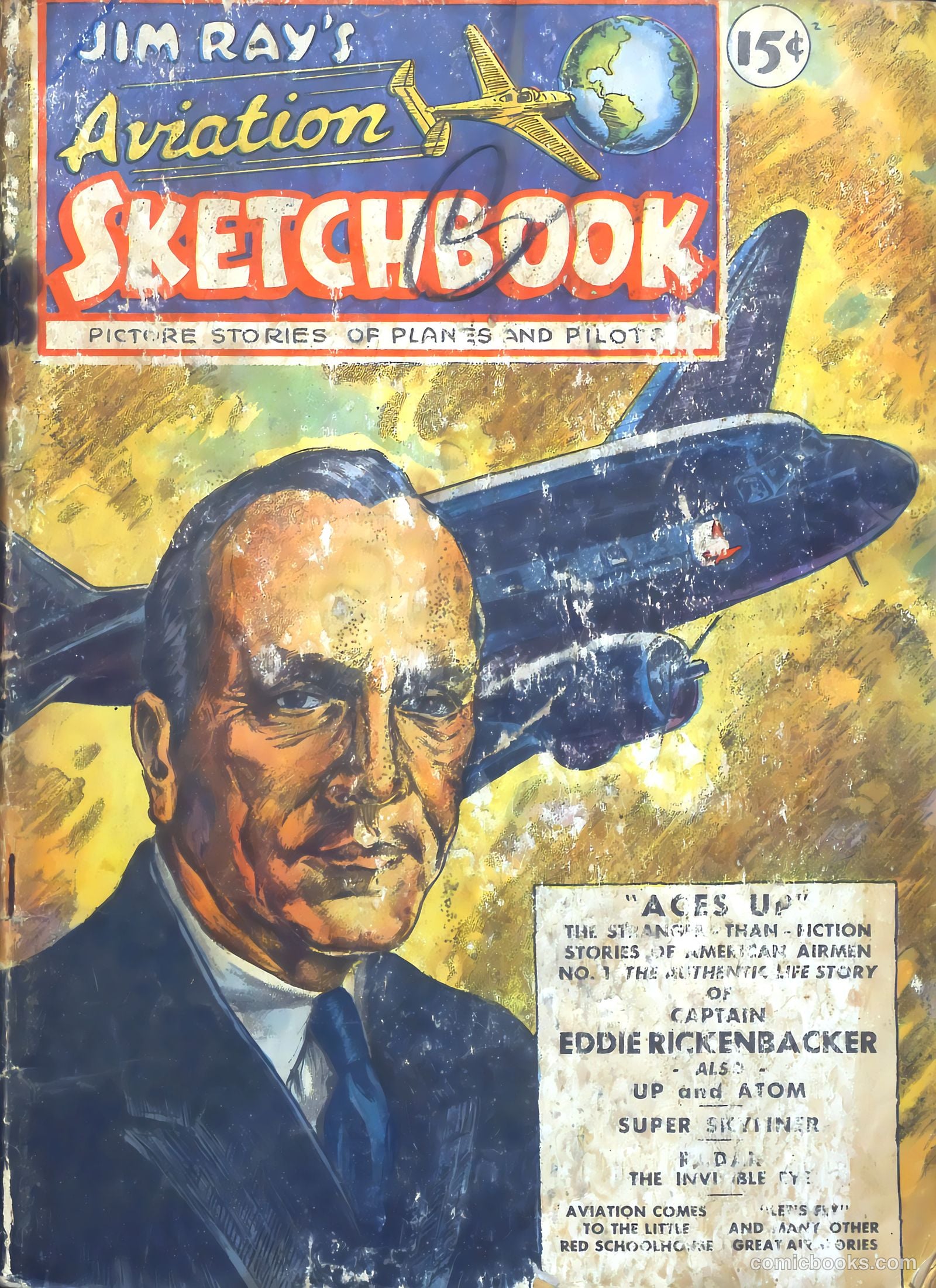
Jim Ray's Aviation Sketchbook #1
☆ Be the first to review + Add to your collection — Join freeThis anthology publication collects picture stories of planes and pilots, including the authentic life story of Captain Eddie Rickenbacker and features such as "Up and Atom," "Super Skinner," and "The Invisible Eye." The content covers aviation history and notable aircraft like the Piper Cub, along with educational material on the origins of jet propulsion from ancient Greece and early Chinese rocketry, and a story involving a prospector and bush pilot Jim Dodson attempting to locate a lost Alaskan claim.
Jim Ray chronicles the extraordinary rise of Captain Eddie Rickenbacker, from a determined twelve-year-old who takes factory work to support his family after his father's death, through his meteoric success as America's auto racing champion, and finally into his pursuit of military aviation during World War I. Through hard work and mechanical aptitude, Rickenbacker transforms himself from a poor boy in Columbus, Ohio into an idol of the American racing circuit—and then sets his sights on the skies. This is the true story of one of America's most durable heroes, told with the same grit and determination that defined his own climb to the top.
Jim Ray's 1946 sketchbook shows how American schools are introducing a whole new subject alongside the traditional three R's: aviation education. From first-graders learning cockpit basics to high schoolers disassembling real engines and testing wing designs in homemade wind tunnels, students across the nation are getting hands-on experience with flight—visiting local airports, building model planes, and understanding the forces that keep aircraft in the sky. It's a fascinating snapshot of how the post-war generation is being prepared to become the designers, builders, and pilots who'll keep America leading in aviation.
Jim Ray's "Let's Fly" is a guided tour of America's post-war personal aircraft, showcasing the light planes that designers and manufacturers built for business and pleasure flying once wartime production ended. From the durable Aeronca Chief and the hugely popular Piper Cub to innovations like the spin-proof Ercoupe and the amphibious Republic Seabee, Ray explores how these aircraft were engineered for safety, comfort, and practical use—whether for farmers inspecting their land, country doctors making house calls, or families planning vacations. Each plane represents a different vision of civilian flying in 1946, revealing an industry eager to bring aviation into everyday American life.
Jim Ray traces the development of radar from its scientific foundations through its decisive role in World War II, showing how Heinrich Hertz's experiments with radio waves and early detection work by researchers like Doctor Alfred Taylor paved the way for Robert Alexander Watson-Watt's breakthrough radar system in 1935. As Britain and America raced to perfect the technology—culminating in innovations like the cavity magnetron and work at MIT's Radiation Laboratory—radar became the unseen ally that transformed aerial warfare, guiding fighter planes to enemy bombers and protecting coastlines through conditions no human eye could penetrate. This illustrated history celebrates how peacetime science became the "all-seeing eye" that hastened victory in the war.
Jim Ray presents a clear-eyed look at how radar technology works in modern aviation, breaking down everything from navigation systems like LORAN and Rebecca beacons to safety devices that help pilots avoid obstacles and land safely in poor weather. With detailed illustrations and straightforward explanations, "Radar at Work" shows readers the many practical applications that made this wartime innovation essential to both military and civilian flight.
Jim Ray presents a comprehensive technical sketch of the Lockheed Constellation, the sleek new transatlantic airliner born from the vision of Howard Hughes and Jack Frye of TWA, powered by four mighty Wright Cyclone engines capable of crossing the Atlantic in as little as twelve to fourteen hours. The story also follows the hardy brush pilots of Alaska and Northern Canada, who use their aircraft to deliver everything from mining equipment to medicine and mail across the snow-swept wilderness, transforming what once took days by dogteam into journeys of mere minutes.
Jim Ray traces the atomic bomb's genesis from ancient philosophy to its devastating deployment, charting how Democritus's speculation about indivisible particles evolved through centuries of scientific discovery—from radium's mysteries to the splitting of the uranium nucleus—before culminating in the secret Manhattan Project and the bomb's use over Hiroshima in August 1945. This illustrated account reveals the brilliant minds and massive industrial effort behind humanity's entry into the atomic age, a transformation born from theoretical physics and forged in the crucible of total war.
Jim Ray's instructional guide breaks down the cloud formations every pilot needs to recognize to make smart decisions in the cockpit. By learning to read cumulus, cirrus, nimbostratus, and other cloud types—and what each one signals about the air around it—a flyer can tell at a glance whether conditions favor safe flight or demand staying grounded. This practical 1946 aviation reference arms pilots with the weather knowledge that could mean the difference between a smooth flight and a dangerous encounter.
Jim Ray's "Rockets and Jets" traces the fascinating history and mechanics of two revolutionary propulsion systems that often get confused for one another. From ancient Greek steam-powered devices through Nazi "buzz bombs" and modern fighter planes, this illustrated guide breaks down how rockets and jets actually work—and why rockets might one day reach the Moon while jets are forever bound to Earth's atmosphere. Whether you're interested in wartime weaponry like the bazooka and P-80 "Shooting Star," or the science behind jet engines and jet-assisted takeoffs, Ray delivers a clear, engaging tour of aviation's cutting edge.
Jim Ray presents a fascinating look at how simplified aircraft controls revolutionized light plane design, tracing the development from Fred Weick's experimental W-1 through the groundbreaking Ercoupe—a two-control system that eliminates the need for foot pedals and makes flying accessible to pilots who once struggled with coordinating complex movements. Through technical diagrams and a remarkable true account of an untrained pilot who unexpectedly found herself airborne, Ray demonstrates how the Ercoupe's linked rudders, ailerons, and elevator stops create a genuinely foolproof flying experience, even for complete beginners.
ComicBooks.com Value
Show all 14 grades ▾
Find on ebay
Read it digitally
Sell my copy
Have this issue — or a whole collection? Get a fair offer from us, skip the marketplace fees and the hassle.
We Buy Collections ▸