
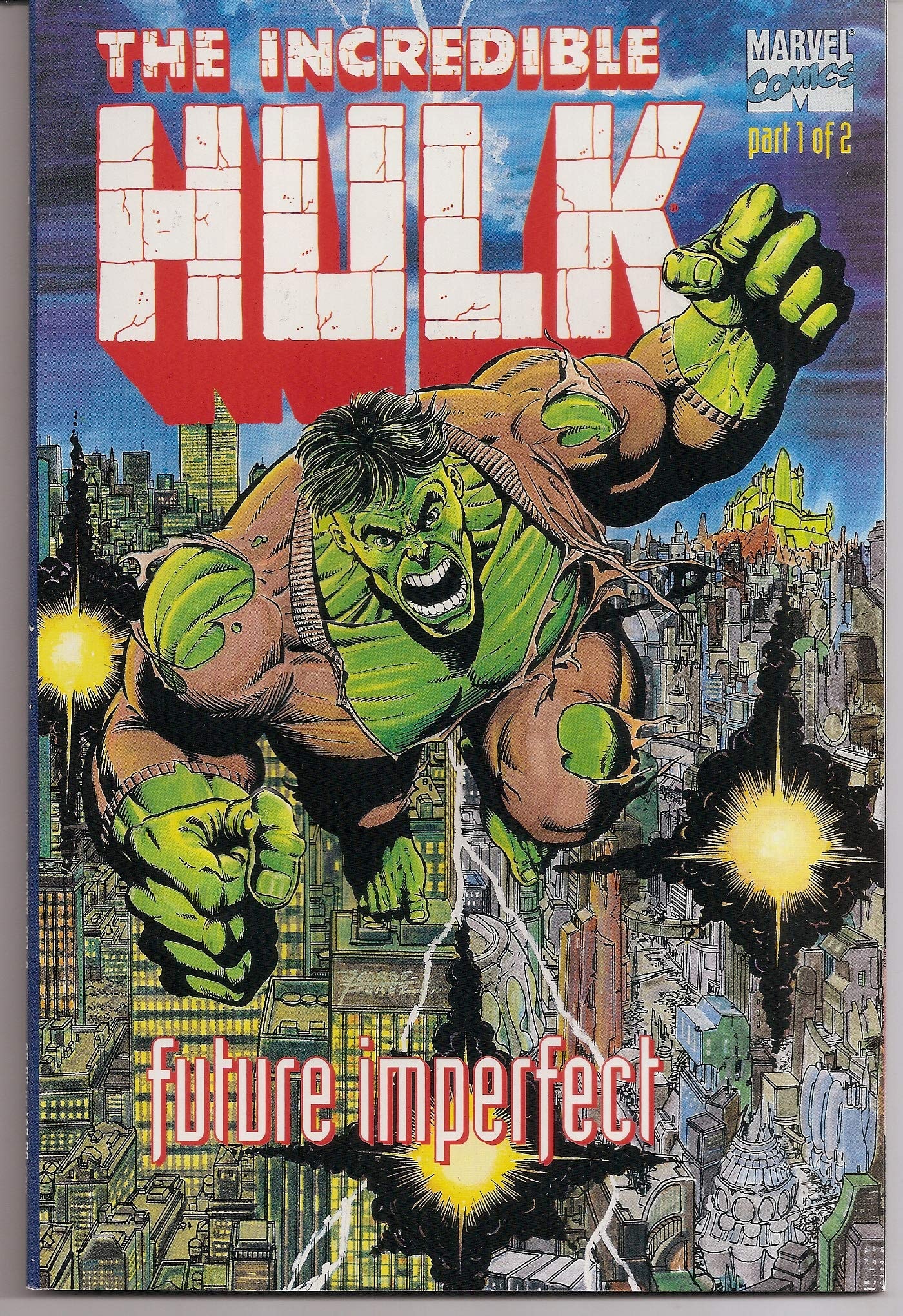
Hulk: Future Imperfect #1
☆ Be the first to review + Add to your collection — Join freeHulk: Future Imperfect #1 marks the debut of the Maestro — the most enduring villain to emerge from Peter David's decade-long Incredible Hulk run — and stands as one of the medium's most psychologically ambitious superhero stories: a hero forced to confront the tyrant his own worst impulses could produce. By setting the action roughly a century ahead on the radiation-scarred alternate Earth designated Earth-9200, David and Pérez asked a question that few superhero narratives had posed so directly: what does a being of limitless power become when civilization and moral constraint have been stripped away? The issue also introduced the unforgettable 'trophy room' device — a chamber filled with the shattered relics, ashes, and skeletons of nearly every major Marvel hero — which served as a devastating visual shorthand for the totality of the catastrophe, and became one of the most discussed single set-pieces of the early modern era. The Maestro has since anchored a prequel trilogy, multiple limited-series appearances, video games, and an animated adaptation, a legacy that traces directly back to this first issue.
In Hulk: Future Imperfect #1 (1992), Peter David and George Pérez launch a bold new chapter as the Hulk journeys into a bleak, radioactive future alongside Rick Jones and his great-granddaughter, Janis. Set in a world dominated by the tyrannical Maestro, the story finds Janis leading a resistance desperate for the Hulk’s strength to strike back. With George Pérez’s dynamic art and a haunting cover by Pérez himself, this issue sets up a high-stakes clash between past and future, power and desperation.
ComicBooks.com Value
Show all 10 grades ▾
This exact issue on ebay
CGC 9.8 ▾ $95–$238 7 listings
CGC 9.6 ▾ $85–$200 3 listings
CGC 9.4 ▾ $60–$70 2 listings
Raw — NM+ ▾ $14.42–$49.97 3 listings
Raw — NM- ▾ $9.95–$24.99 2 listings
Raw — VF/NM ▾ $9.99–$12.99 3 listings
Raw — FN/VF ▾ $9.4–$9.6 2 listings
Raw / ungraded ▾ $8–$120 22 listings
More listings for this title
Where to buy
Read it digitally
Sell my copy
Have this issue — or a whole collection? Get a fair offer from us, skip the marketplace fees and the hassle.
We Buy Collections ▸History
The series grew out of Peter David's celebrated ongoing run on The Incredible Hulk, which editor Bobbie Chase shepherded under editor-in-chief Tom DeFalco; the story slots in continuity between Incredible Hulk #416 and #417 of the main title. Marvel published the two-part story in the prestige 'bookshelf' squarebound format — each issue running 48 pages with an embossed cardstock cover — a production choice that signaled the story's intended status as a self-contained event rather than a standard monthly chapter. George Pérez, who both penciled and inked his own work throughout, brought the same densely populated page architecture he had used on Crisis on Infinite Earths and New Teen Titans to the dystopian crowd scenes and the visually catalogued trophy room; colorist Tom Smith and letterer Joe Rosen completed the creative team. A signed limited set of both issues — restricted to 1,200 copies, each bearing the signatures of David, Pérez, and Smith — was also produced at the time of publication.
Trivia · 8 facts
- First appearance of the Maestro (Bruce Banner of Earth-9200), created by writer Peter David and artist George Pérez; the character debuted as the primary antagonist of this issue.
- First appearance of Janis Jones (Earth-9200), resistance fighter and descendant of Rick Jones, who uses Doctor Doom's Time Platform to recruit the present-day Hulk against the Maestro.
- First appearance of the future Earth-9200 version of Rick Jones — elderly, wheelchair-bound, and crippled, yet still leading the underground resistance against the Maestro.
- The issue also introduces several new Earth-9200 factions and characters in their first appearances: the Gravity Police, the Dogs of War, the Minister of Dystopia, and rebels Pizfiz, Skooter, and Dakord.
- Most catalog characters — including Beast, Black Bolt, Captain America, Daredevil, Doctor Strange, Hawkeye, Jean Grey, Mar-Vell, Professor X, Shang-Chi, Shatterstar, the Thing, the Vision, Warlock, and Wolverine — appear in this issue only as relics, ashes, skeletons, or destroyed costumes displayed in Rick Jones's trophy room; they are not depicted as living characters.
- Published in the prestige squarebound 'bookshelf' format with an embossed cardstock cover; each issue ran 48 pages, and a signed limited variant set of both issues was restricted to 1,200 copies.
- The story is canonically placed between Incredible Hulk #416 and #417 in the main continuity of Peter David's Hulk run, tying the miniseries directly into the ongoing narrative rather than treating it as a standalone elseworlds tale.
- The Maestro concept later generated a prequel trilogy — Maestro (2020), Maestro: War and Pax (2021), and Maestro: World War M (2022) — all written by Peter David, as well as appearances in the 2015 Secret Wars tie-in Future Imperfect and multiple video game adaptations.
Cast · 26 characters
Full credits
Reprints
Reprinted in Top BD #31 (1993), Hulk: Future Imperfect #[nn] (1994), Marvel Limited: Future Imperfect #[nn] (1994), Hulk: The End #[nn] (2008), Hulk: The End #[nn] (2011), Hulk: Future Imperfect [Second Edition] #[nn] (2015), Incredible Hulk Epic Collection #20 (2017), Hulk: The End #[nn] (2019), Maestro: Future Imperfect - Marvel Tales #1 (2020), Hulk: Futuro Imperfeito #[nn] (2020), Incredible Hulk by Peter David Omnibus #3 (2021), Hulk: Maestro by Peter David Omnibus #[nn] (2023), Der unglaubliche Hulk #42, Star Magazine #35
Reviews
Reader reviews
No reader reviews yet.